
An Ultra-Low Dose of ∆9-Tetrahydrocannabinol Alleviates Alzheimer’s Disease-Related Cognitive Impairments and Modulates TrkB Receptor Expression in a 5XFAD Mouse Model

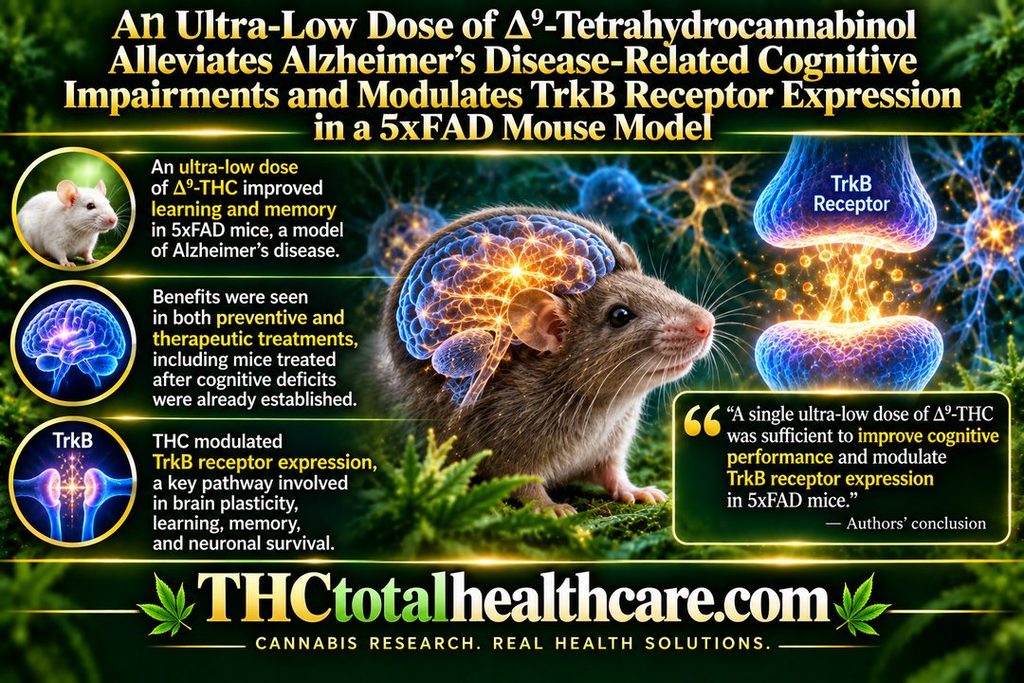
An ultra-low dose of Δ9-THC improved Alzheimer’s disease-related cognitive impairment in 5xFAD mice, including animals treated after memory problems were already established. The study found improvements in learning and memory without relying on repeated high-dose THC exposure.

The researchers also found changes in TrkB receptor expression, a signaling pathway closely tied to brain plasticity, learning, memory, and neuronal survival. These changes suggest that THC’s effects may involve more than temporary symptom relief and may influence mechanisms connected to cognitive function.

The findings add to a growing body of preclinical research showing that very low doses of THC can produce different biological effects than higher doses, particularly in the aging and Alzheimer’s-disease brain. In this model, a single ultra-low dose was enough to improve cognitive performance and alter a key neurotrophic signaling pathway.

“Alzheimer’s disease (AD) is the most common form of dementia, but there is still no available treatment.

Δ9-tetrahydrocannabinol (THC) is emerging as a promising therapeutic agent.

Using THC in conventional high doses may have deleterious effects. Therefore, we propose to use an ultra-low dose of THC (ULD-THC). We previously published that a single injection of ULD-THC ameliorated cognitive functioning in several models of brain injuries as well as in naturally aging mice.

Here, 5xFAD AD model mice received a single treatment of ULD-THC (0.002 mg/kg) after disease onset and were examined in two separate experiments for cognitive functions, neurotropic, and inflammatory factors in the hippocampus.

We show that a single injection of ULD-THC alleviated cognitive impairments in 6- and 12-month-old 5xFAD mice. On the biochemical level, our results indicate an imbalance between the truncated TrkB receptor isoform and the full receptor, with AD mice showing a greater tendency to express the truncated receptor, and ULD-THC improved this imbalance. We also investigated the expression of three AD-related inflammatory markers and found an ameliorating effect of ULD-THC.

The current research demonstrates for the first time the beneficial effects of a single ultra-low dose of THC in a mouse model of AD after disease onset.”

https://pubmed.ncbi.nlm.nih.gov/36012711

“The current research demonstrates for the first time the beneficial effects of a single ultra-low dose of THC in a mouse model of AD after disease onset. As THC is a cheap, widely available substance already approved for use in other conditions, this research brings us closer to understanding its mechanisms and will possibly lead to new treatments.”

https://www.mdpi.com/1422-0067/23/16/9449/htm

Need this THC study explained? thcXplained.com
A chronic low dose of Δ9-tetrahydrocannabinol (3 mg / kg / 21 d) reorganizes the disturbed wound healing process and accelerates wound closure in old female mice

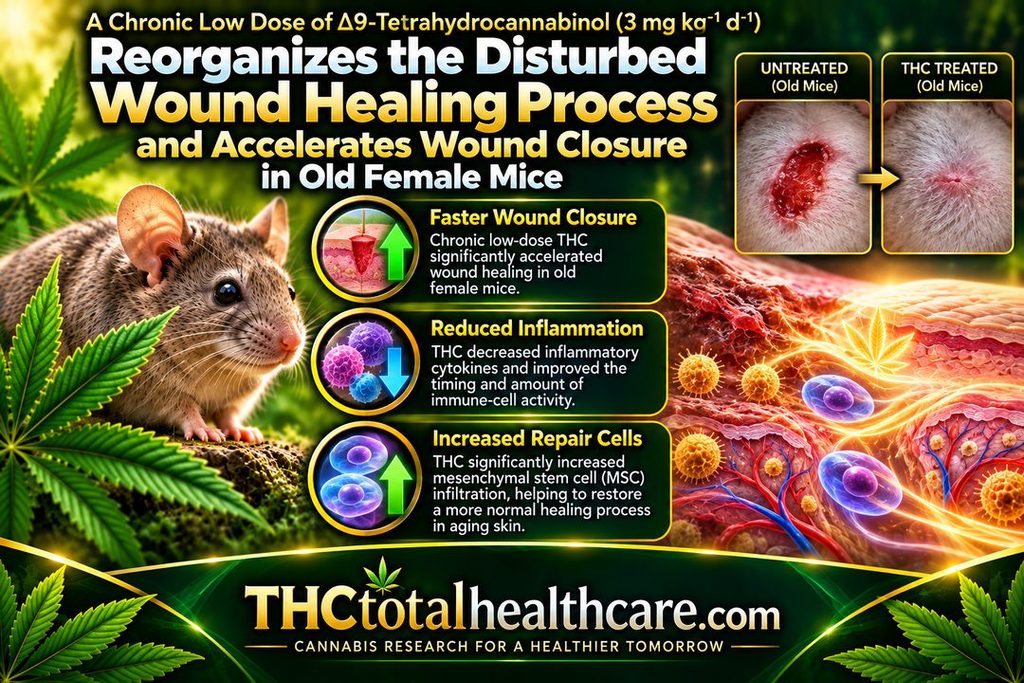
A chronic low dose of Δ9-THC accelerated wound closure in old female mice and helped reorganize an age-disrupted healing process. The biggest improvement occurred during the inflammatory phase, when aged wounds normally heal more slowly and remain inflamed longer.

THC changed the timing and amount of immune-cell activity in the wound, reduced inflammatory cytokines, and significantly increased infiltration of mesenchymal stem cells (MSCs) involved in tissue repair. The treatment did not increase growth-factor release, suggesting the benefit came mainly from better coordination of inflammation and cell migration.

The researchers concluded that THC improved wound healing by restoring a more normal sequence of immune-cell infiltration and cytokine release. The findings suggest that stimulating the aging endocannabinoid system may help support skin regeneration and tissue repair in older organisms.

“Wound healing in old mice is characterized by disturbed tissue homeostasis, manifested by delayed immune cell infiltration and reduced growth factor secretion, leading to a delayed onset and prolonged duration of the inflammatory phase.

The endocannabinoid system (ECS) is an important regulator of tissue homeostasis and cell migration and is also considered to be subject to aging processes, which may contribute to observable aging phenomena. Therefore, stimulating the aged ECS could represent a therapeutic option to support tissue regeneration in aging.

Female old mice received a low-dose of medical THC daily for 3 weeks, before four excisional full skin wounds were created. At day 1, 3 and 7 post-surgery, the wound closure rate was analyzed and wound samples were examined immunohistochemically for the numbers of granulocytes, M1-macrophages and mesenchymal stem cells (MSCs). The concentrations of inflammatory cytokines and regenerative growth factors were determined by ELISA.

Administration of THC improved the wound healing rate of old mice between day 1 and 7, which was associated with an altered timing and quantity of infiltrating immune cells and decreased levels of inflammatory cytokines in wound tissue on days 1 and 3 post-injury.

THC treatment significantly increased MSC infiltration but had no effect on the growth factor release.

The present study confirmed the anti-inflammatory activity of THC in vivo.

The THC-treatment improved wound healing in old mice by coordinating the temporal sequence of immune cell infiltration and cytokine release. Thus, restoration of ECS signaling could be an effective strategy to support age-related skin regeneration.”

https://pubmed.ncbi.nlm.nih.gov/40653209/

“A chronic low dose of THC accelerates the wound closure rate during the inflammatory phase in old mice.”

https://www.sciencedirect.com/science/article/pii/S0531556525001615?via%3Dihub

Meed this THC study explained? thcXplained.com

An Ultra-Low Dose of ∆9-Tetrahydrocannabinol Alleviates Alzheimer’s Disease-Related Cognitive Impairments and Modulates TrkB Receptor Expression in a 5XFAD Mouse Model

An ultra-low dose of Δ9-THC improved Alzheimer’s disease-related cognitive impairment in 5xFAD mice, including animals treated after memory problems were already established. The study found improvements in learning and memory without relying on repeated high-dose THC exposure.

The researchers also found changes in TrkB receptor expression, a signaling pathway closely tied to brain plasticity, learning, memory, and neuronal survival. These changes suggest that THC’s effects may involve more than temporary symptom relief and may influence mechanisms connected to cognitive function.

The findings add to a growing body of preclinical research showing that very low doses of THC can produce different biological effects than higher doses, particularly in the aging and Alzheimer’s-disease brain. In this model, a single ultra-low dose was enough to improve cognitive performance and alter a key neurotrophic signaling pathway.

“Alzheimer’s disease (AD) is the most common form of dementia, but there is still no available treatment.

Δ9-tetrahydrocannabinol (THC) is emerging as a promising therapeutic agent.

Using THC in conventional high doses may have deleterious effects. Therefore, we propose to use an ultra-low dose of THC (ULD-THC). We previously published that a single injection of ULD-THC ameliorated cognitive functioning in several models of brain injuries as well as in naturally aging mice.

Here, 5xFAD AD model mice received a single treatment of ULD-THC (0.002 mg/kg) after disease onset and were examined in two separate experiments for cognitive functions, neurotropic, and inflammatory factors in the hippocampus.

We show that a single injection of ULD-THC alleviated cognitive impairments in 6- and 12-month-old 5xFAD mice. On the biochemical level, our results indicate an imbalance between the truncated TrkB receptor isoform and the full receptor, with AD mice showing a greater tendency to express the truncated receptor, and ULD-THC improved this imbalance. We also investigated the expression of three AD-related inflammatory markers and found an ameliorating effect of ULD-THC.

The current research demonstrates for the first time the beneficial effects of a single ultra-low dose of THC in a mouse model of AD after disease onset.”

https://pubmed.ncbi.nlm.nih.gov/36012711/

“The current research demonstrates for the first time the beneficial effects of a single ultra-low dose of THC in a mouse model of AD after disease onset. As THC is a cheap, widely available substance already approved for use in other conditions, this research brings us closer to understanding its mechanisms and will possibly lead to new treatments.”

https://www.mdpi.com/1422-0067/23/16/9449/htm

Need this THC study explained? thcXplained.com