
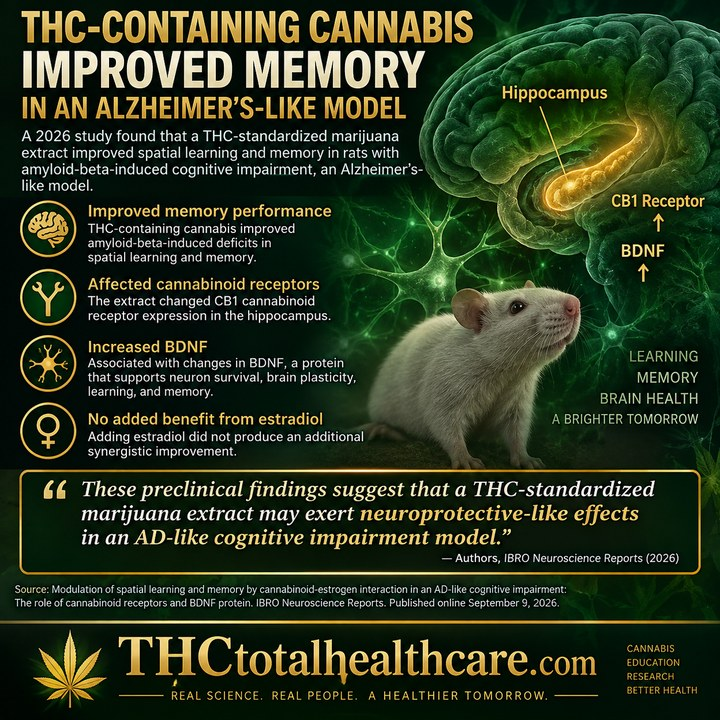
Modulation of spatial learning and memory by cannabinoid-estrogen interaction in an AD-like cognitive impairment: The role of cannabinoid receptors and BDNF protein

A 2026 study found that a THC-standardized marijuana extract improved spatial learning and memory in an Alzheimer’s-like model of cognitive impairment. Researchers tested the extract in rats exposed to amyloid-beta, a protein closely associated with Alzheimer’s disease, and observed improvements in memory performance.

The cognitive improvements were accompanied by changes in cannabinoid receptor signaling and in BDNF, or brain-derived neurotrophic factor, a protein that supports neuron survival, brain plasticity, learning, and memory. The findings suggest that the brain’s cannabinoid system and BDNF may be involved in the neuroprotective-like effects observed with the THC-standardized extract.

The researchers also examined the interaction with estrogen and found that adding estradiol did not produce an additional synergistic improvement. As the authors concluded, “These preclinical findings suggest that a THC-standardized marijuana extract may exert neuroprotective-like effects in an AD-like cognitive impairment model.”

“Alzheimer’s disease (AD) is an increasingly prevalent neurodegenerative disorder worldwide, with women showing a higher risk of developing the disease. The decline in steroid hormones after menopause may contribute to the increased susceptibility of women to neurodegenerative conditions.

In parallel, cannabis-derived compounds have been reported to alleviate certain symptoms associated with neurological disorders. The present study was designed to investigate the effects of marijuana extract on cognitive impairment and hippocampal molecular markers in an ovariectomized AD-like rat model, and to evaluate whether co-administration with estradiol modifies these effects.

The marijuana extract used in this study was characterized by HPLC and was found to contain 8.5% Δ9-THC. AD-like cognitive impairment pathology was induced by intra-hippocampal administration of Aβ25-35 in OVX rats. Animals were treated with marijuana extract (60 mg/kg/day, corresponding to approximately 5.1 mg/kg/day Δ9-THC) either alone or in combination with 17β-estradiol (1 mg/kg every 4 days) for 28 days. Cognitive performance was evaluated using the Morris water maze (MWM). In addition, hippocampal CB1/CB2 receptor expression and BDNF protein levels were measured to examine potential molecular associations.

Our findings showed that chronic administration of the marijuana extract improved Aβ25-35-induced deficits in spatial learning and memory.

Alterations in CB1 receptor expression and BDNF levels accompanied these behavioral effects. Notably, co-treatment with estradiol did not produce a synergistic effect, suggesting a complex interaction between cannabinoid-related and estrogen-related signaling pathways.

These preclinical findings suggest that a THC-standardized marijuana extract may exert neuroprotective-like effects in an AD-like cognitive impairment model. However, because the extract was not fully phytochemically characterized and the mechanistic analyses were correlational, the results should be interpreted cautiously. Further studies are needed to clarify the underlying mechanisms and translational relevance of these findings.”

https://pubmed.ncbi.nlm.nih.gov/42756662

“In conclusion, chronic administration of THC-standardized marijuana extract improved spatial learning and memory performance in the AD-like cognitive impairment model, and these behavioral changes were accompanied by alterations in hippocampal CB1/CB2 gene expression and BDNF protein levels.”

https://www.ibroneuroreports.org/article/S2667-2421(26)00149-1/fulltext
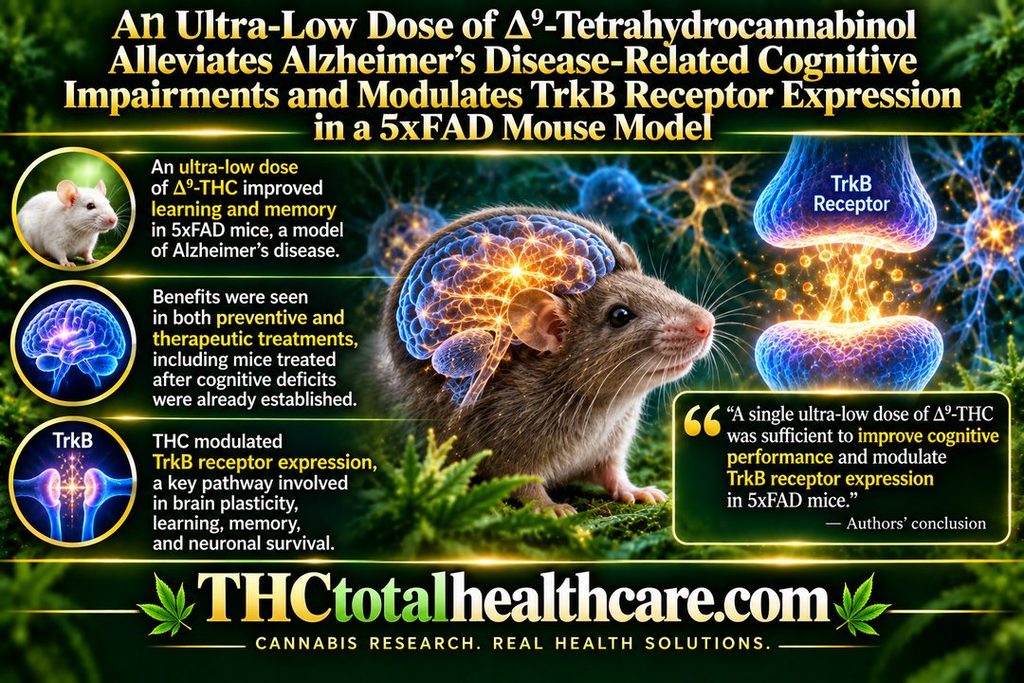
An Ultra-Low Dose of ∆9-Tetrahydrocannabinol Alleviates Alzheimer’s Disease-Related Cognitive Impairments and Modulates TrkB Receptor Expression in a 5XFAD Mouse Model

An ultra-low dose of Δ9-THC improved Alzheimer’s disease-related cognitive impairment in 5xFAD mice, including animals treated after memory problems were already established. The study found improvements in learning and memory without relying on repeated high-dose THC exposure.

The researchers also found changes in TrkB receptor expression, a signaling pathway closely tied to brain plasticity, learning, memory, and neuronal survival. These changes suggest that THC’s effects may involve more than temporary symptom relief and may influence mechanisms connected to cognitive function.

The findings add to a growing body of preclinical research showing that very low doses of THC can produce different biological effects than higher doses, particularly in the aging and Alzheimer’s-disease brain. In this model, a single ultra-low dose was enough to improve cognitive performance and alter a key neurotrophic signaling pathway.

“Alzheimer’s disease (AD) is the most common form of dementia, but there is still no available treatment.

Δ9-tetrahydrocannabinol (THC) is emerging as a promising therapeutic agent.

Using THC in conventional high doses may have deleterious effects. Therefore, we propose to use an ultra-low dose of THC (ULD-THC). We previously published that a single injection of ULD-THC ameliorated cognitive functioning in several models of brain injuries as well as in naturally aging mice.

Here, 5xFAD AD model mice received a single treatment of ULD-THC (0.002 mg/kg) after disease onset and were examined in two separate experiments for cognitive functions, neurotropic, and inflammatory factors in the hippocampus.

We show that a single injection of ULD-THC alleviated cognitive impairments in 6- and 12-month-old 5xFAD mice. On the biochemical level, our results indicate an imbalance between the truncated TrkB receptor isoform and the full receptor, with AD mice showing a greater tendency to express the truncated receptor, and ULD-THC improved this imbalance. We also investigated the expression of three AD-related inflammatory markers and found an ameliorating effect of ULD-THC.

The current research demonstrates for the first time the beneficial effects of a single ultra-low dose of THC in a mouse model of AD after disease onset.”

https://pubmed.ncbi.nlm.nih.gov/36012711

“The current research demonstrates for the first time the beneficial effects of a single ultra-low dose of THC in a mouse model of AD after disease onset. As THC is a cheap, widely available substance already approved for use in other conditions, this research brings us closer to understanding its mechanisms and will possibly lead to new treatments.”

https://www.mdpi.com/1422-0067/23/16/9449/htm

Need this THC study explained? thcXplained.com

An Ultra-Low Dose of ∆9-Tetrahydrocannabinol Alleviates Alzheimer’s Disease-Related Cognitive Impairments and Modulates TrkB Receptor Expression in a 5XFAD Mouse Model

An ultra-low dose of Δ9-THC improved Alzheimer’s disease-related cognitive impairment in 5xFAD mice, including animals treated after memory problems were already established. The study found improvements in learning and memory without relying on repeated high-dose THC exposure.

The researchers also found changes in TrkB receptor expression, a signaling pathway closely tied to brain plasticity, learning, memory, and neuronal survival. These changes suggest that THC’s effects may involve more than temporary symptom relief and may influence mechanisms connected to cognitive function.

The findings add to a growing body of preclinical research showing that very low doses of THC can produce different biological effects than higher doses, particularly in the aging and Alzheimer’s-disease brain. In this model, a single ultra-low dose was enough to improve cognitive performance and alter a key neurotrophic signaling pathway.

“Alzheimer’s disease (AD) is the most common form of dementia, but there is still no available treatment.

Δ9-tetrahydrocannabinol (THC) is emerging as a promising therapeutic agent.

Using THC in conventional high doses may have deleterious effects. Therefore, we propose to use an ultra-low dose of THC (ULD-THC). We previously published that a single injection of ULD-THC ameliorated cognitive functioning in several models of brain injuries as well as in naturally aging mice.

Here, 5xFAD AD model mice received a single treatment of ULD-THC (0.002 mg/kg) after disease onset and were examined in two separate experiments for cognitive functions, neurotropic, and inflammatory factors in the hippocampus.

We show that a single injection of ULD-THC alleviated cognitive impairments in 6- and 12-month-old 5xFAD mice. On the biochemical level, our results indicate an imbalance between the truncated TrkB receptor isoform and the full receptor, with AD mice showing a greater tendency to express the truncated receptor, and ULD-THC improved this imbalance. We also investigated the expression of three AD-related inflammatory markers and found an ameliorating effect of ULD-THC.

The current research demonstrates for the first time the beneficial effects of a single ultra-low dose of THC in a mouse model of AD after disease onset.”

https://pubmed.ncbi.nlm.nih.gov/36012711/

“The current research demonstrates for the first time the beneficial effects of a single ultra-low dose of THC in a mouse model of AD after disease onset. As THC is a cheap, widely available substance already approved for use in other conditions, this research brings us closer to understanding its mechanisms and will possibly lead to new treatments.”

https://www.mdpi.com/1422-0067/23/16/9449/htm

Need this THC study explained? thcXplained.com

Cannabis may help reverse dementia: study

“It makes most people a little foggy-headed, but scientists are investigating whether an active ingredient in cannabis could actually stave off dementia.

A team from Neuroscience Research Australia is in the early stages of research examining if one of the main active ingredients in cannabis, called cannabidiol, could reverse some of the symptoms of memory loss in animals.

Tim Karl, a senior research fellow with the group, said cannabidiol does not have the same psychoactive effects as the main component of marijuana, THC, but it has been found to have anti-inflammatory, antioxidant and other effects that could be beneficial for the brain.”

Read more: http://www.narrominenewsonline.com.au/story/1283217/cannabis-may-help-reverse-dementia-study/

The endocannabinoid system in targeting inflammatory neurodegenerative diseases.

“The classical divide between degenerative and inflammatory disorders of the CNS is vanishing as accumulating evidence shows that inflammatory processes are important in the pathophysiology of primarily degenerative disorders, and neurodegeneration complicates primarily inflammatory diseases of the brain and spinal cord. Here, we review the contribution of degenerative and inflammatory processes to CNS disorders such as Alzheimer’s disease, Parkinson’s disease, amyotrophic lateral sclerosis, multiple sclerosis and HIV-associated dementia.

An early combination of neuroprotective and anti-inflammatory approaches to these disorders seems particularly desirable because isolated treatment of one pathological process might worsen another.

We also discuss the apparently unique opportunity to modify neurodegeneration and neuroinflammation simultaneously by pharmacological manipulation of the endocannabinoid system in the CNS and in peripheral immune cells. Current knowledge of this system and its involvement in the above CNS disorders are also reviewed.”

http://www.ncbi.nlm.nih.gov/pubmed/17350694

The role of phytochemicals in the treatment and prevention of dementia.

Drugs & Aging

“Dementia pathologies such as Alzheimer’s disease (AD) are reaching epidemic proportions, yet they are not successfully managed by effective symptomatic treatments. Only five drugs have been developed to alleviate cognitive symptoms, and more effective and safe treatments are needed for both the cognitive symptoms and behavioural and psychological symptoms of dementia (BPSD). As two of these licensed drugs (cholinesterase inhibitors [ChEIs]) are naturally derived (galantamine and rivastigmine), the potential for plants to yield new therapeutic agents has stimulated extensive research to discover new ChEIs together with plant extracts, phytochemicals and their derivatives with other mechanistic effects relevant to dementia treatment. This review presents the potential and actual therapeutic strategies for dementia in relation to the known mechanisms of dementia pathology. Phytochemicals that have shown mechanistic effects relevant to the pathological targets in dementia are discussed, with an emphasis on those showing positive clinical trial evidence. Those phytochemicals discussed include the alkaloid physostigmine, a ChEI from the calabar bean (Physostigma venenosum), which has been used as a template for the development of synthetic derivatives that inhibit acetylcholinesterase, including the drug rivastigmine. Also discussed are other ChEI alkaloids including huperzine A, from Huperzia serrata, and galantamine, originally from the snowdrop (Galanthus woronowii); both alkaloids improve cognitive functions in AD patients.

Other phytochemicals discussed include cannabinoids (e.g. cannabidiol) from Cannabis sativa, which are emerging as potential therapeutic agents for BPSD, and resveratrol (occurs in various plants) and curcumin (from turmeric [Curcuma longa]), which have been investigated for their pharmacological activities relevant to dementia and their potential effects on delaying dementia progression. The review also discusses plant extracts, and their known constituents, that have shown relevant mechanistic effects for dementia and promising clinical data, but require more evidence for their clinical efficacy and safety. Such plants include Ginkgo biloba, which has been extensively studied in numerous clinical trials, with most outcomes showing positive effects on cognitive functions in dementia patients; however, more reliable and consistent clinical data are needed to confirm efficacy. Other plants and their extracts that have produced promising clinical data in dementia patients, with respect to cognition, include saffron (Crocus sativus), ginseng (Panax species), sage (Salvia species) and lemon balm (Melissa officinalis), although more extensive and reliable clinical data are required. Other plants that are used in traditional practices of medicine have been suggested to improve cognitive functions (e.g. Polygala tenuifolia) or have been associated with alleviation of BPSD (e.g. the traditional prescription yokukansan); such remedies are often prescribed as complex mixtures of different plants, which complicates interpretation of pharmacological and clinical data and introduces additional challenges for quality control. Evidence for the role of natural products in disease prevention, the primary but considerably challenging aim with respect to dementia, is limited, but the available epidemiological and clinical evidence is discussed, with most studies focused on ChEIs, nicotine (from Nicotiana species), curcumin, wine polyphenols such as resveratrol and G. biloba. Challenges for the development of phytochemicals as drugs and for quality control of standardized plant extracts are also considered.”

http://www.ncbi.nlm.nih.gov/pubmed/21639405

https://link.springer.com/article/10.2165%2F11591310-000000000-00000

Medicinal plants and Alzheimer’s disease: from ethnobotany to phytotherapy.

“The use of complementary medicines, such as plant extracts, in dementia therapy varies according to the different cultural traditions. In orthodox Western medicine, contrasting with that in China and the Far East for example, pharmacological properties of traditional cognitive- or memory-enhancing plants have not been widely investigated in the context of current models of Alzheimer’s disease. An exception is Gingko biloba in which the gingkolides have antioxidant, neuroprotective and cholinergic activities relevant to Alzheimer’s disease mechanisms. The therapeutic efficacy of Ginkgo extracts in Alzheimer’s disease in placebo controlled clinical trials is reportedly similar to currently prescribed drugs such as tacrine or donepezil and, importantly, undesirable side effects of Gingko are minimal. Old European reference books, such as those on medicinal herbs, document a variety of other plants such as Salvia officinalis (sage) and Melissa officinalis (balm) with memory-improving properties, and cholinergic activities have recently been identified in extracts of these plants. Precedents for modern discovery of clinically relevant pharmacological activity in plants with long-established medicinal use include, for example, the interaction of alkaloid opioids in Papaver somniferum (opium poppy) with endogenous opiate receptors in the brain. With recent major advances in understanding the neurobiology of Alzheimer’s disease, and as yet limited efficacy of so-called rationally designed therapies, it may be timely to re-explore historical archives for new directions in drug development. This article considers not only the value of an integrative traditional and modern scientific approach to developing new treatments for dementia, but also in the understanding of disease mechanisms. Long before the current biologically-based hypothesis of cholinergic derangement in Alzheimer’ s disease emerged, plants now known to contain cholinergic antagonists were recorded for their amnesia- and dementia-inducing properties.”

http://www.ncbi.nlm.nih.gov/pubmed/10411211

Delta-9-tetrahydrocannabinol for nighttime agitation in severe dementia.

Psychopharmacology

“Nighttime agitation occurs frequently in patients with dementia and represents the number one burden on caregivers today. Current treatment options are few and limited due to substantial side effects.

OBJECTIVES:

The aim of the study was to measure the effect of the cannabinoid dronabinol (THC) on nocturnal motor activity.

RESULTS:

Compared to baseline, dronabinol led to a reduction in nocturnal motor activity. These findings were corroborated by improvements in Neuropsychiatric Inventory total score as well as in subscores for agitation, aberrant motor, and nighttime behaviors . No side effects were observed.

CONCLUSIONS:

The study suggests that dronabinol (THC) was able to reduce nocturnal motor activity and agitation in severely demented patients. Thus, it appears that dronabinol (THC) may be a safe new treatment option for behavioral and circadian disturbances in dementia.”

http://www.ncbi.nlm.nih.gov/pubmed/16521031

https://link.springer.com/article/10.1007%2Fs00213-006-0343-1