

Cannabis flower extracts as a multi-target agent in Alzheimer’s disease: Inhibition of AChE, BChE, and BACE1 with cell-protective effects in a PC12 cell model

Whole cannabis flower extracts inhibited three Alzheimer’s-related enzymes and improved cell viability under oxidative stress in laboratory experiments. The researchers studied multi-component extracts containing diverse cannabis compounds, examining their ability to act on several disease-related targets.

The extracts inhibited acetylcholinesterase (AChE) and butyrylcholinesterase (BChE), enzymes that break down acetylcholine, a chemical messenger important for memory. They also inhibited BACE1, an enzyme involved in producing amyloid-beta. Cholinesterase inhibition exceeded that of galantamine under the tested assay conditions, with activity depending on extract composition.

Researchers also tested the extracts in PC12 cells exposed to hydrogen peroxide and amyloid-beta, finding improved viability under oxidative stress. Together, these findings identify whole cannabis flower extracts as promising candidates for investigating combined enzyme-inhibiting and cell-protective approaches to Alzheimer’s disease.

“Alzheimer’s disease (AD) is a neurodegenerative disorder marked by progressive cognitive decline. Despite extensive research, its multifactorial nature continues to challenge the development of effective therapies. Current treatments, including anticholinergic agents and amyloid β-targeted drugs, alleviate symptoms but fail to halt disease progression and often produce side effects. Therefore, novel multi-target strategies are urgently needed.

Cannabis (Cannabis sativa L.) has long been recognized for its medicinal properties, yet its potential in AD therapy has only recently gained attention. Previous studies have mainly focused on single cannabinoids or endocannabinoid system modulation.

In this study, we investigated whole cannabis flower extracts, rich in diverse active compounds, for their ability to inhibit key AD-related enzymes: acetylcholinesterase (AChE), butyrylcholinesterase (BChE), and β-secretase (BACE1), using spectrophotometric assays.

Fractionation of one extract further identified components with potent inhibitory activity against both BChE and BACE1. Additionally, the extracts were evaluated for their cell-protective potential in PC12 cells exposed to hydrogen peroxide (H₂O₂) and amyloid β (Aβ₁-₄₂), mimicking AD-like oxidative stress conditions.

Cannabis extracts showed stronger inhibition of cholinergic enzymes compared to Galantamine, with efficacy depending on extract composition. Importantly, this study is among the first to reveal significant BACE1 inhibition by cannabis extracts. Moreover, the extracts enhanced PC12 cell viability under oxidative stress, indicating cell-protective effects.

Overall, these findings suggest that multi-component cannabis extracts may interact with several AD-related molecular targets in vitro and may serve as promising leads for further mechanistic and preclinical investigation.”

https://pubmed.ncbi.nlm.nih.gov/42934778

“Taken together, the study highlights the promise of cannabis inflorescence extracts, especially from Type II and III chemovars and fractions, as promising in-vitro multi-target candidates for further investigation in AD related models. By combining cholinesterase inhibition, BACE1 inhibition, and neuroprotection against oxidative and amyloid stress, cannabis-derived compounds may offer a more comprehensive approach compared to current single-target drugs.”

https://link.springer.com/article/10.1186/s42238-026-00479-9
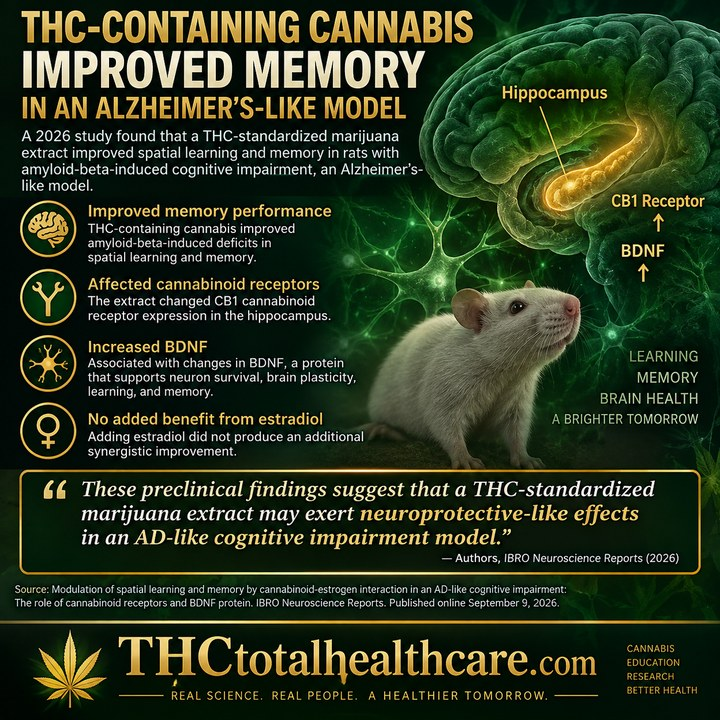
Modulation of spatial learning and memory by cannabinoid-estrogen interaction in an AD-like cognitive impairment: The role of cannabinoid receptors and BDNF protein

A 2026 study found that a THC-standardized marijuana extract improved spatial learning and memory in an Alzheimer’s-like model of cognitive impairment. Researchers tested the extract in rats exposed to amyloid-beta, a protein closely associated with Alzheimer’s disease, and observed improvements in memory performance.

The cognitive improvements were accompanied by changes in cannabinoid receptor signaling and in BDNF, or brain-derived neurotrophic factor, a protein that supports neuron survival, brain plasticity, learning, and memory. The findings suggest that the brain’s cannabinoid system and BDNF may be involved in the neuroprotective-like effects observed with the THC-standardized extract.

The researchers also examined the interaction with estrogen and found that adding estradiol did not produce an additional synergistic improvement. As the authors concluded, “These preclinical findings suggest that a THC-standardized marijuana extract may exert neuroprotective-like effects in an AD-like cognitive impairment model.”

“Alzheimer’s disease (AD) is an increasingly prevalent neurodegenerative disorder worldwide, with women showing a higher risk of developing the disease. The decline in steroid hormones after menopause may contribute to the increased susceptibility of women to neurodegenerative conditions.

In parallel, cannabis-derived compounds have been reported to alleviate certain symptoms associated with neurological disorders. The present study was designed to investigate the effects of marijuana extract on cognitive impairment and hippocampal molecular markers in an ovariectomized AD-like rat model, and to evaluate whether co-administration with estradiol modifies these effects.

The marijuana extract used in this study was characterized by HPLC and was found to contain 8.5% Δ9-THC. AD-like cognitive impairment pathology was induced by intra-hippocampal administration of Aβ25-35 in OVX rats. Animals were treated with marijuana extract (60 mg/kg/day, corresponding to approximately 5.1 mg/kg/day Δ9-THC) either alone or in combination with 17β-estradiol (1 mg/kg every 4 days) for 28 days. Cognitive performance was evaluated using the Morris water maze (MWM). In addition, hippocampal CB1/CB2 receptor expression and BDNF protein levels were measured to examine potential molecular associations.

Our findings showed that chronic administration of the marijuana extract improved Aβ25-35-induced deficits in spatial learning and memory.

Alterations in CB1 receptor expression and BDNF levels accompanied these behavioral effects. Notably, co-treatment with estradiol did not produce a synergistic effect, suggesting a complex interaction between cannabinoid-related and estrogen-related signaling pathways.

These preclinical findings suggest that a THC-standardized marijuana extract may exert neuroprotective-like effects in an AD-like cognitive impairment model. However, because the extract was not fully phytochemically characterized and the mechanistic analyses were correlational, the results should be interpreted cautiously. Further studies are needed to clarify the underlying mechanisms and translational relevance of these findings.”

https://pubmed.ncbi.nlm.nih.gov/42756662

“In conclusion, chronic administration of THC-standardized marijuana extract improved spatial learning and memory performance in the AD-like cognitive impairment model, and these behavioral changes were accompanied by alterations in hippocampal CB1/CB2 gene expression and BDNF protein levels.”

https://www.ibroneuroreports.org/article/S2667-2421(26)00149-1/fulltext