
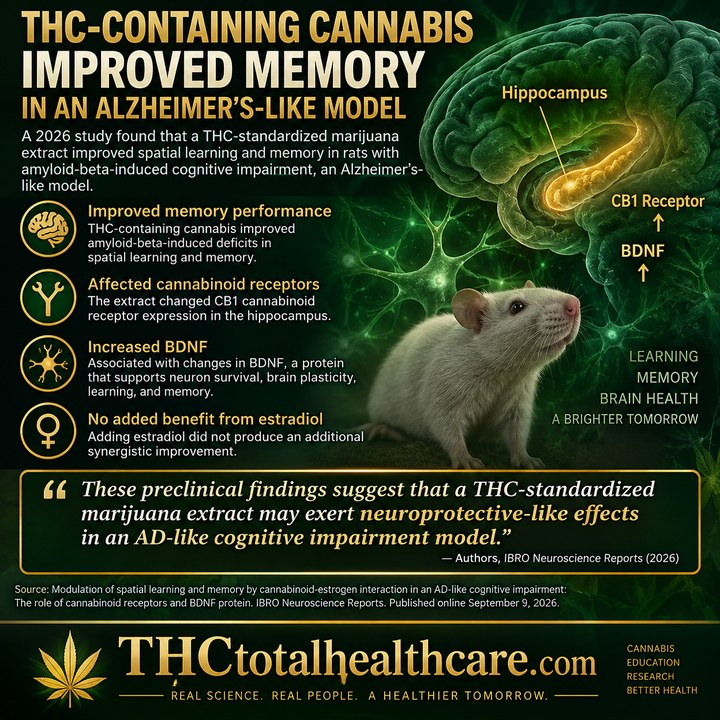
A 2026 study found that a THC-standardized marijuana extract improved spatial learning and memory in an Alzheimer’s-like model of cognitive impairment. Researchers tested the extract in rats exposed to amyloid-beta, a protein closely associated with Alzheimer’s disease, and observed improvements in memory performance.
The cognitive improvements were accompanied by changes in cannabinoid receptor signaling and in BDNF, or brain-derived neurotrophic factor, a protein that supports neuron survival, brain plasticity, learning, and memory. The findings suggest that the brain’s cannabinoid system and BDNF may be involved in the neuroprotective-like effects observed with the THC-standardized extract.
The researchers also examined the interaction with estrogen and found that adding estradiol did not produce an additional synergistic improvement. As the authors concluded, “These preclinical findings suggest that a THC-standardized marijuana extract may exert neuroprotective-like effects in an AD-like cognitive impairment model.”
“Alzheimer’s disease (AD) is an increasingly prevalent neurodegenerative disorder worldwide, with women showing a higher risk of developing the disease. The decline in steroid hormones after menopause may contribute to the increased susceptibility of women to neurodegenerative conditions.
In parallel, cannabis-derived compounds have been reported to alleviate certain symptoms associated with neurological disorders. The present study was designed to investigate the effects of marijuana extract on cognitive impairment and hippocampal molecular markers in an ovariectomized AD-like rat model, and to evaluate whether co-administration with estradiol modifies these effects.
The marijuana extract used in this study was characterized by HPLC and was found to contain 8.5% Δ9-THC. AD-like cognitive impairment pathology was induced by intra-hippocampal administration of Aβ25-35 in OVX rats. Animals were treated with marijuana extract (60 mg/kg/day, corresponding to approximately 5.1 mg/kg/day Δ9-THC) either alone or in combination with 17β-estradiol (1 mg/kg every 4 days) for 28 days. Cognitive performance was evaluated using the Morris water maze (MWM). In addition, hippocampal CB1/CB2 receptor expression and BDNF protein levels were measured to examine potential molecular associations.
Our findings showed that chronic administration of the marijuana extract improved Aβ25-35-induced deficits in spatial learning and memory.
Alterations in CB1 receptor expression and BDNF levels accompanied these behavioral effects. Notably, co-treatment with estradiol did not produce a synergistic effect, suggesting a complex interaction between cannabinoid-related and estrogen-related signaling pathways.
These preclinical findings suggest that a THC-standardized marijuana extract may exert neuroprotective-like effects in an AD-like cognitive impairment model. However, because the extract was not fully phytochemically characterized and the mechanistic analyses were correlational, the results should be interpreted cautiously. Further studies are needed to clarify the underlying mechanisms and translational relevance of these findings.”
https://pubmed.ncbi.nlm.nih.gov/42756662
“In conclusion, chronic administration of THC-standardized marijuana extract improved spatial learning and memory performance in the AD-like cognitive impairment model, and these behavioral changes were accompanied by alterations in hippocampal CB1/CB2 gene expression and BDNF protein levels.”
https://www.ibroneuroreports.org/article/S2667-2421(26)00149-1/fulltext