
Effect of solvent polarity on phenolic antioxidant extraction from Cannabis sativa L. leaves and inflorescences: mixture design optimization and HPLC-DAD/ESI-MS2 profiling

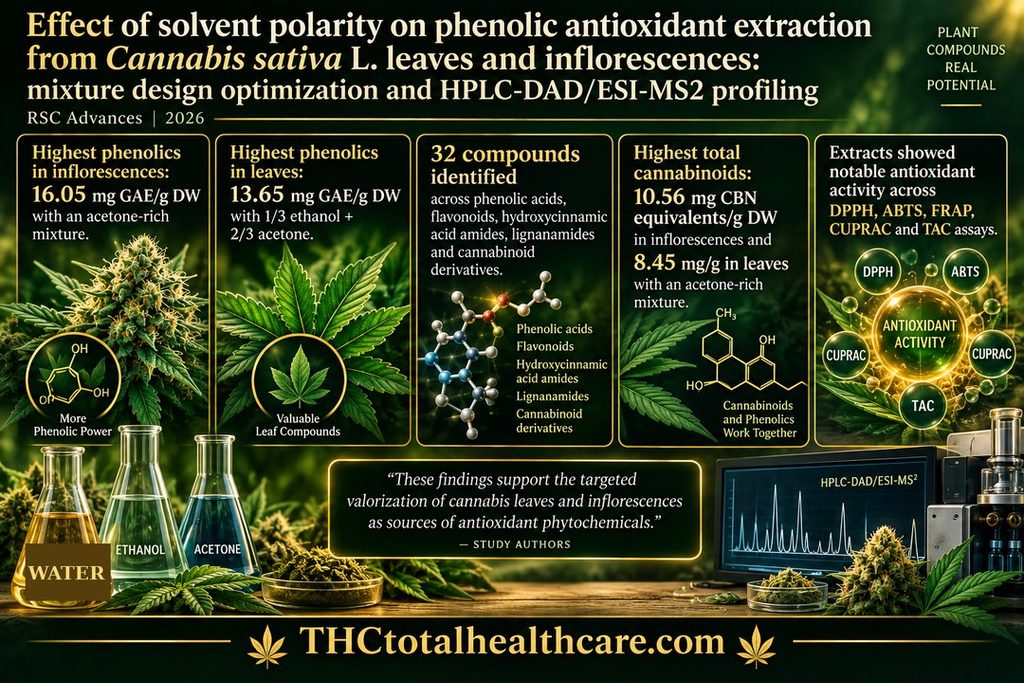
A new 2026 study shows that how cannabis is extracted can dramatically change which beneficial compounds are recovered. Researchers tested water, ethanol and acetone mixtures on Cannabis sativa leaves and inflorescences and found that solvent composition significantly affected total phenolics, cannabinoids and antioxidant activity.

Inflorescences produced their highest total phenolic content — 16.05 mg GAE/g dry weight — with an acetone-rich mixture, while leaves reached 13.65 mg GAE/g with one-third ethanol and two-thirds acetone. Chemical profiling identified 32 compounds, including phenolic acids, flavonoids, hydroxycinnamic acid amides, lignanamides and cannabinoid derivatives.

The extracts also showed notable antioxidant activity across DPPH, ABTS, FRAP, CUPRAC and TAC assays. The authors concluded that cannabis leaves and flowers may be valuable targeted sources of antioxidant phytochemicals for pharmaceutical, nutraceutical and cosmetic applications.

“Cannabis (Cannabis sativa L.) is a source of bioactive compounds with promising applications in the nutraceutical, pharmaceutical, and cosmetic fields.

Applying a mixture design approach with three solvents (water, acetone and ethanol), this study investigated how solvent composition modulates the recovery of phenolic compounds from cannabis inflorescences and leaves. Extracts were assessed for total phenolic content (TPC) and antioxidant activities using DPPH, ABTS, FRAP, CUPRAC, and TAC assays, and their chemical profiles were characterized by HPLC-DAD/ESI-MS2.

Solvent composition significantly affected extraction efficiency across plant organs. For inflorescences, the highest TPC value (16.05 mg GAE per g dry weight) was obtained with an acetone-enriched mixture (1/6 water-1/6 ethanol-2/3 acetone), whereas leaves reached their maximum (13.65 mg GAE per g DW) with 1/3 ethanol-2/3 acetone.

Multi-response optimization identified 1/3 water-1/3 ethanol-1/3 acetone for inflorescences and 50% water-30% ethanol-20% acetone for leaves as the optimal solvent mixtures.

HPLC-DAD/ESI-MS2 analysis identified 32 compounds belonging to several classes, including phenolic acids, flavonoids, hydroxycinnamic acid amides, lignanamides, and cannabinoid derivatives. These classes showed diverse content depending on the solvent and plant matrix. The acetone rich mixture produced the highest total cannabinoids (10.56 and 8.45 mg CBN equivalents per g dry weight) for inflorescences and leaves, respectively.

These results reveal clear organ and solvent-dependent selectivity in Moroccan Cannabis. These differences were reflected in the antioxidant activities, with extracts showing notable reducing and radical-scavenging capacities across DPPH, ABTS, FRAP, CUPRAC, and TAC assays.

These findings support the targeted valorization of cannabis leaves and inflorescences as sources of antioxidant phytochemicals for pharmaceutical and cosmetic applications.”

https://pubmed.ncbi.nlm.nih.gov/42751042

“The chemical diversity of Cannabis sativa metabolites has stimulated extensive research into their extraction and characterization. In this study, water, ethanol, and acetone were combined to enhance the extraction of phenolic compounds and antioxidants from Cannabis sativa L. leaves and inflorescences.

Multi-response optimization showed that each plant matrix required a specific optimal solvent mixture, confirming matrix-dependent extraction behavior: 1/3 water–1/3 acetone–1/3 ethanol for inflorescences and 50% water–30% ethanol–20% acetone for leaves. HPLC-DAD/ESI-MS2 enabled the tentative identification of several compound classes, including cannabinoids, hydroxycinnamic acid amides, flavonoids, and lignanamides. Inflorescences were characterized by higher total cannabinoid contents, whereas leaves contained higher levels of hydroxycinnamic acid amides. These differences highlight both the importance of solvent selection and the distinct chemical composition of Cannabis sativa L. organs.

Overall, these results support the potential valorization of the optimized Cannabis sativa leaf and inflorescence extracts as sources of antioxidant and bioactive compounds for prospective applications in natural cosmetic formulations, such as antioxidant creams, serums or other topical skincare products, as well as in nutraceutical formulations, including functional supplements enriched with plant-derived antioxidants. However, additional studies on formulation stability, bioavailability, efficacy, and safety are required before practical application.”
https://pubs.rsc.org/ra/article/doi/10.1039/d6ra05874d/1356587/Effect-of-solvent-polarity-on-phenolic-antioxidant

Cannabis as a source of novel therapeutics: A computational study combining LBDD and structure-based docking/dynamics to identify novel drug-like compounds for colorectal cancer

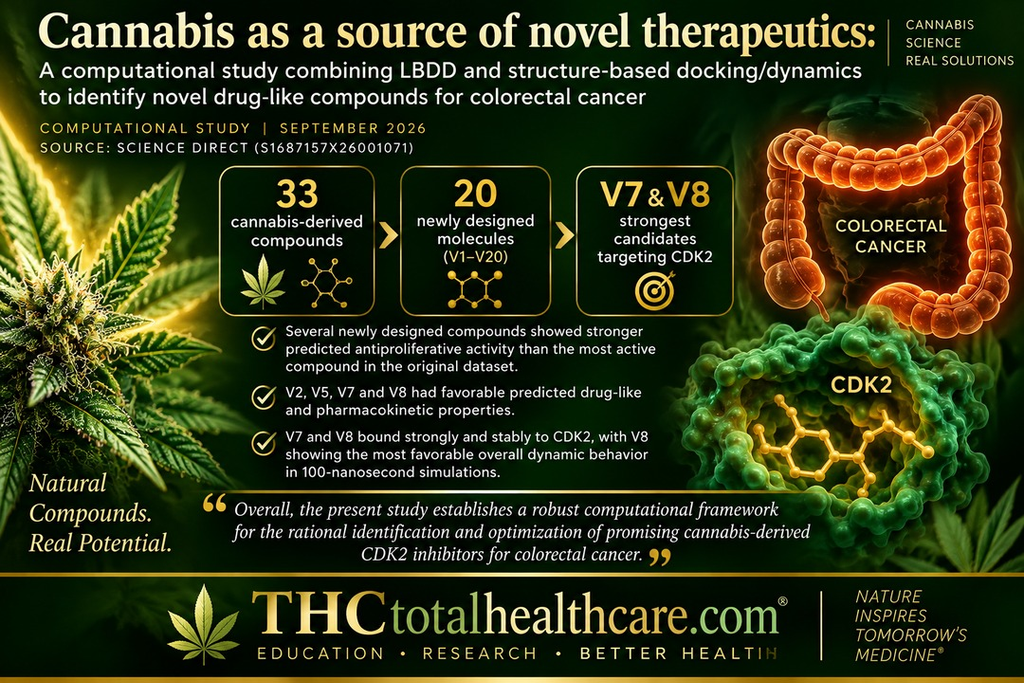
Cannabis continues to provide researchers with chemical starting points for the development of new cancer therapies. In this 2026 study, scientists examined 33 cannabis-derived compounds with reported antiproliferative activity against HCT-116 colorectal cancer cells, then used computational modeling to investigate their potential interactions with CDK2, an enzyme involved in cell-cycle regulation and cancer-cell proliferation.

Using those cannabis compounds as a foundation, the researchers designed 20 new drug-like molecules. Several were predicted to have stronger antiproliferative activity than the most active compound in the original cannabis-derived dataset, with four candidates — V2, V5, V7 and V8 — also showing favorable predicted pharmacokinetic and drug-like properties.

V7 and V8 emerged as the strongest candidates. Molecular docking and 100-nanosecond molecular-dynamics simulations indicated stable interactions with the active site of CDK2, with V8 showing particularly favorable behavior. The findings suggest that compounds inspired by cannabis chemistry could provide promising leads for the development of new therapeutics targeting colorectal cancer.

“Cannabis represents a valuable source of bioactive compounds with significant therapeutic potential, thanks to its rich phytochemical profile, making it a prime candidate for cancer research.

Our study investigates the potential of cannabis-derived compounds to inhibit cyclin-dependent kinase 2 (CDK2), a crucial regulator of cell-cycle progression and colorectal cancer cell proliferation.

A comprehensive computational workflow integrating 3D-QSAR modeling, molecular docking, molecular dynamics simulations, drug-likeness assessment, and ADMET prediction was employed to investigate a dataset of 33 cannabis-derived compounds. The robustness and predictive performance of the generated CoMFA and CoMSIA models were confirmed through internal and external validation, leave-one-out cross-validation (LOOCV), and Y-randomization tests, yielding excellent statistical parameters for CoMFA (Q2=0.651, R2=0.986, SEE=0.069) and CoMSIA (Q2=0.665, R2=0.985, SEE=0.071).

Using contour map analysis, twenty new molecules (V1-V20) with enhanced antiproliferative activity against the HCT-116 colorectal cancer cell line were developed, and outperformed the original dataset’s most active one. Following drug-likeness screening and ADMET profiling, compounds V2, V5, V7, and V8 emerged as the most promising candidates, exhibiting favorable pharmacokinetic properties and drug-like characteristics.

Molecular docking studies revealed that V7 and V8 exhibit high stability within the CDK2 active site and possess stronger binding affinity than the reference compound. Furthermore, 100 ns molecular dynamics simulations demonstrated that both protein-ligand complexes reached stable conformational states, as confirmed by converged backbone RMSD profiles, low residue fluctuations (RMSF), persistent protein-ligand interactions, and complementary structural descriptors including radius of gyration (Rg), solvent-accessible surface area (SASA), and molecular surface area (MolSA).

Collectively, these analyses confirmed the structural stability and compactness of the investigated complexes throughout the simulation period, with V8 exhibiting the most favorable dynamic behavior.”

https://pubmed.ncbi.nlm.nih.gov/42749433

 “Overall, the present study establishes a robust computational framework for the rational identification and optimization of promising cannabis-derived CDK2 inhibitors for colorectal cancer.”

https://www.sciencedirect.com/science/article/pii/S1687157X26001071?via%3Dihub

Phytochemicals as adjunctive with conventional anticancer therapies.

“Cancer is defined as the abnormal proliferations of cells which could occur in any tissue and can cause life-threatening malignancies with high financial costs for both patients and health care system. Plant-derived secondary metabolites are shown to have positive role in various diseases and conditions. The aim of the present study is to summarize clinical evidences on the benefits of phytochemicals as adjuvant therapy along with conventional anticancer therapies.

The findings showed that positive effects of phytochemicals are due to their direct anti-carcinogenic activity, induction of relief in cancer complications, as well as their protective role against side effects of conventional chemotherapeutic agents.

Results obtained from current review demonstrated that numerous phytochemical agents from different chemical categories including alkaloid, benzopyran, coumarin, carotenoid, diarylheptanoid, flavonoid, indole, polysaccharide, protein, stilbene, terpene, and xanthonoid possess therapeutic effect in patients with different types of cancer. Polyphenols are the most studied components. Curcumin, ginsenosides, lycopene, homoharringtonine, aviscumine, and resveratrol are amongst the major components with remarkable volumes of clinical evidence indicating their direct anticancer activities in different types of cancer including hepatocarcinoma, prostate cancer, leukemia and lymphoma, breast and ovarian cancer, and gastrointestinal cancers.

Cannabinoids, cumarin, curcumin, ginsenosides, epigallocatechin gallate, vitexin, and salidroside are phytochemicals with significant alleviative effect on synthetic chemotherapy-induced toxicities.”

http://www.ncbi.nlm.nih.gov/pubmed/27262332

Natural Phytochemicals in the Treatment and Prevention of Dementia: An Overview.

“The word dementia describes a class of heterogeneous diseases which etiopathogenetic mechanisms are not well understood. There are different types of dementia, among which, Alzheimer’s disease (AD), vascular dementia (VaD), dementia with Lewy bodies (DLB) and frontotemporal dementia (FTD) are the more common.

Currently approved pharmacological treatments for most forms of dementia seem to act only on symptoms without having profound disease-modifying effects. Thus, alternative strategies capable of preventing the progressive loss of specific neuronal populations are urgently required.

In particular, the attention of researchers has been focused on phytochemical compounds that have shown antioxidative, anti-amyloidogenic, anti-inflammatory and anti-apoptotic properties and that could represent important resources in the discovery of drug candidates against dementia.

In this review, we summarize the neuroprotective effects of the main phytochemicals belonging to the polyphenol, isothiocyanate, alkaloid and cannabinoid families in the prevention and treatment of the most common kinds of dementia.

We believe that natural phytochemicals may represent a promising sources of alternative medicine, at least in association with therapies approved to date for dementia.”

http://www.ncbi.nlm.nih.gov/pubmed/27110749

The role of phytochemicals in the treatment and prevention of dementia.

Drugs & Aging

“Dementia pathologies such as Alzheimer’s disease (AD) are reaching epidemic proportions, yet they are not successfully managed by effective symptomatic treatments. Only five drugs have been developed to alleviate cognitive symptoms, and more effective and safe treatments are needed for both the cognitive symptoms and behavioural and psychological symptoms of dementia (BPSD). As two of these licensed drugs (cholinesterase inhibitors [ChEIs]) are naturally derived (galantamine and rivastigmine), the potential for plants to yield new therapeutic agents has stimulated extensive research to discover new ChEIs together with plant extracts, phytochemicals and their derivatives with other mechanistic effects relevant to dementia treatment. This review presents the potential and actual therapeutic strategies for dementia in relation to the known mechanisms of dementia pathology. Phytochemicals that have shown mechanistic effects relevant to the pathological targets in dementia are discussed, with an emphasis on those showing positive clinical trial evidence. Those phytochemicals discussed include the alkaloid physostigmine, a ChEI from the calabar bean (Physostigma venenosum), which has been used as a template for the development of synthetic derivatives that inhibit acetylcholinesterase, including the drug rivastigmine. Also discussed are other ChEI alkaloids including huperzine A, from Huperzia serrata, and galantamine, originally from the snowdrop (Galanthus woronowii); both alkaloids improve cognitive functions in AD patients.

Other phytochemicals discussed include cannabinoids (e.g. cannabidiol) from Cannabis sativa, which are emerging as potential therapeutic agents for BPSD, and resveratrol (occurs in various plants) and curcumin (from turmeric [Curcuma longa]), which have been investigated for their pharmacological activities relevant to dementia and their potential effects on delaying dementia progression. The review also discusses plant extracts, and their known constituents, that have shown relevant mechanistic effects for dementia and promising clinical data, but require more evidence for their clinical efficacy and safety. Such plants include Ginkgo biloba, which has been extensively studied in numerous clinical trials, with most outcomes showing positive effects on cognitive functions in dementia patients; however, more reliable and consistent clinical data are needed to confirm efficacy. Other plants and their extracts that have produced promising clinical data in dementia patients, with respect to cognition, include saffron (Crocus sativus), ginseng (Panax species), sage (Salvia species) and lemon balm (Melissa officinalis), although more extensive and reliable clinical data are required. Other plants that are used in traditional practices of medicine have been suggested to improve cognitive functions (e.g. Polygala tenuifolia) or have been associated with alleviation of BPSD (e.g. the traditional prescription yokukansan); such remedies are often prescribed as complex mixtures of different plants, which complicates interpretation of pharmacological and clinical data and introduces additional challenges for quality control. Evidence for the role of natural products in disease prevention, the primary but considerably challenging aim with respect to dementia, is limited, but the available epidemiological and clinical evidence is discussed, with most studies focused on ChEIs, nicotine (from Nicotiana species), curcumin, wine polyphenols such as resveratrol and G. biloba. Challenges for the development of phytochemicals as drugs and for quality control of standardized plant extracts are also considered.”

http://www.ncbi.nlm.nih.gov/pubmed/21639405

https://link.springer.com/article/10.2165%2F11591310-000000000-00000