
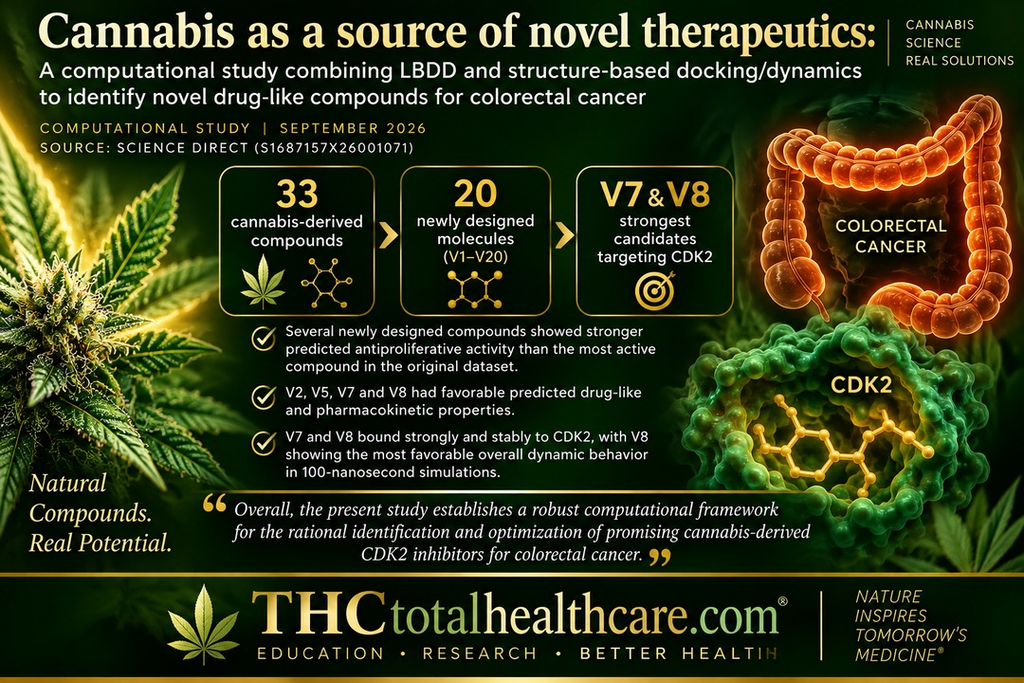
Cannabis continues to provide researchers with chemical starting points for the development of new cancer therapies. In this 2026 study, scientists examined 33 cannabis-derived compounds with reported antiproliferative activity against HCT-116 colorectal cancer cells, then used computational modeling to investigate their potential interactions with CDK2, an enzyme involved in cell-cycle regulation and cancer-cell proliferation.
Using those cannabis compounds as a foundation, the researchers designed 20 new drug-like molecules. Several were predicted to have stronger antiproliferative activity than the most active compound in the original cannabis-derived dataset, with four candidates — V2, V5, V7 and V8 — also showing favorable predicted pharmacokinetic and drug-like properties.
V7 and V8 emerged as the strongest candidates. Molecular docking and 100-nanosecond molecular-dynamics simulations indicated stable interactions with the active site of CDK2, with V8 showing particularly favorable behavior. The findings suggest that compounds inspired by cannabis chemistry could provide promising leads for the development of new therapeutics targeting colorectal cancer.
“Cannabis represents a valuable source of bioactive compounds with significant therapeutic potential, thanks to its rich phytochemical profile, making it a prime candidate for cancer research.
Our study investigates the potential of cannabis-derived compounds to inhibit cyclin-dependent kinase 2 (CDK2), a crucial regulator of cell-cycle progression and colorectal cancer cell proliferation.
A comprehensive computational workflow integrating 3D-QSAR modeling, molecular docking, molecular dynamics simulations, drug-likeness assessment, and ADMET prediction was employed to investigate a dataset of 33 cannabis-derived compounds. The robustness and predictive performance of the generated CoMFA and CoMSIA models were confirmed through internal and external validation, leave-one-out cross-validation (LOOCV), and Y-randomization tests, yielding excellent statistical parameters for CoMFA (Q2=0.651, R2=0.986, SEE=0.069) and CoMSIA (Q2=0.665, R2=0.985, SEE=0.071).
Using contour map analysis, twenty new molecules (V1-V20) with enhanced antiproliferative activity against the HCT-116 colorectal cancer cell line were developed, and outperformed the original dataset’s most active one. Following drug-likeness screening and ADMET profiling, compounds V2, V5, V7, and V8 emerged as the most promising candidates, exhibiting favorable pharmacokinetic properties and drug-like characteristics.
Molecular docking studies revealed that V7 and V8 exhibit high stability within the CDK2 active site and possess stronger binding affinity than the reference compound. Furthermore, 100 ns molecular dynamics simulations demonstrated that both protein-ligand complexes reached stable conformational states, as confirmed by converged backbone RMSD profiles, low residue fluctuations (RMSF), persistent protein-ligand interactions, and complementary structural descriptors including radius of gyration (Rg), solvent-accessible surface area (SASA), and molecular surface area (MolSA).
Collectively, these analyses confirmed the structural stability and compactness of the investigated complexes throughout the simulation period, with V8 exhibiting the most favorable dynamic behavior.”
https://pubmed.ncbi.nlm.nih.gov/42749433
“Overall, the present study establishes a robust computational framework for the rational identification and optimization of promising cannabis-derived CDK2 inhibitors for colorectal cancer.”
https://www.sciencedirect.com/science/article/pii/S1687157X26001071?via%3Dihub