
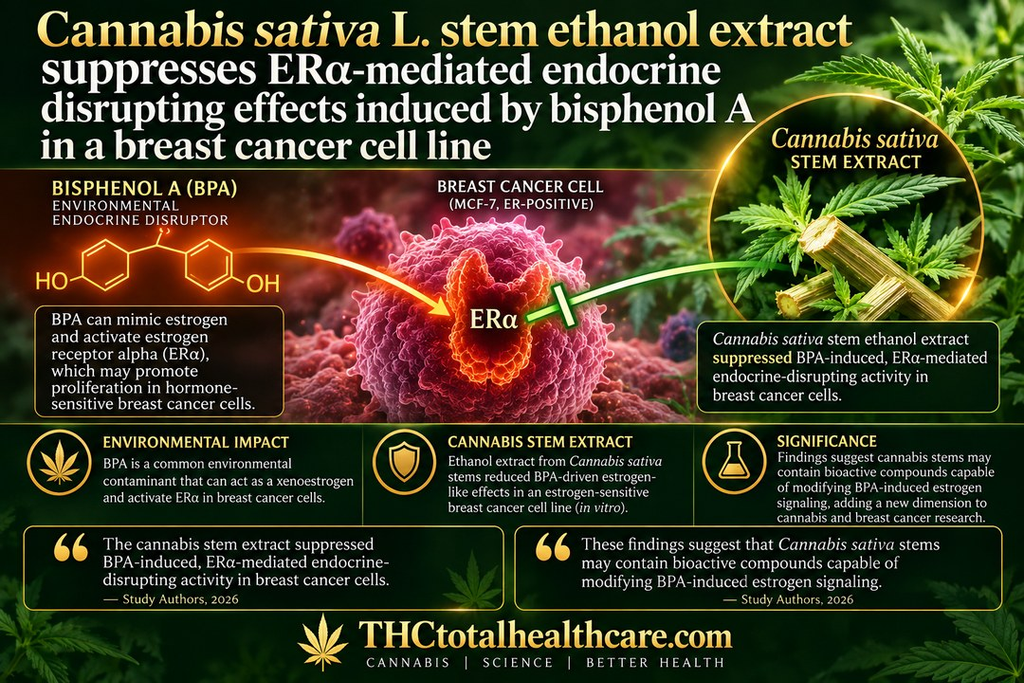
Researchers found that an ethanol extract made from Cannabis sativa stems suppressed the endocrine-disrupting effects of bisphenol A (BPA) in an estrogen-sensitive breast cancer cell line. BPA can mimic estrogen and activate estrogen receptor alpha (ERα), a signaling pathway involved in the growth and proliferation of many hormone-sensitive breast cancers.
The cannabis stem extract interfered with this BPA-driven ERα activity, reducing the estrogen-like effects produced by BPA in the breast cancer cells. Rather than simply testing cannabis for direct cancer-cell toxicity, the researchers examined whether compounds in the plant could counteract a specific molecular pathway activated by an environmental endocrine disruptor.
These findings suggest that Cannabis sativa stems—often treated as agricultural waste—may contain bioactive compounds capable of modifying BPA-induced estrogen signaling. The study adds a new dimension to cannabis and breast cancer research by identifying a potential interaction between cannabis-derived compounds, environmental contaminants, and hormone-responsive cancer pathways.
“Cannabis sativa L. (hemp), a Cannabaceae family member, has been extensively studied for its diverse secondary metabolites with physiological activities. However, stems that lack detectable levels of the delta-9-tetrahydrocannabinol have been understudied.
Herein, we aimed to investigate the antagonistic effects using C. sativa L. stem ethanol extract (CSE) and its bioactive compounds on human ERα activity induced by exogenous estrogen, bisphenol A (BPA), through genomic and non-genomic pathways.
CSE inhibited BPA-induced ERα transcriptional activation in VM7Luc4E2 cells and suppressed cell proliferation. Among the secondary metabolites in CSE, cyclopentane-1,2-dione (CPD), 4-vinylguaiacol (4-VG), and 4-([1E]-hydroxy-1-propenyl)-2-methoxyphenol (4-HMP) exhibited antagonistic effects on ERα transcriptional activation and inhibited cell proliferation. Cell proliferation suppression was mediated by downregulation of p38 phosphorylation in the MAPK signaling pathway.
CPD inhibited exogenous estrogen-induced activation of ERα without significant affecting the translocation of cytosolic ERα to the nucleus. In contrast, 4-VG and 4-HMP exerted antagonistic effect based on suppressing the nuclear translocation of cytosolic ERα.
Collectively, the results showed that CSE suppressed ERα-mediated endocrine disruption induced by exogenous estrogen, suggesting its potential as a natural ingredient to reduce endocrine disruption from dietary sources.”
https://pubmed.ncbi.nlm.nih.gov/42777654
“This study demonstrated that CSE exerted antagonistic effects on activation of ERα induced by BPA, a representative exogenous estrogen, and that these effects were mediated through the regulation of ERα signaling and nuclear translocation. Furthermore, inactivation of ERα caused BPA-induced cell proliferation of human breast cancer cells by modulating the MAPK/p38 pathway. The active compounds in CSE that suppressed BPA-induced endocrine disrupting were CPD, 4-VG, and 4-HMP. Three secondary metabolites had inhibitory effects on BPA-induced cell proliferation of human breast cancer cells based on their ERα antagonistic effects.
Accordingly, these findings suggest the potential of CSE as a natural product to alleviate endocrine disruption associated with exogenous estrogen exposure from environmental or dietary sources.”
https://www.sciencedirect.com/science/article/pii/S0147651326011620?via%3Dihub