
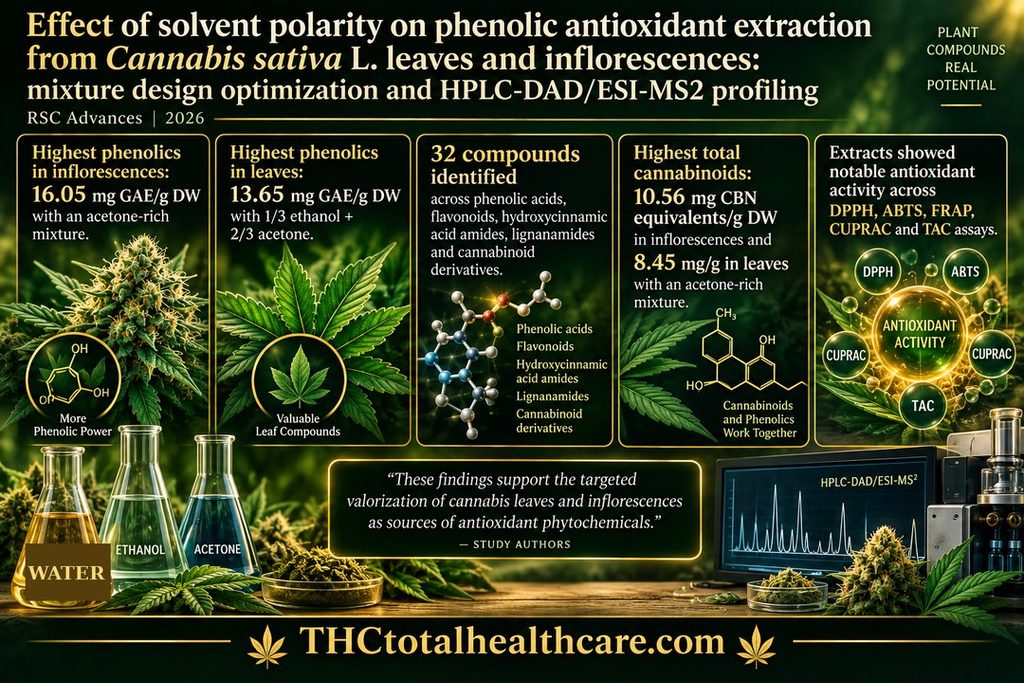
Effect of solvent polarity on phenolic antioxidant extraction from Cannabis sativa L. leaves and inflorescences: mixture design optimization and HPLC-DAD/ESI-MS2 profiling

A new 2026 study shows that how cannabis is extracted can dramatically change which beneficial compounds are recovered. Researchers tested water, ethanol and acetone mixtures on Cannabis sativa leaves and inflorescences and found that solvent composition significantly affected total phenolics, cannabinoids and antioxidant activity.

Inflorescences produced their highest total phenolic content — 16.05 mg GAE/g dry weight — with an acetone-rich mixture, while leaves reached 13.65 mg GAE/g with one-third ethanol and two-thirds acetone. Chemical profiling identified 32 compounds, including phenolic acids, flavonoids, hydroxycinnamic acid amides, lignanamides and cannabinoid derivatives.

The extracts also showed notable antioxidant activity across DPPH, ABTS, FRAP, CUPRAC and TAC assays. The authors concluded that cannabis leaves and flowers may be valuable targeted sources of antioxidant phytochemicals for pharmaceutical, nutraceutical and cosmetic applications.

“Cannabis (Cannabis sativa L.) is a source of bioactive compounds with promising applications in the nutraceutical, pharmaceutical, and cosmetic fields.

Applying a mixture design approach with three solvents (water, acetone and ethanol), this study investigated how solvent composition modulates the recovery of phenolic compounds from cannabis inflorescences and leaves. Extracts were assessed for total phenolic content (TPC) and antioxidant activities using DPPH, ABTS, FRAP, CUPRAC, and TAC assays, and their chemical profiles were characterized by HPLC-DAD/ESI-MS2.

Solvent composition significantly affected extraction efficiency across plant organs. For inflorescences, the highest TPC value (16.05 mg GAE per g dry weight) was obtained with an acetone-enriched mixture (1/6 water-1/6 ethanol-2/3 acetone), whereas leaves reached their maximum (13.65 mg GAE per g DW) with 1/3 ethanol-2/3 acetone.

Multi-response optimization identified 1/3 water-1/3 ethanol-1/3 acetone for inflorescences and 50% water-30% ethanol-20% acetone for leaves as the optimal solvent mixtures.

HPLC-DAD/ESI-MS2 analysis identified 32 compounds belonging to several classes, including phenolic acids, flavonoids, hydroxycinnamic acid amides, lignanamides, and cannabinoid derivatives. These classes showed diverse content depending on the solvent and plant matrix. The acetone rich mixture produced the highest total cannabinoids (10.56 and 8.45 mg CBN equivalents per g dry weight) for inflorescences and leaves, respectively.

These results reveal clear organ and solvent-dependent selectivity in Moroccan Cannabis. These differences were reflected in the antioxidant activities, with extracts showing notable reducing and radical-scavenging capacities across DPPH, ABTS, FRAP, CUPRAC, and TAC assays.

These findings support the targeted valorization of cannabis leaves and inflorescences as sources of antioxidant phytochemicals for pharmaceutical and cosmetic applications.”

https://pubmed.ncbi.nlm.nih.gov/42751042

“The chemical diversity of Cannabis sativa metabolites has stimulated extensive research into their extraction and characterization. In this study, water, ethanol, and acetone were combined to enhance the extraction of phenolic compounds and antioxidants from Cannabis sativa L. leaves and inflorescences.

Multi-response optimization showed that each plant matrix required a specific optimal solvent mixture, confirming matrix-dependent extraction behavior: 1/3 water–1/3 acetone–1/3 ethanol for inflorescences and 50% water–30% ethanol–20% acetone for leaves. HPLC-DAD/ESI-MS2 enabled the tentative identification of several compound classes, including cannabinoids, hydroxycinnamic acid amides, flavonoids, and lignanamides. Inflorescences were characterized by higher total cannabinoid contents, whereas leaves contained higher levels of hydroxycinnamic acid amides. These differences highlight both the importance of solvent selection and the distinct chemical composition of Cannabis sativa L. organs.

Overall, these results support the potential valorization of the optimized Cannabis sativa leaf and inflorescence extracts as sources of antioxidant and bioactive compounds for prospective applications in natural cosmetic formulations, such as antioxidant creams, serums or other topical skincare products, as well as in nutraceutical formulations, including functional supplements enriched with plant-derived antioxidants. However, additional studies on formulation stability, bioavailability, efficacy, and safety are required before practical application.”

https://pubs.rsc.org/ra/article/doi/10.1039/d6ra05874d/1356587/Effect-of-solvent-polarity-on-phenolic-antioxidant

Novel cannabis flavonoid, cannflavin A displays both a hormetic and neuroprotective profile against amyloid β-mediated neurotoxicity in PC12 cells: comparison with geranylated flavonoids, mimulone and diplacone.

Biochemical Pharmacology

“Flavonoids form a diverse class of naturally occurring polyphenols ascribed various biological activities, including inhibition of amyloid β (Aβ) fibrillisation and neurotoxicity of relevance to Alzheimer’s disease.

Cannabis contains a unique subset of prenylated flavonoids, the cannflavins.

While selected conventional flavonoids have demonstrated anti-amyloid and neuroprotective potential, any neuroprotective bioactivity of prenylated flavonoids has not been determined.

We evaluated the in vitro neuroprotective and anti-aggregative properties of the novel geranylated cannabis-derived flavonoid, cannflavin A against Aβ1-42 and compared it to two similarly geranylated flavonoids, mimulone and diplacone, to compare the bioactive properties of these unique flavonoids more broadly.

RESULTS:

Cannflavin A demonstrated intrinsic hormetic effects on cell viability, increasing viability by 40% from 1-10µM but displaying neurotoxicity at higher (>10-100µM) concentrations. Neither mimulone nor diplacone exhibited such a biphasic effect, instead showing only concentration-dependent neurotoxicity, with diplacone the more potent (from >1 µM). However at the lower concentrations (<10µM), cannflavin A increased cell viability by up to 40%, while 10µM cannflavin A inhibited the neurotoxicity elicited by Aβ1-42 (0-2µM), reducing Aβ aggregate adherence to PC-12 cells and associated neurite loss. The neuroprotective effects of cannflavin A were associated with a direct inhibition of Aβ1-42 fibril and aggregate density, evidenced by attenuated ThT fluorescence kinetics and microscopic evidence of both altered and diminished density of Aβ aggregate and fibril morphology via electron microscopy.

CONCLUSIONS:

These findings highlight a concentration-dependent hormetic and neuroprotective role of cannflavin A against Aβ-mediated neurotoxicity, associated with an inhibition of Aβ fibrillisation. The efficacy of the cannabis flavone may itself direct further lead development targeting neurodegeneration in Alzheimer’s disease. However, the geranylated flavonoids generally displayed a comparatively potent neurotoxicity not observed with many conventional flavonoids in vitro.”

https://www.ncbi.nlm.nih.gov/pubmed/31437460

https://www.sciencedirect.com/science/article/abs/pii/S0006295219302990?via%3Dihub

Ultrasound-Assisted Extraction of Cannabinoids from Cannabis Sativa L. Optimized by Response Surface Methodology.

“Ultrasonication was used to extract bioactive compounds from Cannabis sativa L. such as polyphenols, flavonoids, and cannabinoids. On comparing the ultrasonic process with the control extraction, noticeably higher values were obtained for each of the responses. Additionally, ultrasound considerably improved the extraction of cannabinoids present in Cannabis.

PRACTICAL APPLICATION:

Low frequency ultrasound was employed to extract bioactive compounds from the inflorescence part of Cannabis. The responses evaluated were-total phenols, flavonoids, ferric reducing assay and yield. The solvent composition and time significantly influenced the extraction process. Appreciably higher extraction of cannabinoids was achieved on sonication against control.” https://www.ncbi.nlm.nih.gov/pubmed/29437231 http://onlinelibrary.wiley.com/doi/10.1111/1750-3841.14075/abstract]]>

Cannabis phenolics and their bioactivities.

“Although Cannabis sativa L. is one of the most versatile plant species with multipurpose use both as medical, alimentary source and as psychoactive abuse, its biomedical relevance focused the attention on major cannabinoids. Phytochemical characterization of cannabis highlights the presence of various non-cannabinoids constituents including flavonoids, spiroindans, dihyrostilbenes, dihydrophenanthrenes, lignanamides, steroids and alkaloids. Cannabis is a plant with high pharmacological and nutrition values, its potentialities and applications are not only circumscribed to cannabinoids biological activities, but also defined by non-cannabinoid compounds. This review deals with polyphenols present in this plant, their biosynthesis, their bioactivities and their synthesis, when this occurred.” https://www.ncbi.nlm.nih.gov/pubmed/28799497]]>