
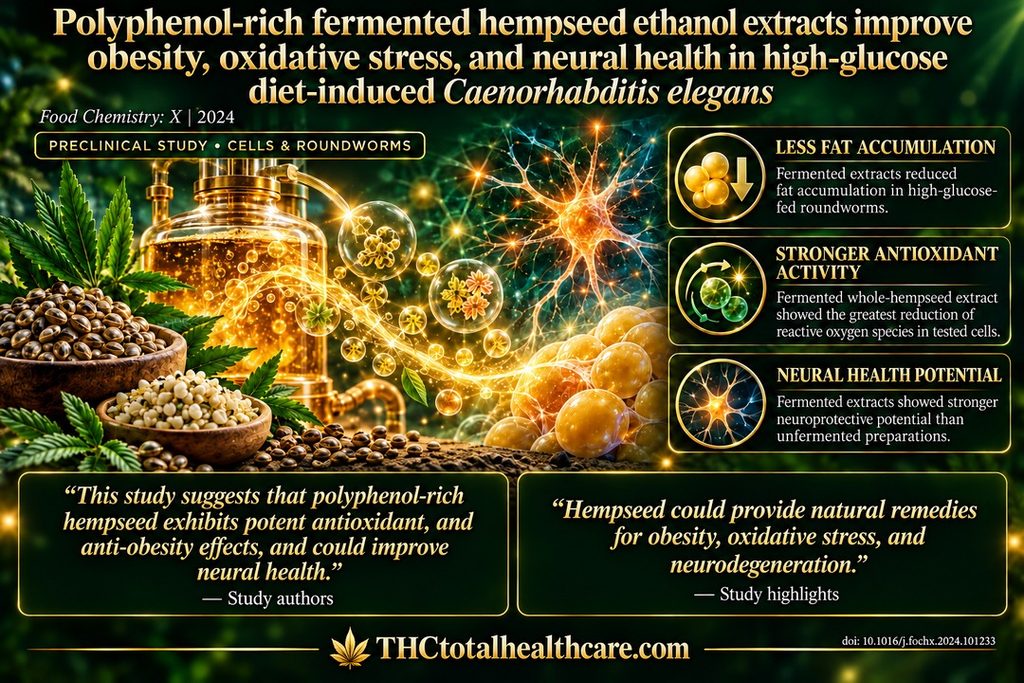
Fermented hempseed extracts reduced fat accumulation and oxidative stress and showed neuroprotective effects in a high-glucose-fed roundworm model. Researchers compared extracts from whole and hulled hemp seeds before and after fermentation, finding that fermented preparations generally produced stronger biological benefits.
Fermented whole-hempseed extract inhibited pancreatic lipase, an enzyme that breaks down dietary fats, by 70.80% and acetylcholinesterase, which breaks down the nerve-signaling chemical acetylcholine, by 78.94% in laboratory assays. It also showed the strongest reduction in reactive oxygen species in tested cells, supporting its antioxidant activity.
The researchers identified diverse seed polyphenols, including flavonoids, phenolic acids, lignanamides, and phenylamides. These preclinical findings highlight fermented hempseed as a promising source of bioactive compounds for research into obesity, oxidative stress, and neural health.
“Whole hempseed (WHS), fermented whole hempseed (FWHS), dehulled hempseed (DHS), and fermented dehulled hempseed (FDHS) ethanol extracts were tested for their toxicity and physiological benefits in relation to their phenolic profiles.
The safety of all samples was confirmed by the absence of toxic effects on HepG2 cells. FWHS exhibited the highest capacity to inhibit lipase activity (70.80%) and acetylcholinesterase (AChE) (78.94%) in vitro. Similarly, in HepG2 cells, FWHS revealed the greatest ability to reduce the accumulation of reactive oxygen species (ROS).
Fermented hempseed demonstrated superior antioxidant, neuroprotective and anti-fat potential, counteracting ageing in high glucose diet-induced C. elegans than unfermented. HPLC and UHPLC-Q-TOF-MS/MS2 phenolic identification revealed the presence of diverse flavonoids, phenolic acids, lignanamides, and phenylamides in hempseed extracts. Among these polyphenols, quercetin, gallic acid, and kaempferol exhibited excellent antioxidant potential, whereas N-trans-feruloyl tyramine displayed the highest anti-lipase potential.
This study suggests that polyphenol-rich hempseed exhibits potent antioxidant, and anti-obesity effects, and could improve neural health.”
https://pubmed.ncbi.nlm.nih.gov/38426074
“Fermented hempseeds demonstrated superior anti-obesity and antioxidant capabilities.”
“Hempseed could provide natural remedies for obesity, oxidative stress, and neurodegeneration.”
https://www.sciencedirect.com/science/article/pii/S2590157524001202?via%3Dihub
 “Diet and lifestyle-induced dysregulated lipid metabolism have been implicated in fatty liver disease. Chronic redox modulation and hepatic inflammation are key pathological mediators and hallmarks of fatty liver disease associated liver steatosis and steatohepatitis.
 “New neuroprotective treatments of natural origin are being investigated. Both, plant extracts and isolated compounds have shown bioactive effects.

 “The seed of the hemp plant (Cannabis sativa L.) has been revered as a nutritional resource in Old World Cultures. This has been confirmed by contemporary science wherein hempseed oil (HSO) was found to exhibit a desirable ratio of omega-6 and omega-3 polyunsaturated fatty acids (PUFAs) considered optimal for human nutrition. HSO also contains gamma-linoleic acid (GLA) and non-psychoactive cannabinoids, which further contribute to its’ potential bioactive properties. Herein, we present the kinetics of the thermal stability of these nutraceutical compounds in HSO, in the presence of various antioxidants (e.g. butylated hydroxytoluene, alpha-tocopherol, and ascorbyl palmitate). We focussed on oxidative changes in fatty acid profile and acidic cannabinoid stability when HSO was heated at different temperatures (25 °C to 85 °C) for upto 24 h. The fatty acid composition was evaluated using both GC/MS and 1H-NMR, and the cannabinoids profile of HSO was obtained using both HPLC-UV and HPLC/MS methods. The predicted half-life (DT50) for omega-6 and omega-3 PUFAs in HSO at 25 °C was about 3 and 5 days, respectively; while that at 85 °C was about 7 and 5 hours respectively, with respective activation energies (Ea) being 54.78 ± 2.36 and 45.02 ± 2.87 kJ/mol. Analysis of the conjugated diene hydroperoxides (CDH) and p-Anisidine value (p-AV) revealed that the addition of antioxidants significantly (p < 0.05) limited lipid peroxidation of HSO in samples incubated at 25-85 °C for 24 h. Antioxidants reduced the degradation constant (k) of PUFAs in HSO by upto 79%. This corresponded to a significant (p < 0.05) increase in color stability and pigment retention (chlorophyll a, chlorophyll b and carotenoids) of heated HSO. Regarding the decarboxylation kinetics of cannabidiolic acid (CBDA) in HSO, at both 70 °C and 85 °C, CBDA decarboxylation led to predominantly cannabidiol (CBD) production. The half-life of CBDA decarboxylation (originally 4 days) could be increased to about 17 days using tocopherol as an antioxidant. We propose that determining acidic cannabinoids decarboxylation kinetics is a useful marker to measure the shelf-life of HSO. The results from the study will be useful for researchers looking into the thermal treatment of hempseed oil as a functional food product, and those interested in the decarboxylation kinetics of the acidic cannabinoids.”
 “Hempseed (Cannabis sativa L.) has beneficial impact on human health mainly because of its wide variability of bioactive compounds. However, many of them are not fully characterized yet. In this work, hempseed was defatted and through a bio-guided studied, two fractions (F03 and F05) with the highest content of phenols, flavonoids and antioxidant capacity were selected. Fractions were chemically analyzed by UHPLC HRMS/MS. The anti-inflammatory capacities of these compounds were evaluated on human monocytes using flow cytometry, RT-qPCR and Elisa procedures. A high amount of phenolic compounds were identified, with the major compound being: N-trans-caffeoyltyramine (6.36 mg g-1 in F05 and 1.28 mg g-1 in F03). Both, F03 and F05 significantly reduced the inflammatory competence of LPS-treated human primary monocytes, decreasing TNF-α and IL-6 gene expression and secretion. These findings indicate that in the defatted fraction of the hempseed there are a wide number of compounds with beneficial potential to prevent and treat inflammatory disorders, as well as other processes caused by oxidative stress.”
 “The weak but noteworthy presence of (poly)phenols in hemp seeds has been long overshadowed by the essential polyunsaturated fatty acids and digestible proteins, considered responsible for their high nutritional benefits. Instead, lignanamides and their biosynthetic precursors, phenylamides, seem to display interesting and diverse biological activities only partially clarified in the last decades. Herein, negative mode HR-MS/MS techniques were applied to the chemical investigation of a (poly)phenol-rich fraction, obtained from hemp seeds after extraction/fractionation steps. This extract contained phenylpropanoid amides and their random oxidative coupling derivatives, lignanamides, which were the most abundant compounds and showed a high chemical diversity, deeply unraveled through high resolution tandem mass spectrometry (HR-MS/MS) tools.
 “The endocannabinoid system (ECS), modulated by metabolites of linoleic acid (LA), is important in regulating cardiovascular function.
 “Heavy metals pollution affects the nutritive value of fish.
 “Hypercholesterolemia indirectly increases the risk for myocardial infarction by enhancing the ability of platelets to aggregate.
Diets enriched with polyunsaturated fatty acids (PUFAs) have been shown to reduce the detrimental effects of cholesterol on platelet aggregation.
This study investigated whether dietary hempseed, a rich source of PUFAs, inhibits platelet aggregation under normal and hypercholesterolemic conditions.
The results of this study demonstrate that when hempseed is added to a cholesterol-enriched diet, cholesterol-induced platelet aggregation returns to control levels.”