Delta-8-tetrahydrocannabinol ameliorates murine autoimmune hepatitis and is associated with epigenetic modulation of immune responses

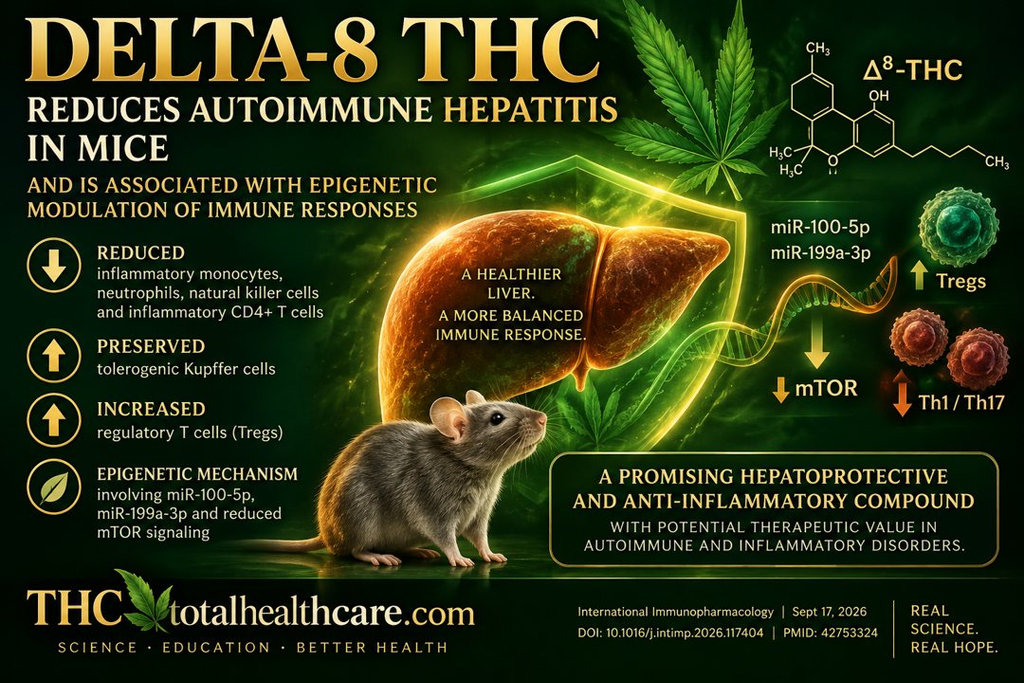
A new 2026 study published in International Immunopharmacology found that delta-8-tetrahydrocannabinol (Δ8-THC) significantly reduced autoimmune hepatitis in mice while altering the immune responses responsible for liver inflammation. Researchers found that Δ8-THC reduced inflammatory immune cells and helped preserve immune cells involved in protecting the liver.

The researchers also uncovered a possible mechanism. Δ8-THC increased two microRNAs, miR-100-5p and miR-199a-3p, which suppressed mTOR signaling and shifted CD4+ T-cell development away from inflammatory Th1 and Th17 cells and toward regulatory T cells that help control excessive immune activity.

The authors concluded that Δ8-THC showed both hepatoprotective and anti-inflammatory activity and highlighted its potential therapeutic value for autoimmune and inflammatory disorders. The study adds new evidence that cannabinoids may influence disease not only by reducing inflammation, but by changing the molecular and epigenetic pathways that regulate immune responses.

“Aim of the study: Cannabinoids have gained attention for their ability to modulate immune responses and suppress inflammation. However, the effect of Δ8-THC, a minor cannabinoid found in Cannabis, has not been explored in autoimmune hepatitis. To address knowledge gap, the present study aimed to investigate the hepatoprotective and immunoregulatory properties of Δ8-THC in experimental autoimmune hepatitis and to identify molecular and epigenetic mechanisms underlying its immunoregulatory effects.

Methods: miRNA sequencing and flow cytometric analysis were performed using hepatic immune cells from female C57BL/6 mice treated with ConA (12.5 mg/kg, i.v.) and Δ8-THC (20 mg/kg, i.p.). Differential miRNA expressions were analyzed using the edgeR, and miRNA targets were predicted using Ingenuity Pathway Analysis. Target gene expression was validated by qRT-PCR and Western blot. Functional assays including miRNA mimic/inhibitor transfection and CD4+ T-cell differentiation were performed to validate target gene regulation by miRNAs and its role in CD4+ T-cell differentiation.

Results: Δ8-THC markedly suppressed ConA-induced autoimmune hepatitis by restoring immune homeostasis within the liver through suppression of inflammatory monocytes, neutrophils, and natural killer cells, and preservation of tolerogenic Kupffer cells. In addition, Δ8-THC reshaped the hepatic lymphoid compartment, diminishing inflammatory CD4+ T-cell responses while favoring regulatory T-cell expansion. These effects were associated with the preservation of miR-100-5p and miR-199a-3p expression in the liver, whereas both miRNAs were markedly downregulated following ConA treatment. mTOR, a central regulator of T-cell differentiation, was identified as a target of these miRNAs. Consistent with these findings, Δ8-THC reduced mTOR expression and upregulated hepatoprotective miRNAs in both in vivo and in vitro models. Functional analyses with miRNA overexpression and inhibition approaches verified the direct regulation of mTOR by these miRNAs in T cells and RAW 264.7 cells. In naïve CD4+ T cells, miRNA gain- and loss-of-function experiments demonstrated that miR-100-5p/miR-199a-3p-mediated suppression of mTOR promotes regulatory T-cell differentiation while limiting Th1 and Th17 polarization.

Conclusion: Our results identify Δ8-THC as a promising hepatoprotective and anti-inflammatory compound that ameliorates ConA-induced autoimmune hepatitis by influencing CD4+ T-cell differentiation potentially through the miR-100-5p/miR-199a-3p-mTOR axis, highlighting its potential therapeutic value in autoimmune and inflammatory disorders.”

https://pubmed.ncbi.nlm.nih.gov/42753324

“In conclusion, our findings suggest that Δ8-THC can mitigate ConA-induced hepatitis, potentially through epigenetic regulation involving microRNAs. Specifically, Δ8-THC improved liver function and reduced systemic and intrahepatic inflammation in ConA-exposed mice. These effects were associated with increased expression of miR-100-5p and miR-199a-3p in the liver, suggesting that these miRNAs may regulate mTOR signaling and contribute to the suppression of proinflammatory responses and promotion of anti-inflammatory pathways. Functional studies supported the involvement of these miRNAs in the regulation of mTOR signaling, CD4+ T-cell differentiation, and inflammatory responses.”

https://www.sciencedirect.com/science/article/pii/S1567576926012518?via%3Dihub

Anti-Inflammatory, Antioxidative, and Hepatoprotective Effects of Trans Δ9-Tetrahydrocannabinol/Sesame Oil on Adjuvant-Induced Arthritis in Rats

logo

“Rheumatoid arthritis (RA) is a painful chronic autoimmune disease affecting the joints. Its first-line therapy, Methotrexate (MTX), although effective in ameliorating the progress of the disease, induces hepatotoxicity over long-term usage. Thus, seeking natural compounds with fewer side effects could be an alternative therapeutic approach. This study aimed to investigate the anti-inflammatory, antiarthritic, and antioxidative effects of synthetic trans-Δ9-tetrahydrocannabinol (Δ9-THC) dissolved in sesame oil (Dronabinol) against MTX in adjuvant-induced arthritis (AIA) rat model. Daily oral administration of Δ9-THC/sesame oil, over a period of 21 days, was well tolerated in arthritic rats with no particular psychoactive side effects. It markedly attenuated the severity of clinical manifestations, recovered the histopathological changes in tibiotarsal joints, and repressed the splenomegaly in arthritic rats. Δ9-THC/sesame oil therapy showed similar effects to MTX in neutralizing the inflammatory process of AIA, through attenuating erythrocyte sedimentation rate (ESR) scores and proinflammatory cytokines, including tumor necrosis factor-alpha (TNF-α), interleukin 1-beta (IL-1β), and interleukin-6 (IL-6) levels, to normal values. As opposed to MTX, this natural combination markedly protected the liver of arthritic rats and downregulated the induced oxidative stress by increasing the antioxidant defense system such as activities of catalase and superoxide dismutase (SOD) and levels of glutathione (GSH). These results suggest promising effects for the clinical use of Δ9-THC/sesame oil therapy in alleviating arthritic clinical signs as well as arthritis-induced liver injury.”

https://pubmed.ncbi.nlm.nih.gov/30046349/

“Dronabinol (Δ9-THC in sesame oil) is usually used to treat nausea and vomiting caused by chemotherapy or weight loss and loss of appetite in AIDS patients, yet, to the best of our knowledge, this is the first study that proves the antiarthritic and antioxidative effects of this combination in an experimental model of RA with a hepatoprotective effect against arthritis-induced liver injury compared to commonly used antirheumatic drug (MTX).”

https://www.hindawi.com/journals/ecam/2018/9365464/


Cannabis sativa L. (var. indica) Exhibits Hepatoprotective Effects by Modulating Hepatic Lipid Profile and Mitigating Gluconeogenesis and Cholinergic Dysfunction in Oxidative Hepatic Injury

Frontiers Logo

“Cannabis sativa L. is a crop utilized globally for recreational, therapeutic, and religious purposes. Although considered as an illicit drug in most countries, C. sativa until recently started gaining attention for its medicinal application. This study sought to investigate the hepatoprotective effect of C. sativa on iron-mediated oxidative hepatic injury. Hepatic injury was induced ex vivo by incubating hepatic tissues with Fe2+, which led to depleted levels of reduced glutathione, superoxide dismutase, catalase and ENTPDase activities, triglyceride, and high-density lipoprotein-cholesterol (HDL-C). Induction of hepatic injury also caused significant elevation of malondialdehyde, nitric oxide, cholesterol, and low-density lipoprotein-cholesterol (LDL-C) levels while concomitantly elevating the activities of ATPase, glycogen phosphorylase, glucose-6-phosphatase, fructose-1,6-bisphosphatase, amylase, and lipase. Treatment with the hexane, dichloromethane (DCM), and ethanol extracts of C. sativa leaves significantly (p < 0.05) reversed these levels and activities to almost near normal. However, there was no significant effect on the HDL-C level. The extracts also improved the utilization of glucose in Chang liver cells. High-performance liquid chromatography (HPLC) analysis showed the presence of phenolics in all extracts, with the ethanol extract having the highest constituents. Cannabidiol (CBD) was identified in all the extracts, while Δ-9-tetrahydrocannabinol (Δ-9-THC) was identified in the hexane and DCM extracts only. Molecular docking studies revealed strong interactions between CBD and Δ-9-THC with the β2 adrenergic receptor of the adrenergic system. The results demonstrate the potential of C. sativa to protect against oxidative-mediated hepatic injury by stalling oxidative stress, gluconeogenesis, and hepatic lipid accumulation while modulating cholinergic and purinergic activities. These activities may be associated with the synergistic effect of the compounds identified and possible interactions with the adrenergic system.”

https://pubmed.ncbi.nlm.nih.gov/34992528/

“The data obtained in this study indicate the ability of C. sativa to protect against oxidative-mediated hepatic injury by stalling oxidative stress, gluconeogenesis, and hepatic lipid accumulation while modulating cholinergic and purinergic activities. These activities may be associated with the synergistic effect of the identified phenolics, CBD, and Δ-9-THC and possible interactions with the adrenergic system.”

https://www.frontiersin.org/articles/10.3389/fphar.2021.705402/full

Hempseed ( Cannabis sativa) lipid fractions alleviate high-fat diet-induced fatty liver disease through regulation of inflammation and oxidative stress

 Heliyon (@HeliyonJournal) | Twitter“Diet and lifestyle-induced dysregulated lipid metabolism have been implicated in fatty liver disease. Chronic redox modulation and hepatic inflammation are key pathological mediators and hallmarks of fatty liver disease associated liver steatosis and steatohepatitis.

In this context, owing to the beneficial phytochemical properties such as optimal omega-6: omega-3 PUFA ratio of hempseed, we aimed to explore its potential anti-inflammatory and antioxidant properties against high-fat diet (HFD)-induced experimental model of fatty liver disease.

The hempseed lipid fractions (HEMP) were prepared and their ameliorating effects on HFD induced morphological changes, lipid profiles, liver function markers (LFT), markers of oxidative stress and inflammation were studied.

Results indicated that HEMP administration to hypercholesterolemic rats resolved the morphological, histopathological, and biochemical indicators of fatty liver diseases. Further, the mechanistic evidence revealed that these hepatoprotective effects of HEMP are mediated through inhibition of oxidative stress and inflammatory mediators such as Cox-2, hPGDS, mPGES, IL-4, TNF-α and sEH.

In conclusion, current study suggests the plausible antioxidant and anti-inflammatory role of HEMP in alleviating pathophysiological conditions including fatty liver disease, where oxidative stress and inflammation are key mediators.”

https://pubmed.ncbi.nlm.nih.gov/32685737/

https://www.cell.com/heliyon/pdf/S2405-8440(20)31266-4.pdf?_returnURL=https%3A%2F%2Flinkinghub.elsevier.com%2Fretrieve%2Fpii%2FS2405844020312664%3Fshowall%3Dtrue

Cannabidiol improves metabolic dysfunction in middle-aged diabetic rats submitted to a chronic cerebral hypoperfusion.

Chemico-Biological Interactions“Cannabidiol (CBD), a compound obtained from Cannabis sativa, has wide range of therapeutic properties, including mitigation of diabetes and neurodegeneration.

Cerebral ischemia and consequent learning disabilities are aggravated in elderly diabetic subjects. However, there are no studies showing the effect of CBD treatment in elderly diabetes patients suffering cerebral ischemia.

The present work tested the hypothesis that CBD treatment improves metabolic dysfunctions in middle-aged diabetic rats submitted to chronic cerebral hypoperfusion.

CBD may be used as therapeutic tool to protect metabolism against injuries from diabetes aggravated by cerebral ischemia.”

https://www.ncbi.nlm.nih.gov/pubmed/31499052

“CBD reduced hyperglycemia of middle-aged diabetic rats with CCH. CBD increased insulin secretion and decreased AGEs levels. CBD reduced fructosamine, LDL, HDL, triglycerides and total cholesterol levels. CBD presented hepatoprotective effect. CBD could mitigate neurodegeneration caused by DM associated to cerebral ischemia.”

https://www.sciencedirect.com/science/article/abs/pii/S000927971930701X?via%3Dihub

AM-1241 CB2 Receptor Agonist Attenuates Inflammation, Apoptosis and Stimulate Progenitor Cells in Bile Duct Ligated Rats.

 “The cannabinoid receptor 2 (CB2) plays a pleiotropic role in the innate immunity and is considered a crucial mediator of liver disease.

Cannabinoid CB2 receptor activation has been reported to attenuate liver fibrosis in CCl4 exposed mice and also plays a potential role in liver regeneration in a mouse model of I/R and protection against alcohol-induced liver injury.

AIM:

In this study, we investigated the impact of CB2 receptors on the antifibrotic and regenerative process associated with cholestatic liver injury.

RESULTS:

Following bile duct ligation (BDL) for 3 weeks, there was increased aminotransferase levels, marked inflammatory infiltration and hepatocyte apoptosis with induced oxidative stress, as reflected by increased lipid peroxidation. Conversely, following treatment with the CB2 agonist, AM-1241, BDL rats displayed a reduction in liver injury and attenuation of fibrosis as reflected by expression of hydroxyproline and α-smooth muscle actin. AM1241 treatment also significantly attenuated lipid peroxidation end-products, p53-dependent apoptosis and also attenuated inflammatory process by stimulating IL-10 production. Moreover, AM1241 treated rats were associated with significant expression of hepatic progenitor/oval cell markers.

CONCLUSION:

In conclusion, this study points out that CB2 receptors reduce liver injury and promote liver regeneration via distinct mechanisms including IL-10 dependent inhibition of inflammation, reduction of p53-reliant apoptosis and through stimulation of oval/progenitor cells. These results suggest that CB2 agonists display potent hepatoregenrative properties, in addition to their antifibrogenic effects.”

https://www.ncbi.nlm.nih.gov/pubmed/30976335

https://www.id-press.eu/mjms/article/view/oamjms.2019.194

Protective effects of specific cannabinoid receptor 2 agonist GW405833 on concanavalin A-induced acute liver injury in mice.

Image result for nature communications

“Cannabinoid receptor 2 (CB2R) is highly expressed in immune cells and plays an important role in regulating immune responses. In the current study, we investigated the effects of GW405833 (GW), a specific CB2R agonist, on acute liver injury induced by concanavalin A (Con A).

In animal experiments, acute liver injury was induced in mice by injection of Con A (20 mg/kg, i.v.). The mice were treated with GW (20 mg/kg, i.p., 30 min after Con A injection) or GW plus the selective CB2R antagonist AM630 (2 mg/kg, i.p., 15 min after Con A injection).

We found that Con A caused severe acute liver injury evidenced by significantly increased serum aminotransferase levels, massive hepatocyte apoptosis, and necrosis, as well as lymphocyte infiltration in liver tissues. Treatment with GW significantly ameliorated Con A-induced pathological injury in liver tissue, decreased serum aminotransferase levels, and decreased hepatocyte apoptosis.

Our results suggest that GW protects against Con A-induced acute liver injury in mice by inhibiting Jurkat T-cell proliferation through the CB2Rs.”

https://www.ncbi.nlm.nih.gov/pubmed/30918343

https://www.nature.com/articles/s41401-019-0213-0

A systematic review on the neuroprotective perspectives of beta-caryophyllene.

Image result for phytother res “Beta (β)-caryophyllene (BCAR) is a major sesquiterpene of various plant essential oils reported for several important pharmacological activities, including antioxidant, anti-inflammatory, anticancer, cardioprotective, hepatoprotective, gastroprotective, nephroprotective, antimicrobial, and immune-modulatory activity. Recent studies suggest that it also possesses neuroprotective effect. This study reviews published reports pertaining to the neuropharmacological activities of BCAR. Databases such as PubMed, Scopus, MedLine Plus, and Google Scholar with keywords “beta (β)-caryophyllene” and other neurological keywords were searched. Data were extracted by referring to articles with information about the dose or concentration/route of administration, test system, results and discussion, and proposed mechanism of action. A total of 545 research articles were recorded, and 41 experimental studies were included in this review, after application of exclusion criterion. Search results suggest that BCAR exhibits a protective role in a number of nervous system-related disorders including pain, anxiety, spasm, convulsion, depression, alcoholism, and Alzheimer’s disease. Additionally, BCAR has local anesthetic-like activity, which could protect the nervous system from oxidative stress and inflammation and can act as an immunomodulatory agent. Most neurological activities of this natural product have been linked with the cannabinoid receptors (CBRs), especially the CB2R. This review suggests a possible application of BCAR as a neuroprotective agent.” https://www.ncbi.nlm.nih.gov/pubmed/30281175 “β-caryophyllene (BCP) is a common constitute of the essential oils of numerous spice, food plants and major component in Cannabis.” http://www.ncbi.nlm.nih.gov/pubmed/23138934
]]>