
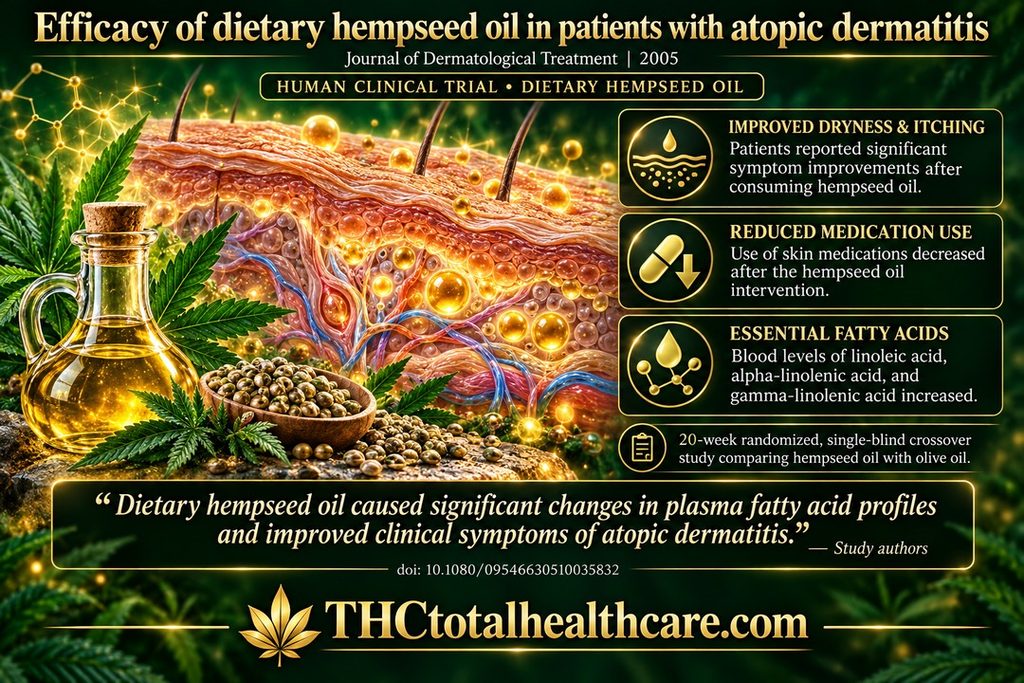
Dietary hempseed oil improved skin dryness and itching and reduced the use of skin medications in patients with atopic dermatitis, commonly called eczema. Researchers compared hempseed oil with olive oil in a 20-week randomized, single-blind crossover trial, examining symptoms, blood fatty acid profiles, and moisture loss through the skin.
After hempseed oil consumption, blood levels of linoleic acid, alpha-linolenic acid, and gamma-linolenic acid increased. Patients reported significant improvements in dryness and itching, along with reduced medication use. Skin moisture loss also decreased, although that change did not reach statistical significance.
The authors suggested that the symptom improvements resulted from hempseed oil’s abundant, balanced supply of polyunsaturated fatty acids. These human clinical findings support the therapeutic potential of dietary hempseed oil for eczema and highlight the value of cannabis seeds beyond their basic nutritional benefits.
“Background: Hempseed oil is a rich and balanced source of omega-6 and omega-3 polyunsaturated fatty acids (PUFAs). Anecdotal evidence indicated that dietary hempseed oil might be useful in treating symptoms of atopic dermatitis.
Patients and methods: Dietary hempseed oil and olive oil were compared in a 20-week randomized, single-blind crossover study with atopic patients. Fatty acid profiles were measured in plasma triglyceride, cholesteryl and phospholipid fractions. A patient questionnaire provided additional information on skin dryness, itchiness and usage of dermal medications. Skin transepidermal water loss (TEWL) was also measured.
Results: Levels of both essential fatty acids (EFAs), linoleic acid (18:2n6) and alpha-linolenic acid (18:3n3), and gamma-linolenic acid (GLA; 18:3n6) increased in all lipid fractions after hempseed oil, with no significant increases of arachidonic acid (20:4n6) in any lipid fractions after either oil. Intra-group TEWL values decreased (p=0.074), qualities of both skin dryness and itchiness improved (p=0.027) and dermal medication usage decreased (p=0.024) after hempseed oil intervention.
Conclusions: Dietary hempseed oil caused significant changes in plasma fatty acid profiles and improved clinical symptoms of atopic dermatitis. It is suggested that these improvements resulted from the balanced and abundant supply of PUFAs in this hempseed oil.”
https://pubmed.ncbi.nlm.nih.gov/16019622
https://www.tandfonline.com/doi/abs/10.1080/09546630510035832
 “Diet and lifestyle-induced dysregulated lipid metabolism have been implicated in fatty liver disease. Chronic redox modulation and hepatic inflammation are key pathological mediators and hallmarks of fatty liver disease associated liver steatosis and steatohepatitis.
 “Increased levels of
 “The anticancer effects of the omega-3 long chain polyunsaturated fatty acids (LCPUFA), EPA and DHA may be due, at least in part, to conversion to their respective endocannabinoid derivatives, eicosapentaenoyl-ethanolamine (EPEA) and docosahexaenoyl-ethanolamine (DHEA).
 “Hypercholesterolemia (HC) is a major risk factor for cardiovascular (CV) diseases, that are the major cause of mortality worldwide.

 “A total of sixteen Holstein dairy cows (35 ± 1.1 kg/d of milk yield) were randomly assigned to consider the effects of feeding omega-3 sources on endometrial
 “The brain is enriched in arachidonic acid (ARA) and docosahexaenoic acid (DHA), long-chain polyunsaturated fatty acids (LCPUFAs) of the n-6 and n-3 series, respectively. Both are essential for optimal brain development and function. Dietary enrichment with DHA and other long-chain n-3 PUFA, such as eicosapentaenoic acid (EPA), has shown beneficial effects on learning and memory, neuroinflammatory processes, and synaptic plasticity and neurogenesis. ARA, DHA and EPA are precursors to a diverse repertoire of bioactive lipid mediators, including endocannabinoids.
The endocannabinoid system comprises
