
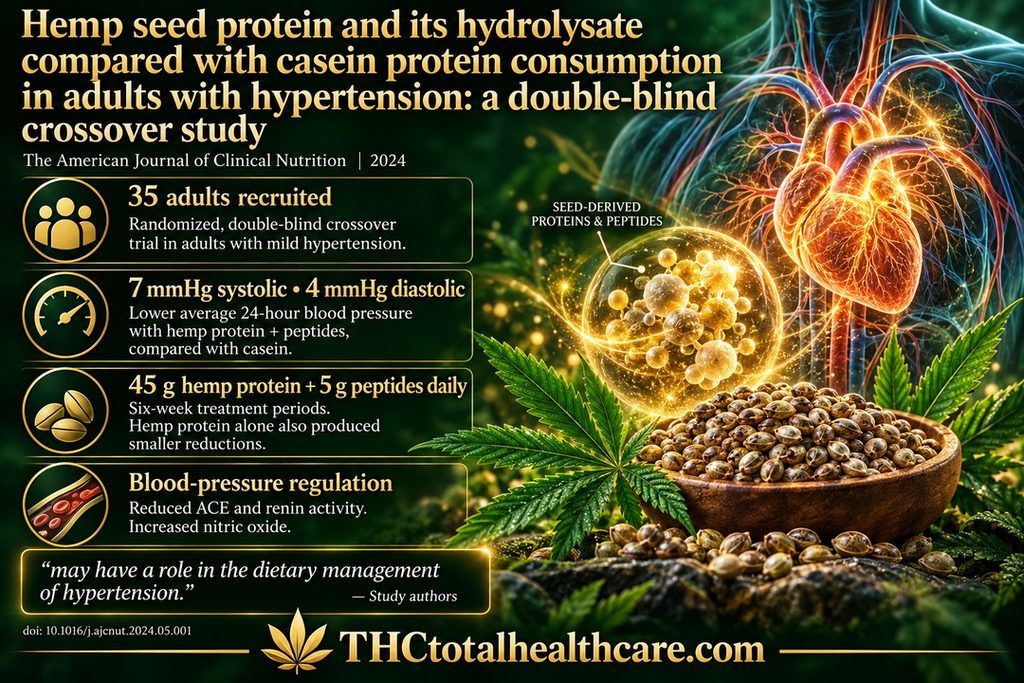
Hemp seed protein lowered blood pressure in adults with mild hypertension, with stronger effects when combined with seed-derived bioactive peptides. In this randomized, double-blind crossover trial, researchers recruited 35 adults to compare hemp protein, hemp protein plus peptides, and casein protein over six-week treatment periods.
Compared with casein, the hemp protein-plus-peptide preparation lowered average 24-hour systolic blood pressure by approximately 7 mmHg and diastolic pressure by 4 mmHg. Hemp protein alone produced smaller reductions. Both hemp preparations reduced the activity of ACE and renin—enzymes involved in raising blood pressure—and increased nitric oxide, which helps blood vessels relax.
These findings provide human clinical evidence that hemp seed proteins and their bioactive peptides could support dietary management of hypertension. The study highlights therapeutic value beyond the seed’s oil, identifying its proteins as a source of compounds that influence blood-pressure regulation.
“Background
The effects of consuming hemp seed protein (HSP) as well as its hydrolysate-derived bioactive peptide (HSP+) on blood pressure (BP) has not, to our knowledge, been investigated in humans.
Objectives
We aimed to investigate how consumption of HSP and its hydrolysate modulates 24-h systolic (SBP) and diastolic BP (DBP) and plasma biomarkers of BP compared with casein.
Methods
In a double-blind, randomized, crossover design trial, 35 adults who had mild hypertension with SBP between 130 and 160 mmHg and DBP ≤110 mmHg were recruited. Participants were randomly assigned to varying sequences of 3 6-wk treatments, 50 g casein/d, 50 g HSP/d, or 45 g HSP plus 5 g HSP-derived bioactive peptides/d (HSP+), separated by a 2-wk washout period. Treatment effects were assessed with a linear mixed model with repeated measures.
Results
Compared with casein, after HSP+ consumption, 24-h SBP and 24-h DBP decreased from 135.1 and 80.0 mmHg to 128.1 ± 1.6 (P < 0.0001) and 76.0 ± 1.4 mmHg (P < 0.0001), respectively, whereas these values were 133.5 ± 1.6 and 78.9 ± 1.4 mmHg after HSP consumption (P < 0.0001). There were no differences between the HSP and HSP+ consumption in plasma angiotensin-converting enzyme (ACE) activity, renin, or nitric oxide (NO) concentrations. However, these 2 treatments were able to lower both ACE and renin activities and raise NO concentration in plasma compared with casein.
Conclusions
These results suggest that hemp protein consumption, as well as in combination with bioactive peptides, may have a role in the dietary management of hypertension.”