Δ 9 -Tetrahydrocannabinol promotes functional remyelination in the mouse brain

Myelin is the protective coating that surrounds nerve fibers and helps electrical signals move efficiently through the brain and spinal cord. Damage to myelin is a major feature of neurological disorders involving demyelination, making the repair of this protective layer an important therapeutic target.

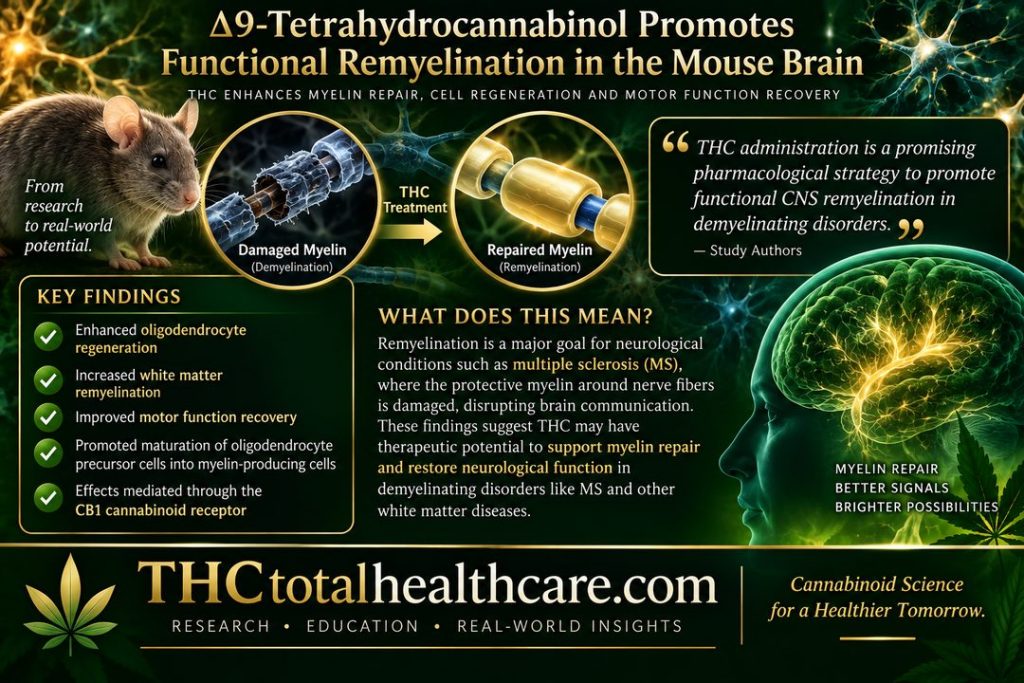
In this mouse study, Δ9-THC promoted the regeneration of oligodendrocytes, the cells responsible for producing myelin, and enhanced remyelination in damaged white matter. THC treatment was also associated with improved recovery of motor function.

The researchers found that these effects involved activation of the CB1 cannabinoid receptor and the maturation of oligodendrocyte precursor cells into myelin-producing cells. The findings suggest that THC may have potential as a compound capable of supporting functional repair after myelin damage.

“Background and purpose: Research on demyelinating disorders aims to find novel molecules that are able to induce oligodendrocyte precursor cell differentiation to promote central nervous system remyelination and functional recovery. Δ9 -Tetrahydrocannabinol (THC), the most prominent active constituent of the hemp plant Cannabis sativa, confers neuroprotection in animal models of demyelination. However, the possible effect of THC on myelin repair has never been studied.

Experimental approach: By using oligodendroglia-specific reporter mouse lines in combination with two models of toxin-induced demyelination, we analysed the effect of THC on the processes of oligodendrocyte regeneration and functional remyelination.

Key results: We show that THC administration enhanced oligodendrocyte regeneration, white matter remyelination and motor function recovery. THC also promoted axonal remyelination in organotypic cerebellar cultures. THC remyelinating action relied on the induction of oligodendrocyte precursor differentiation upon cell cycle exit and via CB1 cannabinoid receptor activation.

Conclusions and implications: Overall, our study identifies THC administration as a promising pharmacological strategy aimed to promote functional CNS remyelination in demyelinating disorders.”

https://pubmed.ncbi.nlm.nih.gov/34216154/

“THC administration following cuprizone-induced demyelination enhanced oligodendrocyte regeneration, white matter remyelination and motor function recovery.”

“THC administration is a promising pharmacological strategy to promote functional CNS remyelination in demyelinating disorders.”

“Our study provides a novel therapeutic advantage of THC-based interventions in multiple sclerosis by promoting remyelination and functional recovery. New clinical trials with improved designs on cannabinoids in people with multiple sclerosis are needed now, considering these compounds as potential remyelinating/disease-modifying drugs to try to overcome previous failures. Our work also suggests that at least part of the neuroprotective action of phytocannabinoids in multiple sclerosis animal models and potentially in patients as well may be due to an enhanced CNS remyelination. Finally, this study also identifies THC as a potent inductor of oligodendrocyte progenitor cell differentiation under demyelination in mice, opening the possibility for this molecule to become a candidate drug to promote oligodendrocyte regeneration and remyelination in the treatment of demyelinating disorders.”

https://bpspubs.onlinelibrary.wiley.com/doi/10.1111/bph.15608

Need this THC study explained? thcXplained.com

Erythrocyte membrane Fatty acids in multiple sclerosis patients and hot-nature dietary intervention with co-supplemented hemp-seed and evening-primrose oils.

“The risk of developing multiple sclerosis (MS) is associated with increased dietary intake of saturated fatty acids. For many years it has been suspected that this disease might be associated with an imbalance between unsaturated and saturated fatty acids.

We determined erythrocyte membrane fatty acids levels in Hot nature dietary intervention with co-supplemented hemp seed and evening primrose oils in multiple sclerosis patients…

We concluded that Hot-nature dietary intervention with co-supplemented hemp seed and evening primrose oils caused an increase PUFAs in MS patients and improvement in the erythrocyte membrane fatty acids composition. This could be an indication of restored plasma stores, and a reflection of disease severity reduction.”

http://www.ncbi.nlm.nih.gov/pubmed/24311880

Chemicals in Marijuana Could Help Treat MS

TAU researchers have found that chemicals in marijuana could help treat multiple sclerosis. (Source: AFTAU)

“TAU researchers have found that chemicals in marijuana could help treat multiple sclerosis.

Multiple sclerosis is an inflammatory disease in which the immune system attacks the nervous system. The result can be a wide range of debilitating motor, physical, and mental problems. No one knows why people get the disease or how to treat it. 

In a new study published in the Journal of Neuroimmune Pharmacology, Drs. Ewa Kozela, Ana Juknat, Neta Rimmerman and Zvi Vogel of Tel Aviv University’s Dr. Miriam and Sheldon G. Adelson Center for the Biology of Addictive Diseases and Sackler Faculty of Medicine demonstrate that some chemical compounds found in marijuana can help treat MS-like diseases in mice by preventing inflammation in the brain and spinal cord…”


“Cannabinoids Decrease the Th17 Inflammatory Autoimmune Phenotype” http://link.springer.com/article/10.1007/s11481-013-9493-1 

Sending Multiple Sclerosis Up in Smoke

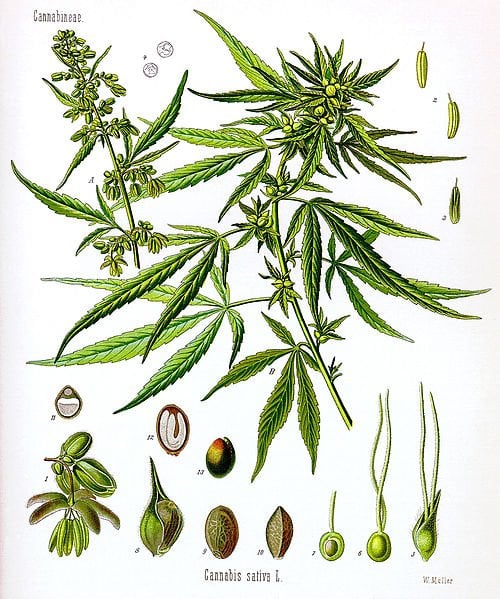
The illustration is of the cannabis sativa plant.

 “TAU researchers find chemicals in marijuana could help treat MS.

Multiple sclerosis is an inflammatory disease in which the immune system attacks the nervous system. The result can be a wide range of debilitating motor, physical, and mental problems. No one knows why people get the disease or how to treat it.

In a new study published in the Journal of Neuroimmune Pharmacology, Drs. Ewa Kozela, Ana Juknat, Neta Rimmerman and Zvi Vogel of Tel Aviv University’s Dr. Miriam and Sheldon G. Adelson Center for the Biology of Addictive Diseases and Sackler Faculty of Medicine demonstrate that some chemical compounds found in marijuana can help treat MS-like diseases in mice by preventing inflammation in the brain and spinal cord.

“Inflammation is part of the body’s natural immune response, but in cases like MS it gets out of hand,” says Kozela. “Our study looks at how compounds isolated from marijuana can be used to regulate inflammation to protect the nervous system and its functions.” Researchers from the Weizmann Institute of Science co-authored the study…”

More: http://neurosciencenews.com/neurology-thc-cbd-multiple-sclerosis-482/

 “Sending Multiple Sclerosis Up in Smoke” http://www.sciencedaily.com/releases/2013/10/131007132253.htm

“Cannabinoids Decrease the Th17 Inflammatory Autoimmune Phenotype” http://link.springer.com/article/10.1007/s11481-013-9493-1

Researchers find chemicals in marijuana could help treat MS

Researchers find chemicals in marijuana could help treat MS

“In a new study published in the Journal of Neuroimmune Pharmacology, Drs. Ewa Kozela, Ana Juknat, Neta Rimmerman and Zvi Vogel of Tel Aviv University’s Dr. Miriam and Sheldon G. Adelson Center for the Biology of Addictive Diseases and Sackler Faculty of Medicine demonstrate that some chemical compounds found in marijuana can help treat MS-like diseases in mice by preventing inflammation in the brain and spinal cord.

“Inflammation is part of the body’s natural immune response, but in cases like MS it gets out of hand,” says Kozela. “Our study looks at how compounds isolated from marijuana can be used to regulate inflammation to protect the nervous system and its functions.” Researchers from the Weizmann Institute of Science co-authored the study.”

More: http://medicalxpress.com/news/2013-10-chemicals-marijuana-ms.html

“Cannabinoids Decrease the Th17 Inflammatory Autoimmune Phenotype” http://link.springer.com/article/10.1007/s11481-013-9493-1

Tel Aviv University researchers find chemicals in marijuana could help treat MS

“Multiple sclerosis is an inflammatory disease in which the immune system attacks the nervous system. The result can be a wide range of debilitating motor, physical, and mental problems. No one knows why people get the disease or how to treat it.

In a new study published in the Journal of Neuroimmune Pharmacology, Drs. Ewa Kozela, Ana Juknat, Neta Rimmerman and Zvi Vogel of Tel Aviv University’s Dr. Miriam and Sheldon G. Adelson Center for the Biology of Addictive Diseases and Sackler Faculty of Medicine demonstrate that some chemical compounds found in marijuana can help treat MS-like diseases in mice by preventing inflammation in the brain and spinal cord…”

More: http://www.news-medical.net/news/20131008/Tel-Aviv-University-researchers-find-chemicals-in-marijuana-could-help-treat-MS.aspx

“Cannabinoids Decrease the Th17 Inflammatory Autoimmune Phenotype” http://link.springer.com/article/10.1007/s11481-013-9493-1

Clinical experiences with cannabinoids in spasticity management in multiple sclerosis.

“Spasticity is a common symptom among patients with multiple sclerosis (MS). This study aims to assess the effectiveness and safety of the combination of delta-9-tetrahydrocannabinol (THC) and cannabidiol (CBD) in clinical practice for the treatment of spasticity in MS…

Retrospective observational study with patients treated with inhaled THC/CBD…

 THC/CBD was effective in 80% of patients…

CONCLUSIONS:

THC/CBD appears to be a good alternative to standard treatment as it improves refractory spasticity in MS and has an acceptable toxicity profile.”

http://www.ncbi.nlm.nih.gov/pubmed/24035293

Therapeutic Potential of a Novel Cannabinoid Agent CB52 in the Mouse Model ofExperimental Autoimmune Encephalomyelitis.

“The endocannabinoid system has recently emerged as a promising therapeutic target for MS. The protective mechanisms of cannabinoids are thought to be mediated by activation of cannabinoid receptor 1 (CB1) and 2 (CB2)…

activation of CB1 receptors contributes significantly to the anti-inflammatory and neuroprotective effects of cannabinoids on MS.”

http://www.ncbi.nlm.nih.gov/pubmed/24036373

Treatment of spasticity in multiple sclerosis: new perspectives regarding the use of cannabinoids.

“Spasticity remains a prevalent symptom in multiple sclerosis, with a significant associated disability and quality of life impairment… Cannabinoids provide a new way for therapy.

A delta-9-tetrahydrocannabinol plus cannabidiol (1:1) association, administered through an oromucosal route, has been approved in several countries including Spain; it causes a specific effect on CB(1) and CB(2) receptors, with traditional psychotropic cannabis actions being minimized.

Randomized, placebo-controlled trials, as well as longer-term open-label extensions, have shown a clear-cut efficacy to reduce spasticity and their associated symptoms in those patients refractory to other therapies, with a good tolerability/safety profile.

No tolerance, abuse or addictive issues have been found…”

http://www.ncbi.nlm.nih.gov/pubmed/23011861

Does the cannabinoid dronabinol reduce central pain in multiple sclerosis? Randomised double blind placebo controlled crossover trial.

“Clinical reports indicate that cannabinoids may alleviate pain in different pain conditions, including multiple sclerosis related pain…

Randomised double blind placebo controlled crossover trial… To evaluate the effect of the oral synthetic delta-9-tetrahydrocannabinol dronabinol on central neuropathic pain in patients with multiple sclerosis…

CONCLUSIONS:

Dronabinol has a modest but clinically relevant analgesic effect on central pain in patients with multiple sclerosis. Adverse events, including dizziness, were more frequent with dronabinol than with placebo during the first week of treatment.”

http://www.ncbi.nlm.nih.gov/pmc/articles/PMC498019/