
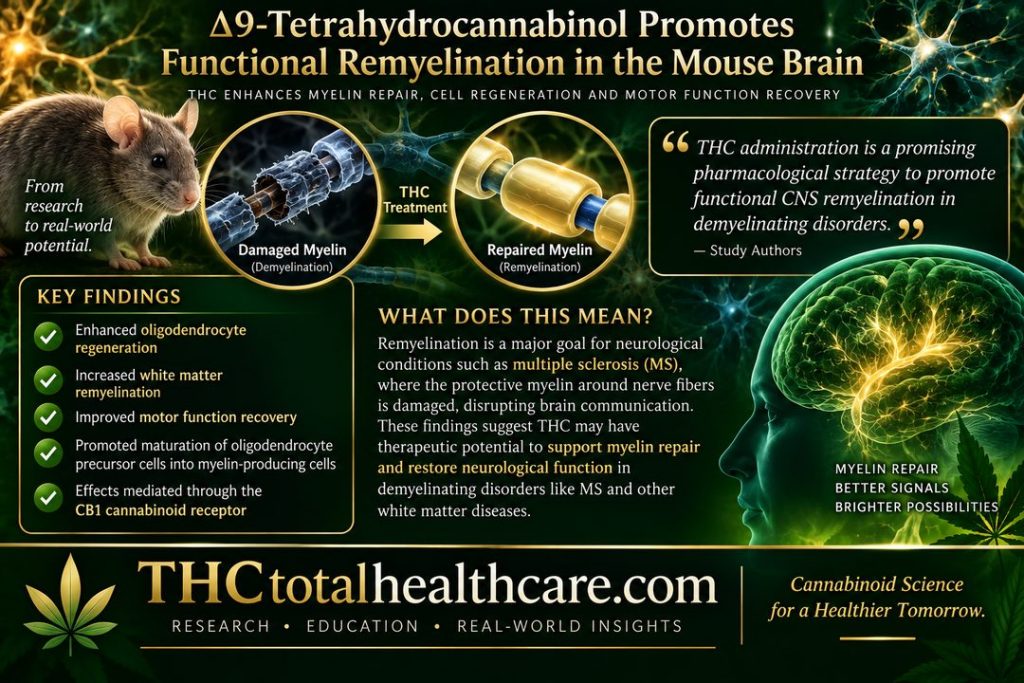
Δ 9 -Tetrahydrocannabinol promotes functional remyelination in the mouse brain

Myelin is the protective coating that surrounds nerve fibers and helps electrical signals move efficiently through the brain and spinal cord. Damage to myelin is a major feature of neurological disorders involving demyelination, making the repair of this protective layer an important therapeutic target.

In this mouse study, Δ9-THC promoted the regeneration of oligodendrocytes, the cells responsible for producing myelin, and enhanced remyelination in damaged white matter. THC treatment was also associated with improved recovery of motor function.

The researchers found that these effects involved activation of the CB1 cannabinoid receptor and the maturation of oligodendrocyte precursor cells into myelin-producing cells. The findings suggest that THC may have potential as a compound capable of supporting functional repair after myelin damage.

“Background and purpose: Research on demyelinating disorders aims to find novel molecules that are able to induce oligodendrocyte precursor cell differentiation to promote central nervous system remyelination and functional recovery. Δ9 -Tetrahydrocannabinol (THC), the most prominent active constituent of the hemp plant Cannabis sativa, confers neuroprotection in animal models of demyelination. However, the possible effect of THC on myelin repair has never been studied.

Experimental approach: By using oligodendroglia-specific reporter mouse lines in combination with two models of toxin-induced demyelination, we analysed the effect of THC on the processes of oligodendrocyte regeneration and functional remyelination.

Key results: We show that THC administration enhanced oligodendrocyte regeneration, white matter remyelination and motor function recovery. THC also promoted axonal remyelination in organotypic cerebellar cultures. THC remyelinating action relied on the induction of oligodendrocyte precursor differentiation upon cell cycle exit and via CB1 cannabinoid receptor activation.

Conclusions and implications: Overall, our study identifies THC administration as a promising pharmacological strategy aimed to promote functional CNS remyelination in demyelinating disorders.”

https://pubmed.ncbi.nlm.nih.gov/34216154/

“THC administration following cuprizone-induced demyelination enhanced oligodendrocyte regeneration, white matter remyelination and motor function recovery.”

“THC administration is a promising pharmacological strategy to promote functional CNS remyelination in demyelinating disorders.”

“Our study provides a novel therapeutic advantage of THC-based interventions in multiple sclerosis by promoting remyelination and functional recovery. New clinical trials with improved designs on cannabinoids in people with multiple sclerosis are needed now, considering these compounds as potential remyelinating/disease-modifying drugs to try to overcome previous failures. Our work also suggests that at least part of the neuroprotective action of phytocannabinoids in multiple sclerosis animal models and potentially in patients as well may be due to an enhanced CNS remyelination. Finally, this study also identifies THC as a potent inductor of oligodendrocyte progenitor cell differentiation under demyelination in mice, opening the possibility for this molecule to become a candidate drug to promote oligodendrocyte regeneration and remyelination in the treatment of demyelinating disorders.”

https://bpspubs.onlinelibrary.wiley.com/doi/10.1111/bph.15608

Need this THC study explained? thcXplained.com

Medicinal marijuana use: experiences of people with multiple sclerosis.

 “OBJECTIVE: To describe medical marijuana use from the perspectives of patients with multiple sclerosis.

If evidence of benefit is seen, medicinal marijuana should be made available to patients who could benefit from it…

Conclusion:

Participants reported that marijuana was effective in helping them to manage symptoms of MS.”

http://www.ncbi.nlm.nih.gov/pmc/articles/PMC1479734/

[Cannabinoids for symptomatic therapy of multiple sclerosis].

“Spasticity represents a common troublesome symptom in patients with multiple sclerosis (MS). Treatment of spasticity remains difficult, which has prompted some patients to self-medicate with and perceive benefits from cannabis. Advances in the understanding of cannabinoid biology support these anecdotal observations.

Various clinical reports as well as randomized, double-blind, placebo-controlled studies have now demonstrated clinical efficacy of cannabinoids for the treatment of spasticity in MS patients. Sativex is a 1:1 mix of delta-9-tetrahydocannabinol and cannabidiol extracted from cloned Cannabis sativa chemovars, which recently received a label for treating MS-related spasticity in Germany.

The present article reviews the current understanding of cannabinoid biology and the value of cannabinoids as a symptomatic treatment option in MS.”

http://www.ncbi.nlm.nih.gov/pubmed/22080198

Symptomatic therapy in multiple sclerosis: the role of cannabinoids in treating spasticity

“Anecdotal evidence suggests a beneficial effect of cannabis on spasticity as well as pain. Recently, randomized, double-blind, placebo-controlled studies have confirmed the clinical efficacy of cannabinoids for the treatment of spasticity in patients with MS. Based on these data, nabiximols (Sativex), a 1:1 mix of Δ-9-tetrahydrocannabinol and cannabidiol extracted from cloned Cannabis sativa chemovars, received approval for treating MS-related spasticity in various countries around the globe. In this article we review the current understanding of cannabinoid biology and the value of cannabinoids as a symptomatic treatment option addressing spasticity in patients with MS.

Based on individual case reports, the consumption of plant parts, specifically, the resin of the Cannabis sativa hemp plant, has, for years, been attributed to the capacity to reduce the symptoms of multiple sclerosis (MS), such as spasticity, neuropathic pain, tremor, and disturbed bladder function. As characterization of the endocannabinoid system and its role in the motor system and pain processing continue to advance, there is increasing evidence of a scientific basis for the postulated therapeutic effect of cannabis derivatives.

The oromucosal administration of THC and CBD in a 1:1 ratio has proven to be a well tolerated therapeutic option for treating spasticity in patients with MS who respond poorly to conventional antispastic drugs. Assessment of the efficacy is limited by the fact that spasticity as a symptom is very difficult to measure reliably, objectively, and validly. Current study data support the position that the beneficial effects of nabiximols on subjective and objective endpoints in a selected patient sample outweigh the adverse pharmaceutical effects. The effects of long-term nabiximols treatment on neuropsychological processes and the structure of the endocannabinoid system need to be further characterized.”

Full text: http://www.ncbi.nlm.nih.gov/pmc/articles/PMC3437528/

Sativex® in multiple sclerosis spasticity: a cost-effectiveness model.

“Multiple sclerosis (MS) is a chronic, progressive disease that carries a high socioeconomic burden. Spasticity (rigidity and spasms) is common in MS and a key contributor to MS-related disability.

This study evaluated the cost-effectiveness of Sativex®, a 9-d-tetrahydrocannabinol/cannabidiol-based oromucosal spray that acts as an endocannabinoid system modulator. Sativex was recently approved for the management of resistant MS spasticity as add-on medication.

CONCLUSION:

Despite having a relatively high acquisition cost, Sativex was shown to be a cost-effective treatment option for patients with MS-related spasticity.”

http://www.ncbi.nlm.nih.gov/pubmed/22681512

A new multiple sclerosis spasticity treatment option: effect in everyday clinical practice and cost-effectiveness in Germany.

“Sativex(®) (GW Pharmaceuticals PLC, Porton Down, UK; Laboratorios Almirall, SA, Barcelona, Spain), a cannabinoid oromucosal spray containing a 1:1 ratio of 9-δ-tetrahydrocannabinol and cannabidiol, has been licensed in Germany since July 2011 as add-on therapy for moderate-to-severe multiple sclerosis (MS) treatment-resistant spasticity symptoms.

The ‘MOVE 2′ study evaluated clinical outcomes, treatment satisfaction, quality of life (QoL) and provision of care in MS patients with spasticity receiving Sativex in everyday clinical practice. Data from 300 patients were collected from 42 specialized MS centers across Germany and were available for this analysis. Assessments, including the MS spasticity 0-10 numerical rating scale, modified Ashworth scale, patients’ and physicians’ clinical impressions, and QoL scales were rated at baseline and at 1 and 3 months after starting treatment with Sativex.

 Sativex provided relief of MS-related spasticity in the majority of patients who were previously resistant to treatment. In addition, clear improvements were noted in MS spasticity-associated symptoms (e.g., sleep quality, bladder function and mobility), activities of daily living and QoL. Sativex was generally well tolerated. The majority of patients (84%) reported no adverse events, and there was only a limited risk of serious adverse reactions.

Furthermore, based on data from Sativex clinical trials, a Markov model-based analysis has shown that Sativex is a cost-effective treatment option for patients with MS spasticity in Germany.”

http://www.ncbi.nlm.nih.gov/pubmed/23369055

Cannabinoids and neurodegenerative diseases.

“Although significant advances have taken place in recent years on our understanding of the molecular mechanisms of different neurodegenerative diseases, its translation into effective therapeutic treatments has not been as successful as could be expected. There is still a dramatic lack of curative treatments for the most frequent disorders and only symptomatic relief for many others. Under this perspective, the search for novel therapeutic approaches is demanding and significant attention and efforts have been directed to studying additional neurotransmission systems including the endocannabinoid system (ECS).

The neuroprotective properties of exogenous as well as endogenous cannabinoids have been known for years and the underlying molecular mechanisms have been recently unveiled. As discussed later, antioxidative, antiglutamatergic and antiinflammatory effects are now recognized as derived from cannabinoid action and are known to be of common interest for many neurodegenerative processes.

 Thus, these characteristics make cannabinoids attractive candidates for the development of novel therapeutic strategies.

 The present review will focus on the existing data regarding the possible usefulness of cannabinoid agents for the treatment of relevant neurological pathologies for our society such as Alzheimer’s disease, multiple sclerosis, Huntington’s disease and amyotrophic lateral sclerosis.”

http://www.ncbi.nlm.nih.gov/pubmed/19839933

The endocannabinoid system in the inflammatory and neurodegenerative processes of multiple sclerosis and of amyotrophic lateral sclerosis.

Abstract

“Multiple sclerosis (MS) and amyotrophic lateral sclerosis (ALS) are chronic diseases of the central nervous system (CNS), featured by a complex interplay between inflammation and neurodegeneration. Increasing evidence supports the involvement of the endocannabinoid system (ECS) in both inflammatory and neurodegenerative processes typical of these pathological conditions. Exogenous or endogenous cannabinoids regulate the function of immune system by limiting immune response. On the other hand, by preventing excitotoxic damage, cannabinoids protect neuronal integrity and function. Of note, the ECS not only plays a role as modulator of disease processes, but it can also be disrupted by the same diseases. Agents modulating cannabinoid receptors or endocannabinoid tone provide promising therapeutic opportunities in the treatment of inflammatory neurodegenerative disorders of the CNS.”

http://www.ncbi.nlm.nih.gov/pubmed/20353778

The (endo)cannabinoid system in multiple sclerosis and amyotrophic lateral sclerosis.

“Alterations of the endocannabinoid system (ECS) have been recently implicated in a number of neuroinflammatory and neurodegenerative conditions so that the pharmacological modulation of cannabinoid (CB) receptors and/or of the enzymes controlling synthesis, transport, and degradation of these substances has emerged as a valuable option to treat neurological diseases.

Here, we describe the current knowledge concerning the rearrangement of ECS in a primarily inflammatory disorder of the central nervous system such as multiple sclerosis (MS), and in a primarily degenerative condition such as amyotrophic lateral sclerosis (ALS).

 Furthermore, the data supporting a therapeutic role of agents modulating CB receptors or endocannabinoid tone in these disorders will also be reviewed. Complex changes of ECS take place in both diseases, influencing crucial aspects of their pathophysiology and clinical manifestations. Neuroinflammation, microglial activation, oxidative stress, and excitotoxicity are variably combined in MS and in ALS and can be modulated by endocannabinoids or by drugs targeting the ECS.”

http://www.ncbi.nlm.nih.gov/pubmed/17678961

Medical Marijuana For Multiple Sclerosis and Amyotrophic Lateral Sclerosis

“Marijuana has been classified as a Schedule 1 narcotic since the 1960’s, which means it is deemed by the federal government to have no medicinal value and heavy risk. However, there is an increasing body of research to show that marijuana can be helpful for certain debilitating conditions and 15 states have now legalized it for medicinal usage. One of those conditions research is showing marijuana’s medicinal value is multiple sclerosis (MS) and another is Amyotrophic Lateral Sclerosis (ALS). They are both diseases involving neurologic deterioration.

Approximately 200 individuals per week are diagnosed with MS, with the usual onset between 20 and 40 years of age. The disease has no known cure and involves a neuro-degeneration in which the brain and spinal cord nerves undergo a gradual destruction of its protective tissue called myelin.

Myelin covers these regions in what’s called a Myelin sheath, and as the sheath degenerates symptoms include painful muscle spasms, numbness, impaired vision, loss of coordination, tremors, weakness, and imbalance (ataxia). The disease is progressive and can become incapacitating and lead to death.

MS patients may find that marijuana relieves symptoms of spasticity, tremors, imbalance, depression, and fatigue. Numerous studies have looked at Sativex, which is an oral cannabis spray developed in the UK. It has been shown to relieve pain, spasticity, depression, fatigue, and incontinence.

THC appears to have some immunosuppressive or immunomodulatory effects. This may be beneficial to MS patients. Long term studies need to be completed to see if this is for real and a disease modifying effect is real.

Lou Gehrig’s disease, also called Amyotrophic Lateral Sclerosis, involves the ongoing loss of the brain’s motor neurons. It is rapidly progressive, and usually fatal. There is no known cause. The usual age of onset is 40 to 60 years, and men are more commonly affected.

The most well known person with ALS is Stephen Hawking, a physicist who has lived for over 40 years after being diagnosed. He is the exception, the unfortunate usual prognosis is grim, with about half of patients dying with 2.5 years of onset.

The cannabinoids in medical marijuana may protect against glutamate toxicity. This may be very helpful because ALS involves excessive glutamate in the brain tissue, spinal fluid, and serum of those suffering.

By lowering the chance of glutamate toxicity, there is a chance that marijuana may have a neuroprotective effect. In addition, patients describe alleviation of pain and spasms, improvement of appetite, and less drooling issues which is a common problem with ALS.”

By David L. Greene