
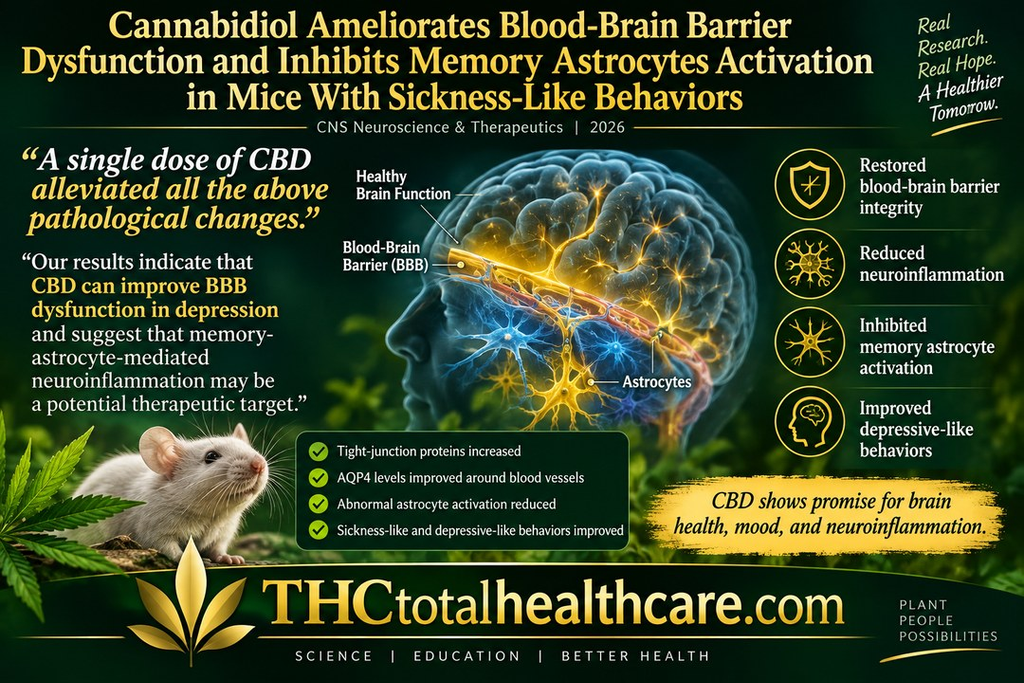
A new 2026 study published in CNS Neuroscience & Therapeutics found that cannabidiol (CBD) improved blood-brain barrier dysfunction, reduced neuroinflammation, and alleviated depressive-like behaviors in mice. The researchers found that sickness-like mice showed weakened blood-brain barrier integrity, reduced protective tight-junction proteins, abnormal astrocyte activation, and increased inflammation in the brain.
A single dose of CBD improved these changes, restoring important blood-brain barrier markers while reducing abnormal astrocyte activity and neuroinflammation. The researchers also identified a particularly interesting target called “memory astrocytes”—astrocytes that can respond more rapidly and strongly when exposed to a second inflammatory challenge.
The study found that CBD inhibited this memory-astrocyte-associated secondary inflammatory response, helping protect the blood-brain barrier and improve behavior. The researchers concluded that CBD may improve blood-brain barrier dysfunction associated with depression and identified memory-astrocyte-mediated neuroinflammation as a potential therapeutic target.
“Background: Blood-brain barrier (BBB) dysfunction has been increasingly implicated in the pathophysiology of depression; however, effective therapeutic strategies targeting this pathology remain limited. This study aimed to investigate the effect of cannabidiol (CBD) on improving depressive-like behaviors and BBB impairment, as well as its underlying mechanism.
Methods: Depressive-like behaviors in mice were assessed via exploratory and despair-like tests. BBB integrity was evaluated by examining tight junction protein expression in endothelial cells and AQP4 reduction from the perivascular membrane. Astrocyte activation and neuroinflammation were also measured. The therapeutic effects of a single CBD dose were examined.
Results: Mice with depressive-like phenotypes showed reduced exploratory behavior and increased despair-like behavior. In the BBB, the expression of tight junction proteins in endothelial cells was downregulated; in astrocytes, decreased AQP4 expression was observed, abnormal activation was enhanced, and neuroinflammation was elevated. A single dose of CBD alleviated all the above pathological changes. Further studies demonstrated that CBD exerted its effects by inhibiting memory astrocyte-associated secondary neuroinflammation, thereby alleviating depressive-like behaviors in mice with depressive-like phenotypes.
Conclusion: Experimental results show that CBD treatment can improve BBB dysfunction in depression and further indicates that targeted inhibition of memory astrocytes-mediated neuroinflammation may promote the treatment of depression.”
https://pubmed.ncbi.nlm.nih.gov/42747207
“Cannabidiol (CBD), a natural extract from cannabis, possesses multiple biological functions including cardioprotection, anti-inflammation, anti-cancer, anti-oxidation, and neuroprotection. Additionally, it plays indispensable roles in relieving depression and regulating BBB function]. CBD ameliorates depression by upregulating brain-derived neurotrophic factor, inhibiting neuroinflammation, alleviating oxidative stress, and modulating neurotransmitter transmission.”