
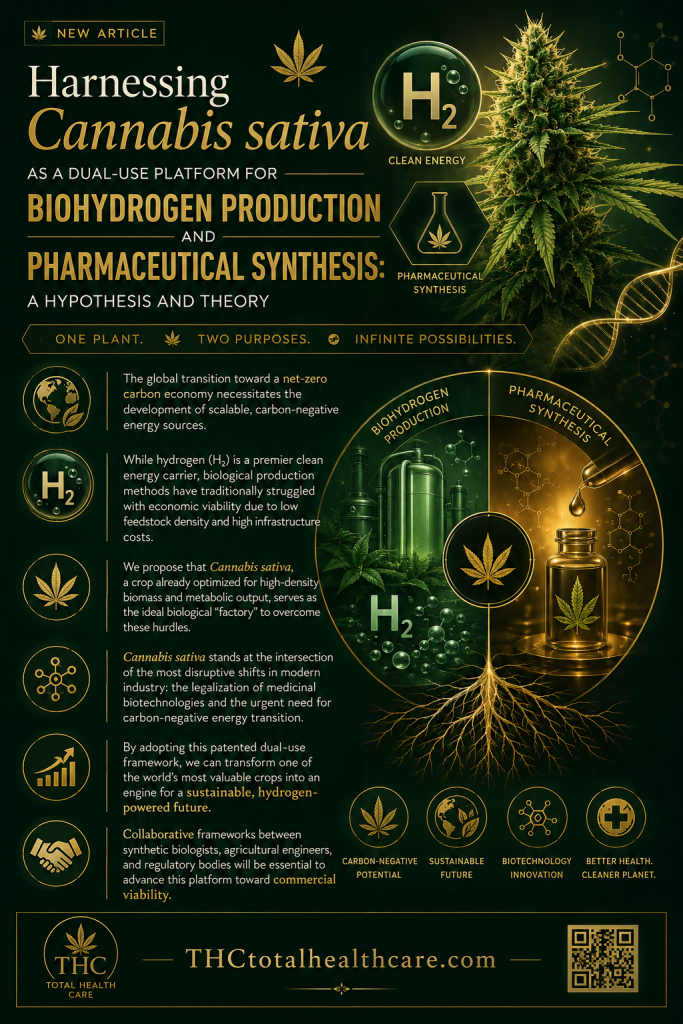
Cannabis sativa may have value not only as a medicinal and industrial crop, but also as a platform for renewable energy production. This hypothesis proposes engineering cannabis photosynthesis to generate biohydrogen while preserving the plant’s ability to produce valuable pharmaceutical compounds. By combining hydrogen production with an already established high-value crop and existing controlled-environment agriculture infrastructure, the model could reduce some of the economic barriers that have slowed biohydrogen development. The concept presents cannabis as a possible dual-use biorefinery capable of producing both medicine and clean energy from the same cultivation system.
“Cannabis sativa, long established as a cornerstone of the pharmaceutical and industrial fiber markets, represents a radical and underexplored platform for renewable energy innovation.
In this Hypothesis and Theory framework, we introduce a novel, patented (Provisional Patent No. 63916615) dual-use bio-refinery paradigm. This model harnesses engineered cannabis photosynthesis to drive green hydrogen production without compromising its established value as a high-yield medicinal crop.
By strategically redirecting photosynthetic electron flow toward oxygen-protected hydrogenase activity, it is possible to generate molecular hydrogen at commercially relevant scales while maintaining plant viability.
Unique to this model is the ability to leverage over $10 billion in existing controlled-environment agriculture (CEA) infrastructure, bypassing the capital-intensive barriers that have hindered traditional algal biohydrogen systems. We outline a tripartite circular economy strategy that integrates hydrogen capture during the vegetative phase with the subsequent harvest of therapeutic cannabinoids and industrial biomass.
This convergence of synthetic biology, clean energy, and biomedicine positions cannabis as a uniquely versatile multipurpose crop capable of fueling both the pharmaceutical industry and the global transition to a sustainable hydrogen economy.”
https://pubmed.ncbi.nlm.nih.gov/42245109
“The global transition toward a net-zero carbon economy necessitates the development of scalable, carbon-negative energy sources. While hydrogen (H2) is a premier clean energy carrier, biological production methods have traditionally struggled with economic viability due to low feedstock density and high infrastructure costs. We propose that Cannabis sativa, a crop already optimized for high-density biomass and metabolic output, serves as the ideal biological “factory” to overcome these hurdles.”
“Cannabis sativa stands at the intersection of the most disruptive shifts in modern industry: the legalization of medicinal biotechnologies and the urgent need for carbon-negative energy transition.
By adopting this patented dual-use framework, we can transform one of the world’s most valuable crops into an engine for a sustainable, hydrogen-powered future.”
“Collaborative frameworks between synthetic biologists, agricultural engineers, and regulatory bodies will be essential to advance this platform toward commercial viability.”
https://www.frontiersin.org/journals/plant-science/articles/10.3389/fpls.2026.1833491/full