
As cannabinoid-based medicines become more widely used, clinicians need better tools for determining whether patients are receiving therapeutic rather than excessive or ineffective doses. This review examines therapeutic drug monitoring for THC across medical cannabis, nabiximols, dronabinol, and nabilone and proposes reference ranges that can help interpret blood concentrations in clinical practice. By linking cannabinoid levels with dosing and treatment context, the work provides a foundation for more precise, individualized use of THC-based medicines and could improve both effectiveness and safety in medical cannabis therapy.
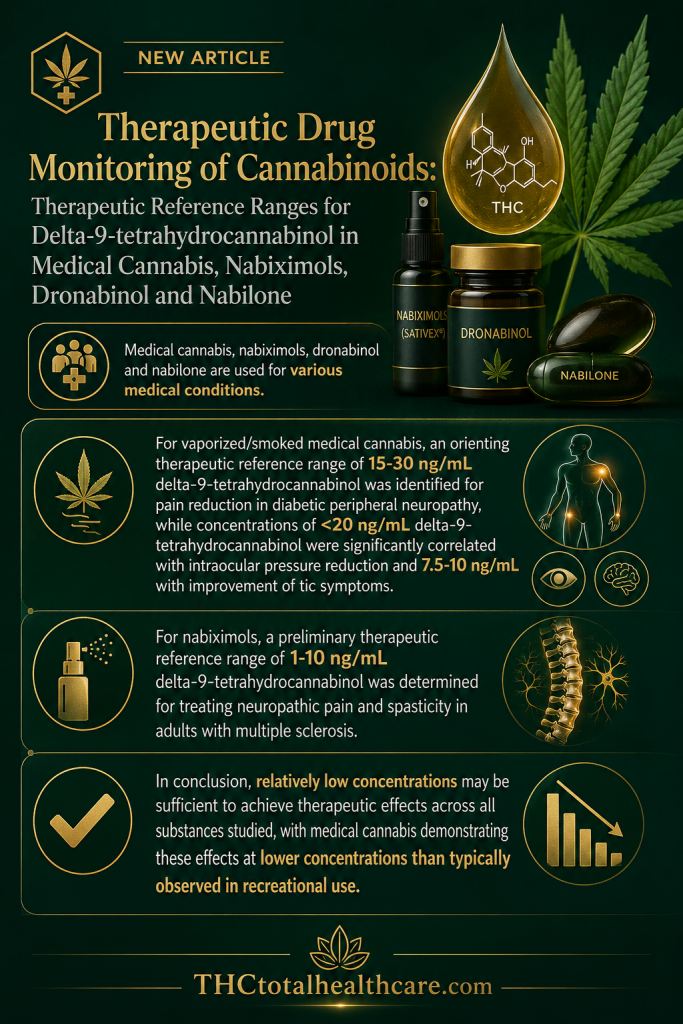
“Medical cannabis, nabiximols, dronabinol and nabilone are used for various medical conditions.
Despite their pronounced pharmacokinetic variability and complex concentration-effect relationships, therapeutic drug monitoring recommendations are lacking. We aimed to identify therapeutic reference ranges based on blood concentration-clinical effect relationships. Studies reporting blood concentrations and clinical effects/adverse effects or assessing cannabinoid receptors 1 and 2 occupancy were selected through a systematic literature search in the MEDLINE database via PubMed. Twenty-three articles were selected for vaporized/smoked medical cannabis, three for nabiximols, nine for dronabinol and one for nabilone. No article was identified for delta-9-tetrahydrocannabinol-dominant cannabis extracts.
For vaporized/smoked medical cannabis, an orienting therapeutic reference range of 15-30 ng/mL delta-9-tetrahydrocannabinol was identified for pain reduction in diabetic peripheral neuropathy, while concentrations of <20 ng/mL delta-9-tetrahydrocannabinol were significantly correlated with intraocular pressure reduction and 7.5-10 ng/mL with improvement of tic symptoms. Half-maximum effective concentrations of 7-29 ng/mL delta-9-tetrahydrocannabinol were reported for “high” effects.
For nabiximols, a preliminary therapeutic reference range of 1-10 ng/mL delta-9-tetrahydrocannabinol was determined for treating neuropathic pain and spasticity in adults with multiple sclerosis. For chemotherapy-induced nausea and vomiting, a preliminary therapeutic reference range of 1-5 ng/mL for nabilone and 5-15 ng/mL delta-9-tetrahydrocannabinol for dronabinol was assessed.
In conclusion, relatively low concentrations may be sufficient to achieve therapeutic effects across all substances studied, with medical cannabis demonstrating these effects at lower concentrations than typically observed in recreational use. Nevertheless, adverse effects at therapeutic reference ranges cannot be excluded.”
https://pubmed.ncbi.nlm.nih.gov/42269696
https://www.thieme-connect.de/products/ejournals/abstract/10.1055/a-2853-4984