
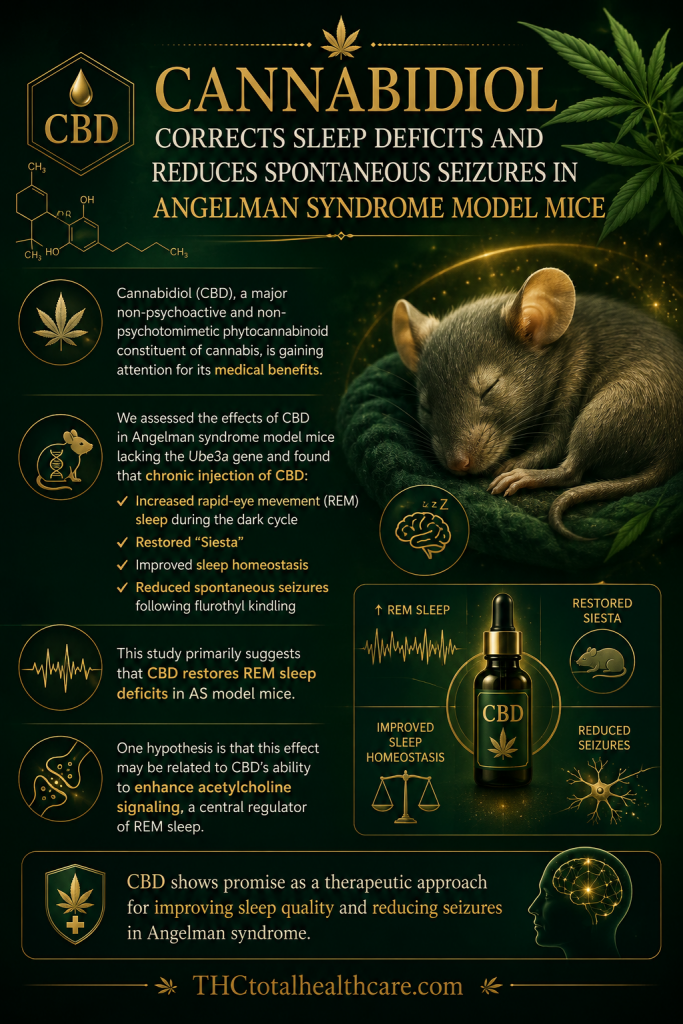
Sleep disruption and seizures are major challenges in Angelman syndrome, and both can significantly affect daily function and quality of life. In this preclinical study, cannabidiol improved abnormal sleep patterns and reduced spontaneous seizures in a mouse model of Angelman syndrome. The findings suggest that CBD may act on two of the disorder’s most burdensome neurological features at the same time, strengthening interest in cannabinoid-based approaches for Angelman syndrome and related neurodevelopmental conditions.
“The off-label use of cannabidiol (CBD) has outpaced investigation. We assessed the effects of CBD in Angelman syndrome model mice lacking the Ube3a gene and found that chronic injection of CBD increased rapid-eye movement sleep during the dark cycle, restored “Siesta”, improved sleep homeostasis, and reduced spontaneous seizures following flurothyl kindling.”
https://pubmed.ncbi.nlm.nih.gov/42265437
“Cannabidiol (CBD), a major non-psychoactive and non-psychotomimetic phytocannabinoid constituent of cannabis, is gaining attention for its medical benefits. The multitarget and complex pharmacological nature of CBD in the central nervous system makes it a unique candidate for treating a wide range of complex neurological and psychiatric conditions, including seizures and sleep deficits.”
“This study primarily suggests that CBD restores REM sleep deficits in AS model mice. One hypothesis is that this effect may be related to CBD’s ability to enhance acetylcholine signaling, a central regulator of REM sleep. CBD’s ability to reduce the frequency of SRS, beyond its effects on induced-seizure suppression, further strengthens the preclinical evidence supporting its potential for clinical translation.”