
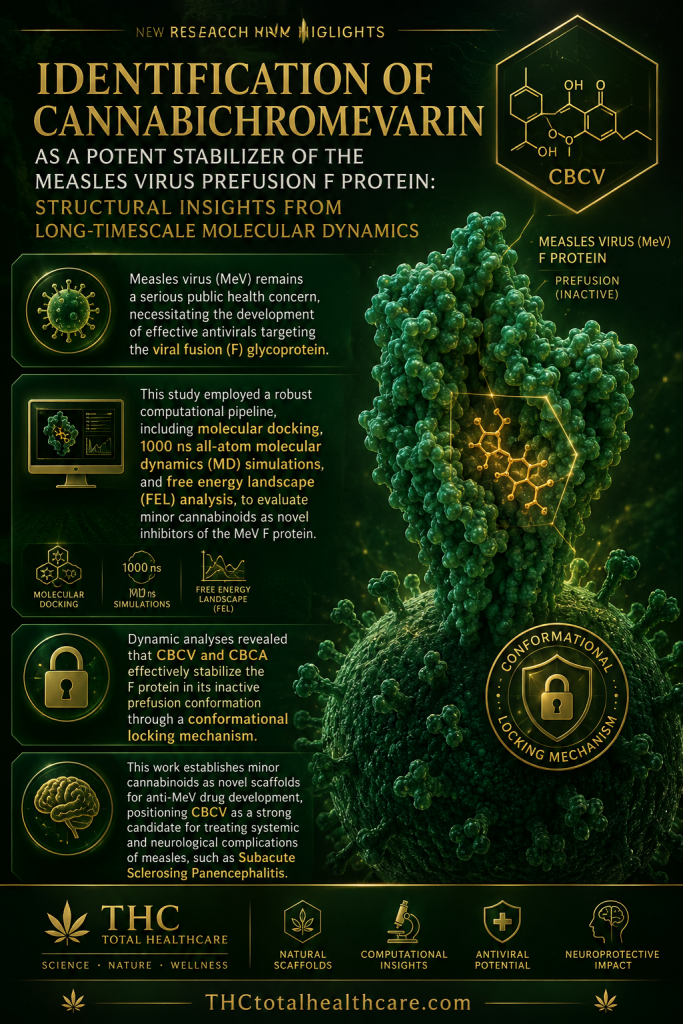
Cannabis research continues to uncover biological activity in lesser-known cannabinoids beyond THC and CBD. In this computational study, researchers identified cannabichromevarin (CBCV) as a potent stabilizer of the measles virus prefusion F protein, a structure essential for viral entry into host cells. Long-timescale molecular dynamics simulations suggested that CBCV could bind and stabilize this vulnerable viral state, potentially interfering with the conformational changes required for infection. The findings are early and entirely in silico, but they highlight CBCV as an unexpected cannabinoid candidate for further antiviral research.
“Measles virus (MeV) remains a serious public health concern, necessitating the development of effective antivirals targeting the viral fusion (F) glycoprotein.
This study employed a robust computational pipeline, including molecular docking, 1000 ns all-atom molecular dynamics (MD) simulations, and free energy landscape (FEL) analysis, to evaluate minor cannabinoids as novel inhibitors of the MeV F protein.
Initial virtual screening identified Cannabichromenic acid (CBCA), Cannabichromevarin (CBCV), and Cannabiripsol (CBR) as high-affinity leads, with docking scores of – 8.5, – 8.2, and – 8.1 kcal/mol, respectively, outperforming the reference inhibitor AS-48 (- 7.6 kcal/mol). Post-MD binding free energy calculations (MM-GBSA) further confirmed the thermodynamic superiority of CBCV (ΔGbind = – 44.7 kcal/mol) and CBCA (ΔGbind = – 30.1 kcal/mol) over the reference.
Dynamic analyses revealed that CBCV and CBCA effectively stabilize the F protein in its inactive prefusion conformation through a conformational locking mechanism. CBCV induced the most significant structural compaction (Rg = 2.4 nm) and displayed the sharpest global energy minimum (0.3 kcal/mol) in the FEL. Furthermore, ADMET profiling and ProTox-3.0 toxicity modeling identified CBCV as the most promising lead, possessing excellent drug-likeness, an inactive toxicity profile, and predicted blood-brain barrier permeability.
This work establishes minor cannabinoids as novel scaffolds for anti-MeV drug development, positioning CBCV as a strong candidate for treating systemic and neurological complications of measles, such as Subacute Sclerosing Panencephalitis.”
https://pubmed.ncbi.nlm.nih.gov/42286054
https://www.nature.com/articles/s41598-026-50199-6
“Cannabichromevarin (CBCV), also known as cannabivarichromene) is one of over 100 variants of cannabinoid chemical compounds that act on cannabinoid receptors. CBCV is a phytocannabinoid found naturally in cannabis, and is a propyl cannabinoid and an effective anticonvulsant and used to treat brain cancer and epilepsy“