
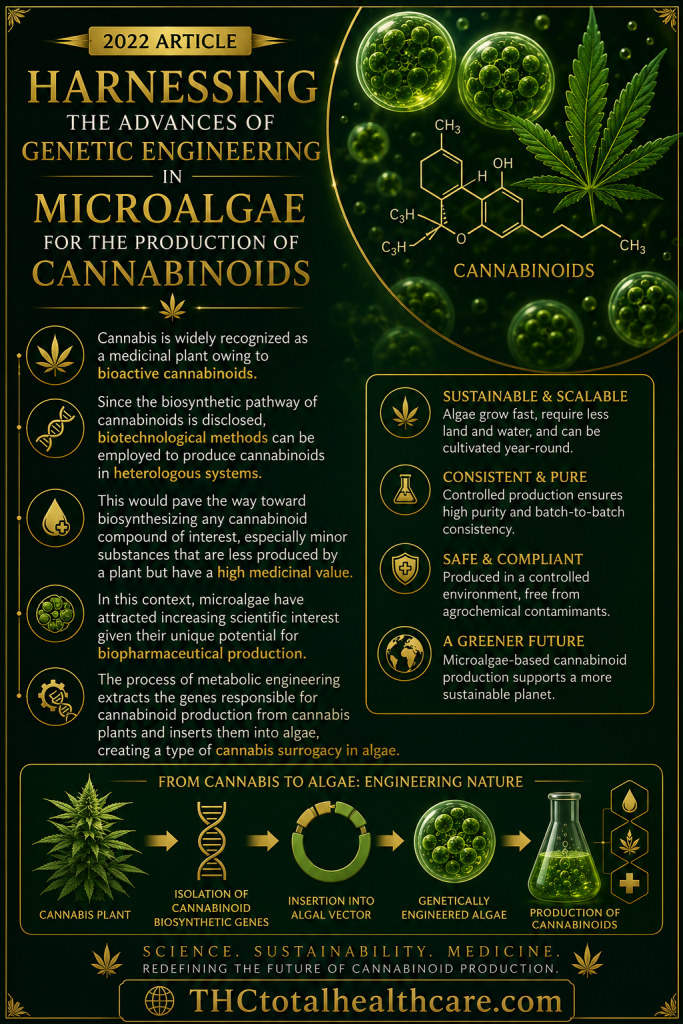
Cannabinoids are traditionally obtained from Cannabis sativa, but advances in synthetic biology are opening the door to entirely different production systems. This review examines the use of genetically engineered microalgae as potential biological factories for cannabinoids, drawing on their rapid growth, photosynthetic efficiency, and ability to be modified for specialized metabolite production. The authors discuss the genetic tools, metabolic pathways, and engineering strategies that could make cannabinoid biosynthesis in microalgae more practical and scalable. The work highlights a future in which cannabinoids may be produced through sustainable biotechnology as well as conventional plant cultivation.
“Cannabis is widely recognized as a medicinal plant owing to bioactive cannabinoids. However, it is still considered a narcotic plant, making it hard to be accessed.
Since the biosynthetic pathway of cannabinoids is disclosed, biotechnological methods can be employed to produce cannabinoids in heterologous systems. This would pave the way toward biosynthesizing any cannabinoid compound of interest, especially minor substances that are less produced by a plant but have a high medicinal value.
In this context, microalgae have attracted increasing scientific interest given their unique potential for biopharmaceutical production. In the present review, the current knowledge on cannabinoid production in different hosts is summarized and the biotechnological potential of microalgae as an emerging platform for synthetic production is put in perspective. A critical survey of genetic requirements and various transformation approaches are also discussed.”
https://pubmed.ncbi.nlm.nih.gov/35762029
https://www.tandfonline.com/doi/full/10.1080/07388551.2022.2071672
“The process of metabolic engineering extracts the genes responsible for cannabinoid production from cannabis plants and inserts them into algae, creating a type of cannabis surrogacy in algae.”