
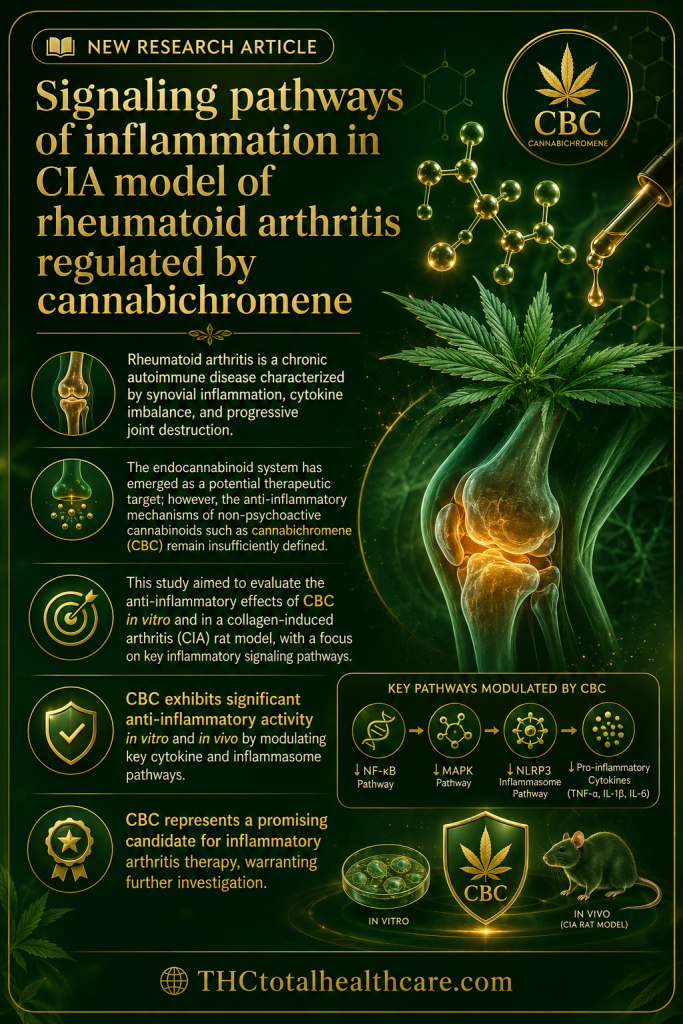
Cannabichromene (CBC) is one of the lesser-studied cannabinoids in Cannabis sativa, but emerging research suggests it may have significant anti-inflammatory activity. In this preclinical rheumatoid arthritis study, researchers examined CBC in a collagen-induced arthritis model and found that it reduced inflammatory responses associated with joint disease. The effects were linked to regulation of key signaling pathways involved in cytokine production and immune activation, providing a clearer mechanistic explanation for CBC’s potential anti-arthritic activity. The findings broaden cannabinoid research in rheumatoid arthritis beyond THC and CBD and support further investigation of CBC as a potential modulator of chronic inflammatory disease.
“Background: Rheumatoid arthritis is a chronic autoimmune disease characterized by synovial inflammation, cytokine imbalance, and progressive joint destruction. The endocannabinoid system has emerged as a potential therapeutic target; however, the anti-inflammatory mechanisms of non-psychoactive cannabinoids such as cannabichromene (CBC) remain insufficiently defined. This study aimed to evaluate the anti-inflammatory effects of CBC in vitro and in a collagen-induced arthritis (CIA) rat model, with a focus on key inflammatory signaling pathways.
Methods: CBC effects were assessed in LPS-stimulated HUVEC cells by qPCR analysis of inflammatory markers. In vivo, female Wistar rats were assigned to four groups: CIA + saline (placebo), CIA + CBC, CIA + methylprednisolone, and non-immunized controls receiving saline. Disease progression was evaluated using clinical scoring, paw thickness, and body weight. Synovial tissues and serum were analyzed by qPCR, Western blotting, and ELISA to assess cytokines, inflammasome components, and signaling pathways, including NF-κB and JAK/STAT.
Results: CBC reduced TNF-α expression in vitro at low micromolar concentrations. In vivo, CBC significantly decreased arthritis scores compared to placebo and attenuated weight loss, although it did not significantly reduce paw swelling. Molecular analyses revealed downregulation of IL-6, STAT3, and IL-17 A, indicating suppression of the TNF-NF-κB-IL-6-STAT3-Th17 axis. CBC also significantly inhibited inflammasome components (NLRP3, NLRP1A, caspase-11). However, MMP-3 and MMP-9 levels were not significantly affected.
Conclusions: CBC exhibits significant anti-inflammatory activity in vitro and in vivo by modulating key cytokine and inflammasome pathways. While its effects on structural joint damage markers were limited, CBC represents a promising candidate for inflammatory arthritis therapy, warranting further investigation.”
https://pubmed.ncbi.nlm.nih.gov/42343451
https://link.springer.com/article/10.1186/s42238-026-00464-2