
Melanoma research increasingly examines how cancer cells respond to environmental stress as well as potential therapeutic compounds. In this study, researchers compared the metabolic responses of normal melanocytes and melanoma cells after UVA radiation and exposure to phytocannabinoids. The results showed that cannabinoid treatment altered cellular metabolism and oxidative-stress responses differently in healthy and malignant cells, suggesting that melanoma cells may have distinct vulnerabilities that can be influenced by cannabis-derived compounds. The findings add to growing mechanistic research on how phytocannabinoids may affect melanoma biology under conditions relevant to ultraviolet exposure.
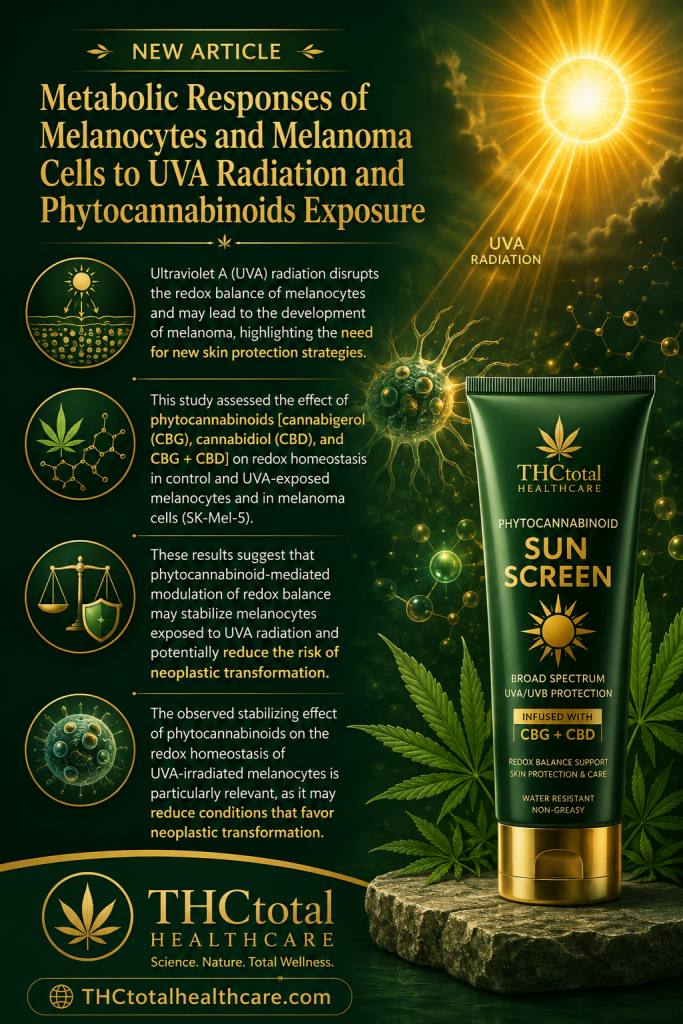
“Ultraviolet A (UVA) radiation disrupts the redox balance of melanocytes and may lead to the development of melanoma, highlighting the need for new skin protection strategies.
This study assessed the effect of phytocannabinoids [cannabigerol (CBG), cannabidiol (CBD), and CBG + CBD] on redox homeostasis in control and UVA-exposed melanocytes and in melanoma cells (SK-Mel-5).
UVA radiation increased the activity of prooxidant enzymes in both melanocytes and SK-Mel-5 cells and, consequently, the level of reactive oxygen species (ROS) (approx. 2-fold). It also activated nuclear factor erythroid 2 (Nrf2), as reflected by increased expression of heme oxygenase 1 (HO-1) (melanocytes approx. 2-fold; SK-Mel-5 approx. 7-fold). Concomitantly, antioxidant mechanisms were impaired, as demonstrated by reduced superoxide dismutase (SOD1/SOD2) activity and impaired glutathione and thioredoxin function. These changes were accompanied by increased levels of oxidative damage markers (isoprostanes, 4-hydroxynonenal-4-HNE, and 4-HNE-protein adducts) (43-100%) and increased inflammatory signaling, including increased expression of nuclear factor kappa B (NF-κB) subunits (melanocytes: p52 ~2-fold, p65 ~75%; SK-Mel-5: ~4-4.5-fold) and tumor necrosis factor alpha (TNF-α; ~30%).
Phytocannabinoid treatment modulated these UVA-induced changes.
In SK-Mel-5 cells, phytocannabinoids normalized the activity of prooxidant enzymes and consequently reduced ROS levels (~30%). They also reduced Nrf2 activation and HO-1 expression; however, CBG increased HO-1 level in melanocytes (~25-40%). Furthermore, phytocannabinoids enhanced antioxidant defense by increasing SOD activity, particularly in melanocytes (~10-40%), and restoring the glutathione and thioredoxin systems. Markers of oxidative damage were reduced by approximately 23-37% after treatment. Furthermore, phytocannabinoids attenuated NF-κB activation (p52 ~18-28%, p65 ~25-29% in melanocytes; ~20% in SK-Mel-5), while TNF-α levels remained unchanged. The effects in non-irradiated cells were modest (<15%).
These results suggest that phytocannabinoid-mediated modulation of redox balance may stabilize melanocytes exposed to UVA radiation and potentially reduce the risk of neoplastic transformation. However, the observed protective effects in SK-Mel-5 cells require further investigation and detailed molecular analysis.”
https://pubmed.ncbi.nlm.nih.gov/42351996
“The observed stabilizing effect of phytocannabinoids on the redox homeostasis of UVA-irradiated melanocytes is particularly relevant, as it may reduce conditions that favor neoplastic transformation.”