
Hemp shiv is being studied as a renewable raw material for producing lower-impact construction and composite products.
In this study, researchers combined hemp shiv with environmentally friendly adhesives and experimentally evaluated the resulting biocomposite’s physical and mechanical properties.
The findings help assess whether hemp-based materials bonded with greener adhesives could provide a more sustainable alternative for future building and manufacturing applications.
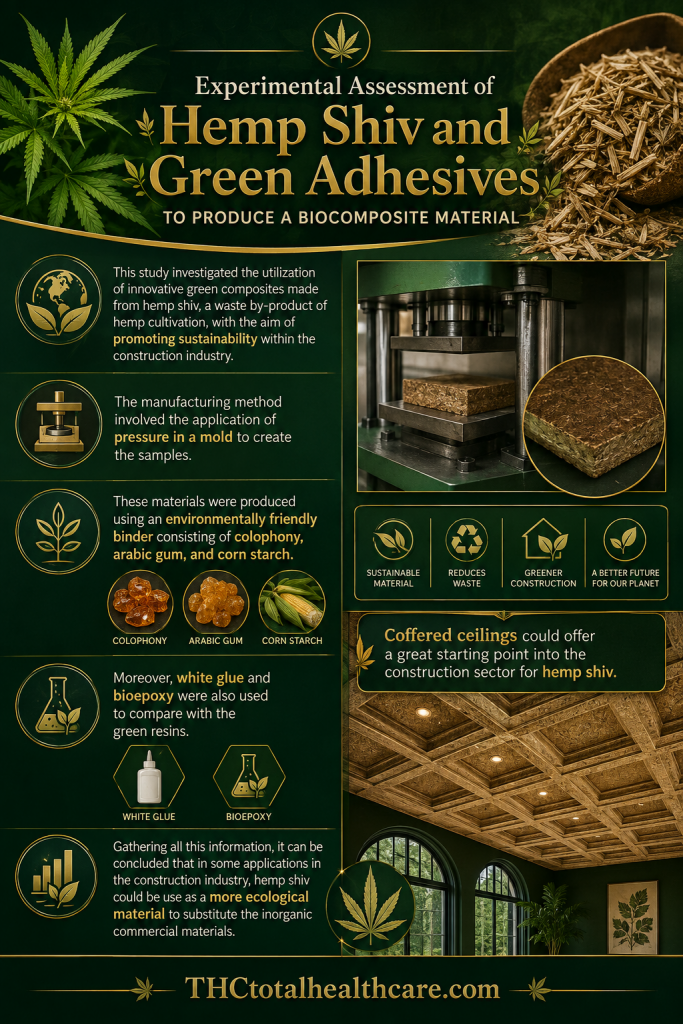
“This study investigated the utilization of innovative green composites made from hemp shiv, a waste by-product of hemp cultivation, with the aim of promoting sustainability within the construction industry.
The manufacturing method involved the application of pressure in a mold to create the samples.
These materials were produced using an environmentally friendly binder consisting of colophony, arabic gum, and corn starch. Moreover, white glue and bioepoxy were also used to compare with the green resins. Three different binder compositions were used for the specimens. The samples underwent mechanical testing through tensile and bending assessments, and their performance was compared to that of non-green binders to validate the effectiveness of the manufacturing processes.
The study revealed that decreasing the moisture content during the curing process was crucial for improving the mechanical properties. The best results were achieved when using arabic gum as a binder, yielding a tensile strength of 2.16 MPa and a bending strength of 5.25 MPa, with a composition of 62.5% hemp shiv and a manufacturing process involving a pressure of 5 MPa.”
https://pubmed.ncbi.nlm.nih.gov/39203077
“Gathering all this information, it can be concluded that in some applications in the construction industry, hemp shiv could be use as a more ecological material to substitute the inorganic commercial materials. Coffered ceilings could offer a great starting point into the construction sector for hemp shiv.”
https://www.mdpi.com/1996-1944/17/16/3900