
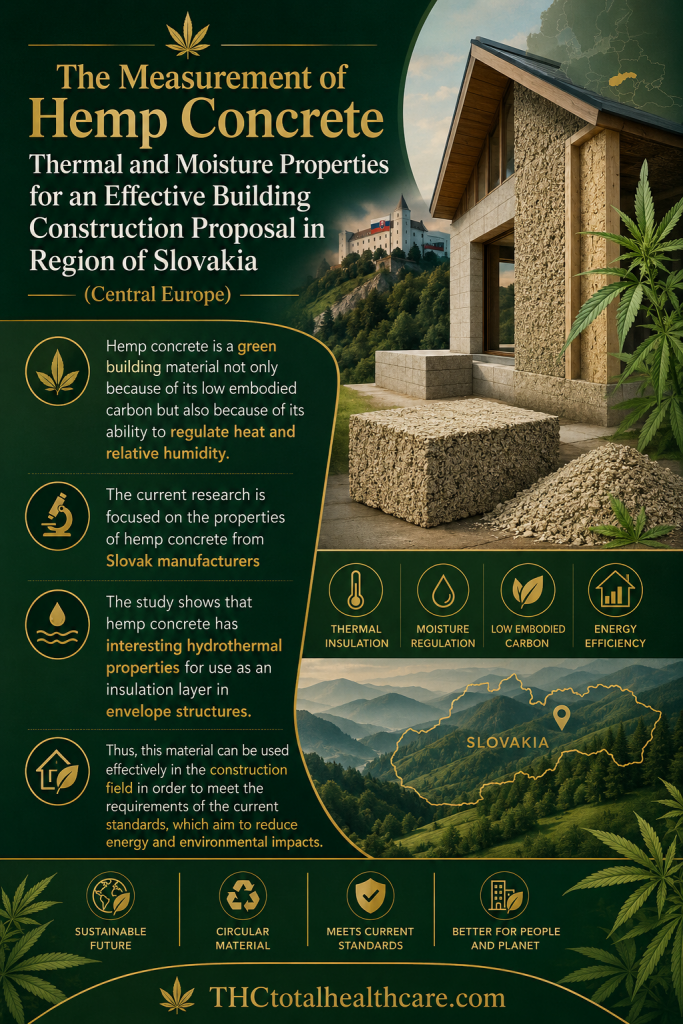
Hemp concrete is gaining attention as a bio-based building material because of its ability to combine insulation with moisture regulation.
In this study, researchers measured the thermal and moisture-related properties of hemp concrete under conditions relevant to building construction in Central Europe.
The findings help show how hemp concrete could be used more effectively in energy-efficient construction while supporting indoor comfort and moisture management.
“The construction industry is facing an increased demand to adopt sustainable green building materials to minimize the carbon footprint.
Hemp concrete is a green building material not only because of its low embodied carbon but also because of its ability to regulate heat and relative humidity. Its thermal characteristics are often viewed as favorable for reducing the energy used to heat or cool indoor buildings.
The current research is focused on the properties of hemp concrete from Slovak manufacturers which can be effectively used in construction as a replacement for conventional building materials and can also be effectively applied in building renovations.
The basic thermal properties of hemp concrete, i.e., specific heat capacity, thermal conductivity, effusivity, thermal diffusivity, and lag time, were determined. The determination of all properties is dependent on the knowledge of heat fluxes at the surface and the density of samples.
The insulation ability was expressed with a thermal conductivity of 0.099 W·m-1·K-1. The accumulation was expressed with a specific heat of 1540 J·kg-1·K-1 and density of 322 kg·m-3 in the air environment temperature of 22 °C and relative humidity of 50%.
To assess moisture properties, the moisture content and the speed of molecules during diffusion and lag time, based on the thickness of the hemp concrete samples, were measured. The speed of water molecules during diffusion in hemp concrete was 8.6 × 10⁻⁷ m·s-1.
The study shows that hemp concrete has interesting hydrothermal properties for use as an insulation layer in envelope structures. Thus, this material can be used effectively in the construction field in order to meet the requirements of the current standards, which aim to reduce energy and environmental impacts.”
https://pubmed.ncbi.nlm.nih.gov/40271892
“Hemp concrete is a lightweight bio-based material, which attracts the attention of developers in Slovakia. This lightweight bio-based material is intended to be an excellent thermal insulator and moisture diffusor with enhanced durability. It holds the potential to significantly impact the climate quality inside buildings and their overall sustainability from a life cycle perspective. Hemp concrete consists of the inner woody core of the hemp plant mixed with a lime-based binder (hydraulic lime and non-hydraulic lime) and water.”