
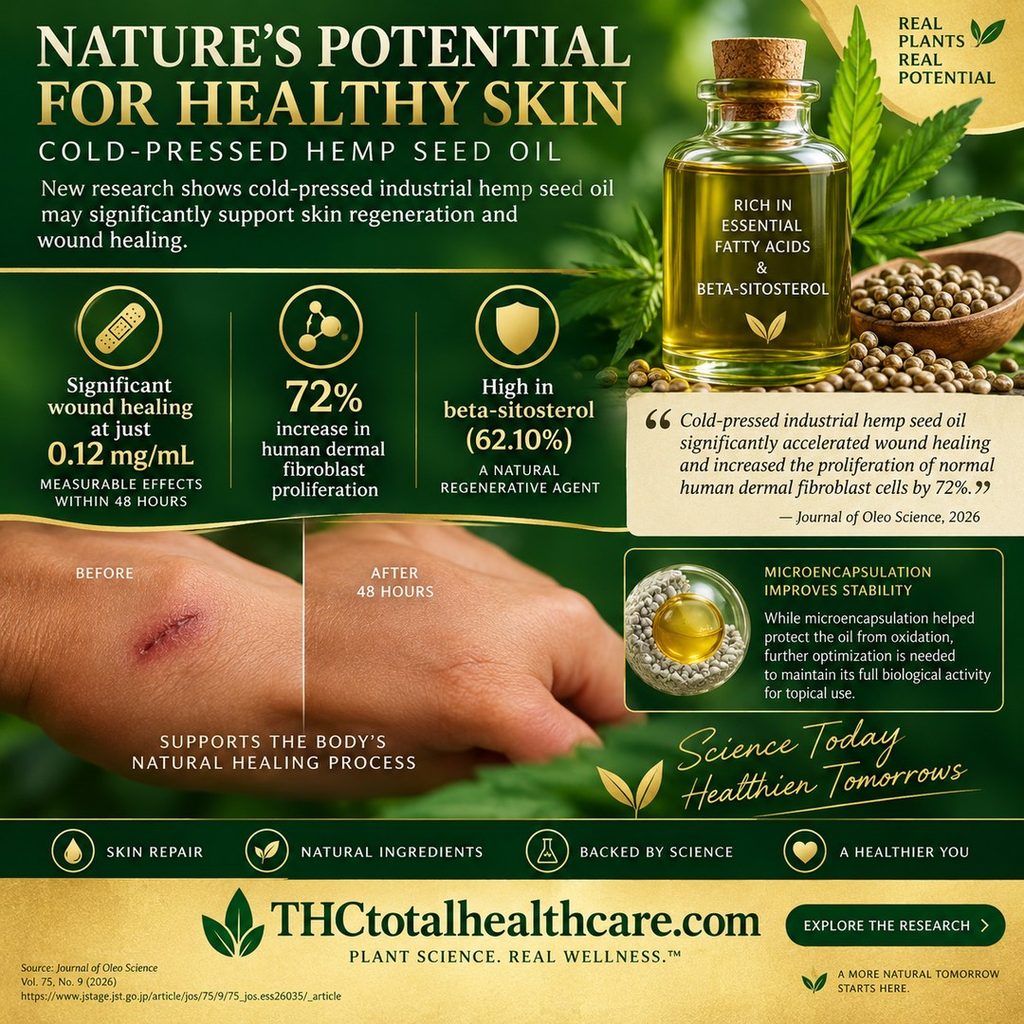
Cold-pressed industrial hemp seed oil may have significant potential for skin regeneration and wound healing, according to a new laboratory study. Researchers found that the oil, naturally rich in essential fatty acids and beta-sitosterol, significantly accelerated wound closure and increased the proliferation of normal human dermal fibroblast cells by 72%. Although microencapsulation improved the oil’s stability against oxidation, it also reduced its biological activity, suggesting that the delivery system will need further optimization for topical use.
“Cold-pressed industrial hemp seed oil (CPCSSO) with a fully characterized physicochemical profile; including fatty acids, sterols and quality indices is a natural regenerative agent due to its high content of essential fatty acids (EFA) and its dominant beta-sitosterol fraction (62.10 %). However, its susceptibility to oxidation (Iodine Value: 157) limits its effectiveness when applied topically.
To address this issue, this study is aimed to stabilize CPCSSO through an innovative complex coacervation system using a gelatin/gum Arabic matrix crosslinked with natural transglutaminase (Tgase) and tannic acid (TA).
Physicochemical analyses confirmed that CPCSSO retained excellent quality criteria, including low free fatty acid and peroxide values. In vitro biological tests showed that unencapsulated CPCSSO at concentrations as low as 0.12 mg/mL significantly accelerated wound healing achieving highly statistically significant results (48 hours) and increased proliferation of normal human dermal fibroblast cells by 72 %.
This demonstrates the oil’s substantial potential for skin regeneration, although microencapsulation improved the stability of CPCSSO, the biological activity of the encapsulated CPCSSO decreased.
The current findings highlight the effectiveness of CPCSSO in wound healing and suggest that further optimization is necessary for the TGase-TA crosslinking system to serve as a reliable method for the topical delivery of natural bioactive compounds.”
https://pubmed.ncbi.nlm.nih.gov/42686591
https://www.jstage.jst.go.jp/article/jos/75/9/75_jos.ess26035/_article