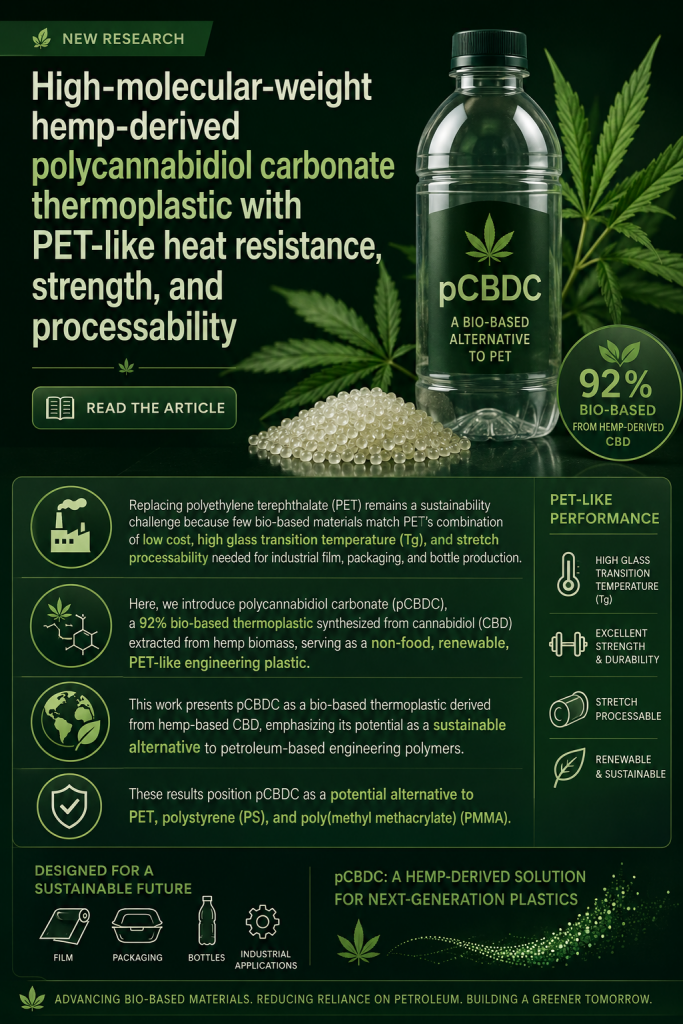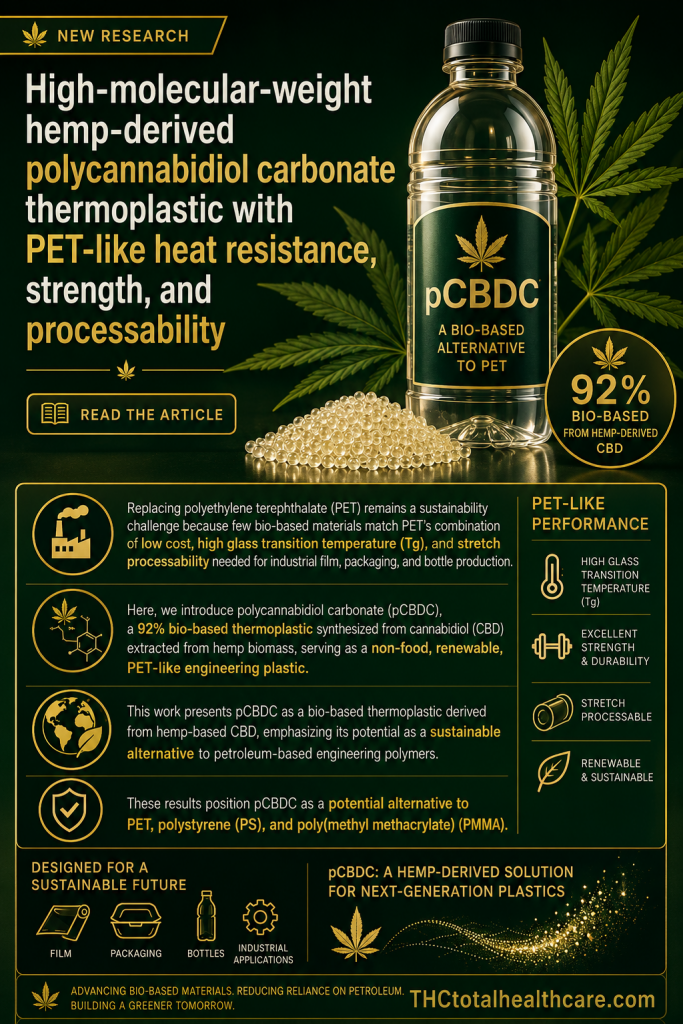
“Replacing polyethylene terephthalate (PET) remains a sustainability challenge because few bio-based materials match PET’s combination of low cost, high glass transition temperature (Tg), and stretch processability needed for industrial film, packaging, and bottle production.
Since PET is produced on a massive scale, multiple polymers from different renewable feedstocks will likely be necessary to significantly cut emissions linked to the global PET market. Polyethylene furanoate (PEF) is a promising alternative with similar properties, but its monomers come from food-derived sugars, connecting production to food crop supply chains and land use while requiring several chemical conversion steps that add to carbon emissions. Therefore, finding additional alternatives from non-food feedstocks is important for diversifying renewable supply options.
Here, we introduce polycannabidiol carbonate (pCBDC), a 92% bio-based thermoplastic synthesized from cannabidiol (CBD) extracted from hemp biomass, serving as a non-food, renewable, PET-like engineering plastic. pCBDC exhibits high molecular weight, high Tg, excellent stretch processability, and high strength. We also establish processing-structure-property relationships that offer guidelines for future industrial manufacturing.”
“This work demonstrates that CBD, a non-food aromatic compound extracted from hemp, can be used directly as a monomer without chemical modification to create a polymer with PET-like Tg, mechanical strength, and processability, providing a complementary pathway to PEF to reduce emissions from PET-scale materials.”
“This work presents pCBDC as a bio-based thermoplastic derived from hemp-based CBD, emphasizing its potential as a sustainable alternative to petroleum-based engineering polymers.”
“These results position pCBDC as a potential alternative to PET, polystyrene (PS), and poly(methyl methacrylate) (PMMA).”
https://www.cell.com/chem-circularity/fulltext/S3051-2948(26)00014-9