
“Background: Prenatal cannabis exposure may have adverse effects on development which could be amplified by co-exposure with tobacco.
Objective: This study examined whether prenatal cannabis exposure was associated with disrupted language or cognitive development, and whether co-exposure to tobacco was associated with worse outcomes than to cannabis alone.
Methods: In this historical cohort study, we compared children from the Danish Family Outpatient Clinics who had prenatal exposure to cannabis (n = 106), tobacco (n = 138), cannabis and tobacco (n = 112), or no exposure to either drug (control group, n = 454) on the Bayley-III Language and Cognitive scales at 1-58 months of age (99.7% at ≤36 months). Roughly half were tested at multiple ages, yielding 1362 language assessments (49.2% tested ≥ twice) and 1549 cognitive assessments (53.6% tested ≥ twice). Most children had additional prenatal exposure to other drugs (49.8%), including the control group (63.9%). Scores were investigated in linear mixed models with factors Exposure Group, Age, and Exposure Group ∗ Age, and covariates alcohol exposure, other drug exposure, maternal medical diagnoses, and maternal education.
Results: Children with prenatal cannabis exposure scored significantly higher on the Language scale compared with controls (3.26 points; 95% CI = 0.26-6.26). There was a positive association between Language scores and age at assessment for children with cannabis and tobacco exposure (0.31 points/month; 95% CI = 0.11-0.51) but not the other groups. There were no significant effects of Exposure Group or Exposure Group × Age for the Bayley-III Cognitive scale.
Conclusion: Prenatal exposure to cannabis, alone or with tobacco, was not associated with disrupted cognitive or language development during the first three years of life in this sample of high-risk children.”
https://pubmed.ncbi.nlm.nih.gov/41990599
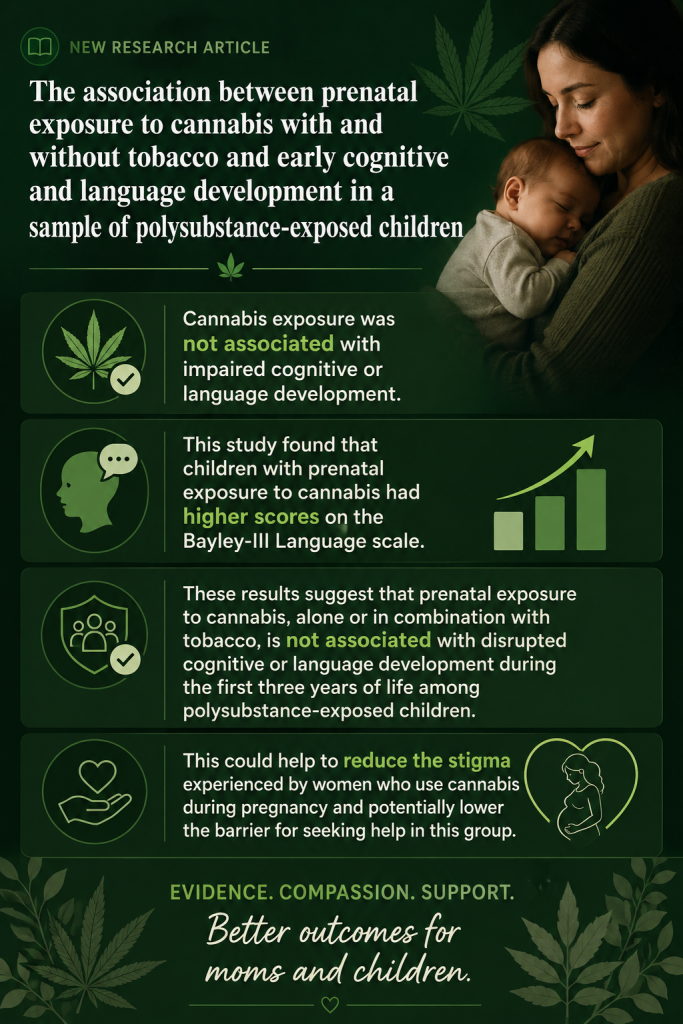
“Cannabis exposure was not associated with impaired cognitive or language development.”
“Using a sample of children with prenatal drug and alcohol exposure from the Danish FOCs, this study found that children with prenatal exposure to cannabis had higher scores on the Bayley-III Language scale compared with control children, and children with prenatal exposure to cannabis and tobacco had a greater increase in Bayley-III Language scores with age compared with all other groups. There were no differences on the Bayley-III Cognitive scale between children with prenatal exposure to cannabis, tobacco, both, or neither.
These results suggest that prenatal exposure to cannabis, alone or in combination with tobacco, is not associated with disrupted cognitive or language development during the first three years of life among polysubstance-exposed children. This could help to reduce the stigma experienced by women who use cannabis during pregnancy and potentially lower the barrier for seeking help in this group.”
https://www.sciencedirect.com/science/article/pii/S0378378226000745?via%3Dihub