
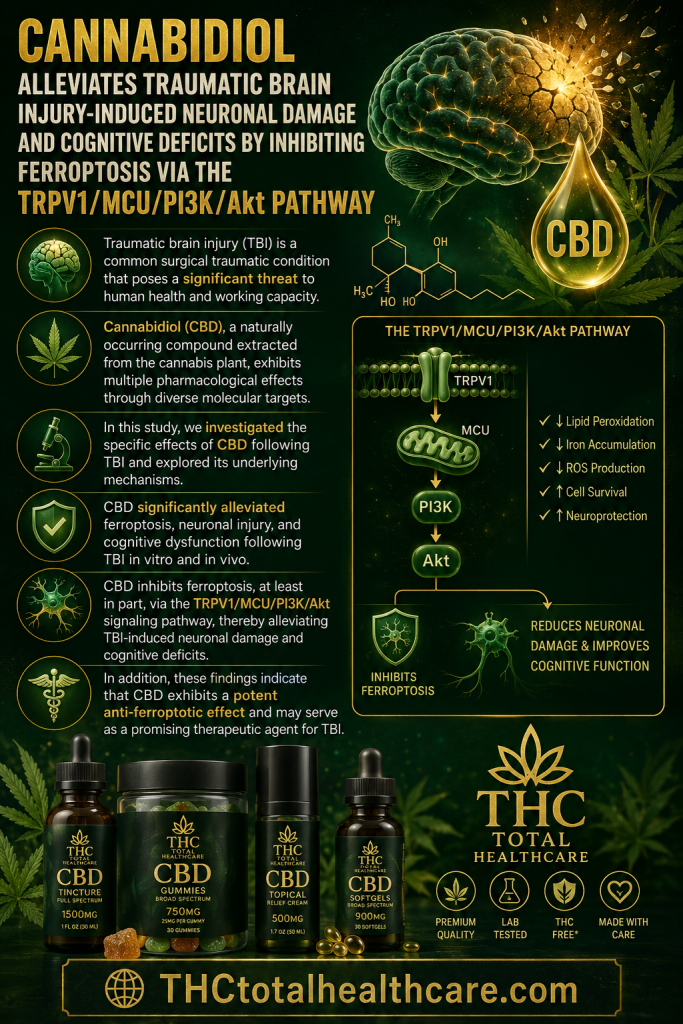
“Background: Traumatic brain injury (TBI) is a common surgical traumatic condition that poses a significant threat to human health and working capacity. However, effective treatments to improve its prognosis remain limited. Cannabidiol (CBD), a naturally occurring compound extracted from the cannabis plant, exhibits multiple pharmacological effects through diverse molecular targets. To date, the role and underlying molecular mechanisms of CBD in the context of TBI have not been fully elucidated. In this study, we investigated the specific effects of CBD following TBI and explored its underlying mechanisms.
Methods: An in vitro ferroptosis model was established using HT-22 cells, and an in vivo TBI model was established in mice. Techniques such as Western blotting, immunofluorescence staining, and behavioral analysis were employed to evaluate the effects of CBD on ferroptosis, pathological changes, and neurological function after TBI, as well as to explore the associated molecular mechanisms.
Results: CBD significantly alleviated ferroptosis, neuronal injury, and cognitive dysfunction following TBI in vitro and in vivo. Further investigation revealed that CBD mitigated mitochondrial dysfunction by reducing Ca2⁺ overload via the TRPV1/MCU signaling pathway. Moreover, utilizing methodologies such as recombinant adeno-associated virus (rAAV) injection and transcriptome analysis, mitochondrial calcium uniporter (MCU) was identified as a core regulator of ferroptosis in neurons following TBI. Neuronal MCU knockdown attenuated the progression of ferroptosis and improved neurological outcomes after TBI. Finally, integrated findings confirmed that CBD inhibit ferroptosis after TBI through the TRPV1/MCU/PI3K/Akt signaling pathway.
Conclusions: CBD inhibits ferroptosis, at least in part, via the TRPV1/MCU/PI3K/Akt signaling pathway, thereby alleviating TBI-induced neuronal damage and cognitive deficits. In addition, these findings indicate that CBD exhibits a potent anti-ferroptotic effect and may serve as a promising therapeutic agent for TBI.”
https://pubmed.ncbi.nlm.nih.gov/42365227
https://link.springer.com/article/10.1186/s11658-026-00983-z