
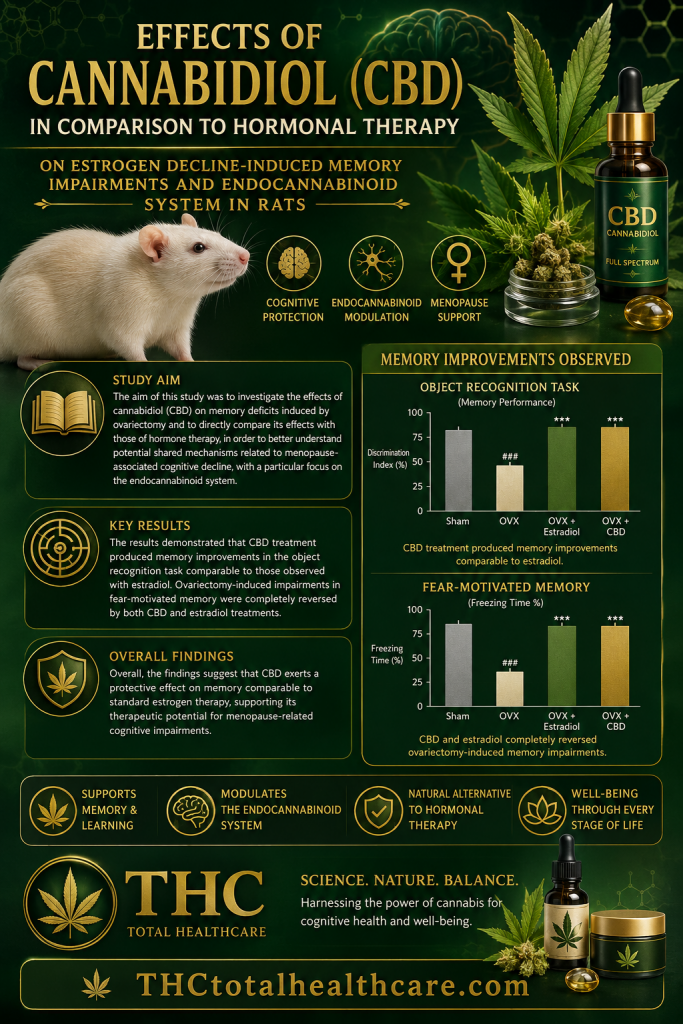
“The aim of this study was to investigate the effects of cannabidiol (CBD) on memory deficits induced by ovariectomy and to directly compare its effects with those of hormone therapy, in order to better understand potential shared mechanisms related to menopause-associated cognitive decline, with a particular focus on the endocannabinoid system.
Three-month-old female Wistar rats were randomly assigned to four experimental groups: SHAM-Veh (Vehicle), OVX-Veh, OVX-E2 (estradiol), and OVX-CBD. Animals underwent either bilateral ovariectomy or sham surgery. Following a three-week recovery period, rats received daily subcutaneous injections of CBD (10 mg/kg), estradiol (10 μg/kg), or vehicle for 21 consecutive days. Behavioral assessments included object recognition and fear-motivated memory tests. Twenty-four hours after the final treatment, animals were euthanized for neurochemical and molecular analyses. Levels of the endocannabinoids anandamide (AEA) and 2-arachidonoylglycerol (2-AG) were measured using high-performance liquid chromatography. Gene expression of cannabinoid receptors CB1 and CB2, as well as enzymes involved in the synthesis and degradation of endocannabinoids (NAPE-PLD, DAGL-A, FAAH, and MGLL), was evaluated in the hippocampus by RT-qPCR.
The results demonstrated that CBD treatment produced memory improvements in the object recognition task comparable to those observed with estradiol. Ovariectomy-induced impairments in fear-motivated memory were completely reversed by both CBD and estradiol treatments. Additionally, CBD reduced the expression of FAAH and MGLL, resulting in increased hippocampal levels of AEA and 2-AG, effects similar to those observed with hormone therapy. Estradiol also increased NAPE-PLD expression, contributing to elevated AEA levels.
Overall, the findings suggest that CBD exerts a protective effect on memory comparable to standard estrogen therapy, supporting its therapeutic potential for menopause-related cognitive impairments.”
https://pubmed.ncbi.nlm.nih.gov/42476954
https://onlinelibrary.wiley.com/doi/10.1111/jne.70234