
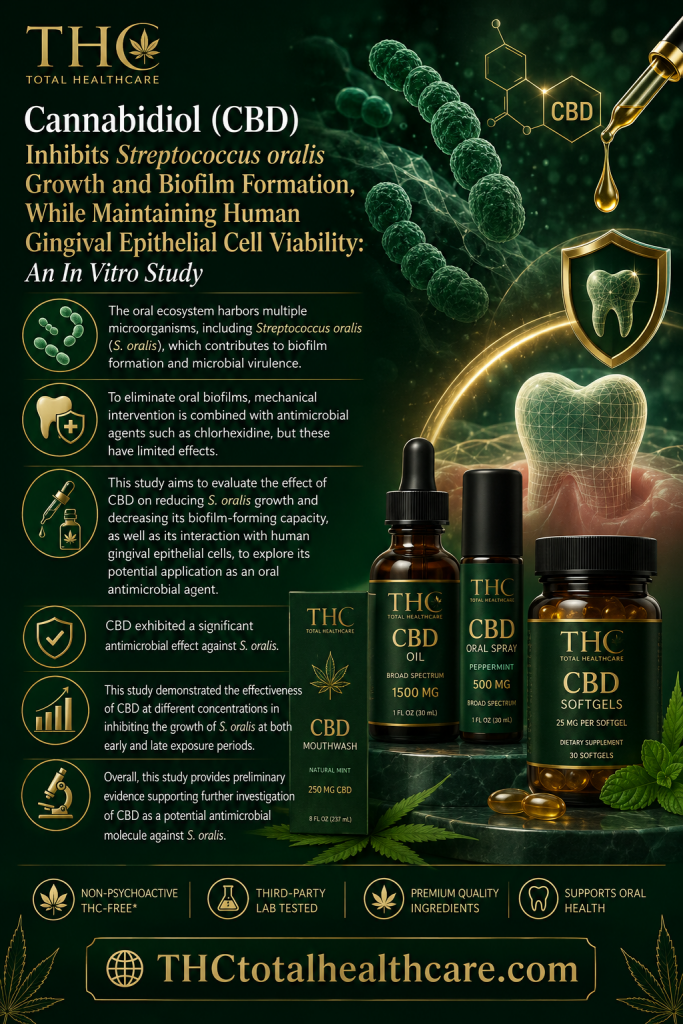
“Background: The oral ecosystem harbors multiple microorganisms, including Streptococcus oralis (S. oralis), which contributes to biofilm formation and microbial virulence. To eliminate oral biofilms, mechanical intervention is combined with antimicrobial agents such as chlorhexidine, but these have limited effects. Such intervention could benefit natural antimicrobial compounds, including cannabidiol (CBD).
Aim: This study aims to evaluate the effect of CBD on reducing S. oralis growth and decreasing its biofilm-forming capacity, as well as its interaction with human gingival epithelial cells, to explore its potential application as an oral antimicrobial agent.
Methodology: S. oralis was cultured in the presence of different concentrations of CBD. Bacterial growth was evaluated at different time points postexposure to CBD. Bacterial biofilm formation was investigated after 3 days of exposure to CBD using histological and quantitative analyses. The interaction between CBD and gingival epithelial cells was assessed using cell morphology, cell adhesion, and cell viability/proliferation assays.
Results: CBD inhibited planktonic growth of S. oralis in a concentration-dependent manner with a minimum inhibitory concentration (MIC) of 6.25 μg/mL and a minimum bactericidal concentration (MBC) of 25 μg/mL. CBD also significantly (p < 0.01) decreased S. oralis biofilm by disrupting its architecture. The effect on the bacterial growth and its capacity to form biofilms was observed even with a low concentration (3.12 μg/mL) of CBD. Given that antimicrobial molecules should be effective against biofilm-associated bacteria while maintaining compatibility with host tissues, this study showed that concentrations (3.12, 6.25, and 12.5 μg/mL) of CBD we tested have anti-S. oralis effect maintained human gingival epithelial cell viability.
Conclusion: CBD exhibited a significant antimicrobial effect against S. oralis. Although the bactericidal concentration was higher than the range tested in gingival epithelial cells, low and intermediate CBD concentrations inhibited S. oralis growth and biofilm formation while maintaining cell viability after 24 h of exposure. These findings provide preliminary evidence supporting further investigation of the antimicrobial and antibiofilm properties of CBD in oral health contexts.”
https://pubmed.ncbi.nlm.nih.gov/42597385
“This study demonstrated the effectiveness of CBD at different concentrations in inhibiting the growth of S. oralis at both early and late exposure periods.
Overall, this study provides preliminary evidence supporting further investigation of CBD as a potential antimicrobial molecule against S. oralis.”