
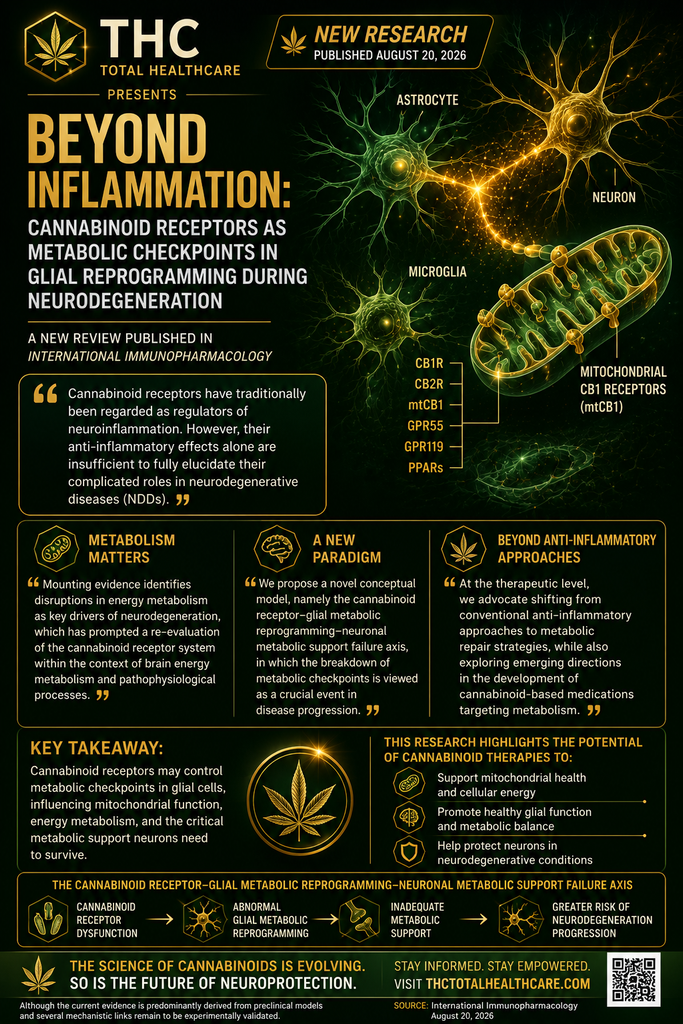
“Cannabinoid receptors have traditionally been regarded as regulators of neuroinflammation. However, their anti-inflammatory effects alone are insufficient to fully elucidate their complicated roles in neurodegenerative diseases (NDDs).
Mounting evidence identifies disruptions in energy metabolism as key drivers of neurodegeneration, which has prompted a re-evaluation of the cannabinoid receptor system within the context of brain energy metabolism and pathophysiological processes. Accumulated findings from several independent preclinical studies have offered novel insights into the potential involvement of cannabinoid receptors in energy metabolism, mitochondrial function, and glial metabolic reprogramming.
This review focuses on the metabolic regulatory potential of classical cannabinoid receptors, including cannabinoid receptor type 1 (CB1R) and cannabinoid receptor type 2 (CB2R), with particular attention to mitochondrial CB1 receptors (mtCB1), as well as non-classical targets such as G protein-coupled receptor 55 (GPR55), G protein-coupled receptor 119 (GPR119), and peroxisome proliferator-activated receptors (PPARs). Additionally, the review explores the mechanisms by which astrocytes maintain neuronal support through cell-type-specific metabolic specialization and how metabolic reprogramming in microglia modulates neuroinflammatory phenotypes.
Although the current evidence is predominantly derived from preclinical models and several mechanistic links remain to be experimentally validated, we propose a novel conceptual model, namely the cannabinoid receptor-glial metabolic reprogramming-neuronal metabolic support failure axis, in which the breakdown of metabolic checkpoints is viewed as a crucial event in disease progression.
At the therapeutic level, we advocate shifting from conventional anti-inflammatory approaches to metabolic repair strategies, while also exploring emerging directions in the development of cannabinoid-based medications targeting metabolism.
Collectively, a deep understanding of the complex metabolic regulatory functions of cannabinoid receptors is critical for developing next-generation treatment strategies for NDDs.”
https://pubmed.ncbi.nlm.nih.gov/42624021
“Shift from anti-inflammation to metabolic repair for cannabinoid NDD therapy.”
https://www.sciencedirect.com/science/article/abs/pii/S1567576926011458?via%3Dihub