
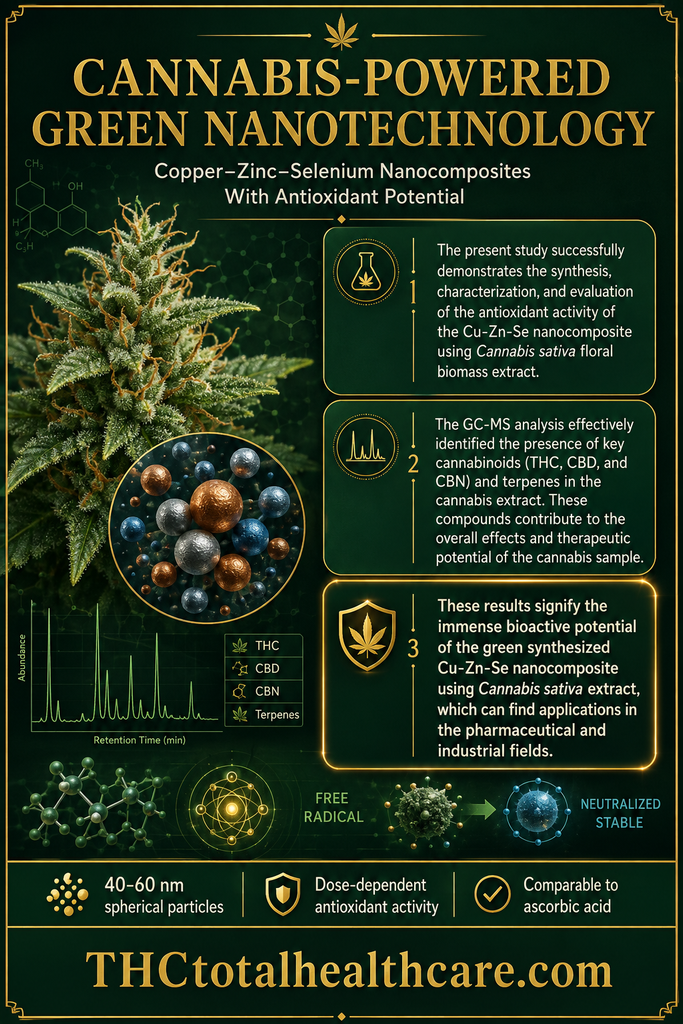
“Background: Nanotechnology is an emerging field widely applied across various disciplines, including medicine, to develop cost-effective and innovative therapies by delivering therapeutic compounds to targeted sites. The integration of multiple metals can yield synergistic multifunctional properties.
Aims: This study focuses on the green synthesis of copper-zinc-selenium (Cu-Zn-Se) nanocomposite, which is a straightforward and reliable method compared to chemical, physical, and mechanical techniques. Cannabis sativa, a dioecious plant from the Cannabinaceae family, has garnered significant attention due to its pharmacological properties and global cultivation.
Methods: In this research, Phytochemical analysis of extracts was carried out using Gas chromatography-mass spectrometry analysis (GC-MS). After that, a trimetallic copper-zinc-selenium (Cu-Zn-Se) nanocomposite was successfully synthesized using the floral biomass extract of Cannabis sativa and characterized by using UV-Vis spectral analysis, Scanning Electron Microscopy (SEM), and FTIR spectroscopy. Further, the potential applications of the synthesized trimetallic nanoparticles were evaluated by assessing their antioxidant activities through DPPH Free Radical Scavenging Activity, Hydrogen Peroxide Scavenging Assay, Ferric Reducing Power Assay, and Phosphomolybdate Antioxidant Activity. In addition, Molecular docking studies were used to investigate the drug target interactions for antioxidant behaviour.
Results: The UV-Vis spectrum displayed overlapping bands at 230, 290, and 327 nm, confirming the successful synthesis of the nanocomposite. FTIR analysis revealed peaks corresponding to various functional groups, notably a band at 1621.37 cm – 1 indicating C = O carbonyl stretching from amides, and a band at 1427.91 cm – 1 associated with C = C stretching (in-ring) from aromatic structures. SEM imaging showed spherical particles with an average size of 40 to 60 nm. A dose-dependent increase in antioxidant activity for the Cu-Zn-Se nanocomposite, which surpassed that of the plant extract in all assays studied and was comparable to the standard ascorbic acid. Molecular docking studies supported the experimental findings by showing that the Cu-Zn-Se nanocomposite binds stably to the antioxidant target protein, suggesting enhanced antioxidant activity.
Conclusion: This study is among the first to report the green synthesis of a Cannabis sativa-mediated Cu-Zn-Se trimetallic nanocomposite, highlighting its strong antioxidant potential and interaction pathways at the molecular level. These findings contribute novel insights into sustainable nanomaterial development and underscore the biomedical promise of phytogenic trimetallic nanocomposites as potent antioxidant agent.”
https://pubmed.ncbi.nlm.nih.gov/41131581
“The present study successfully demonstrates the synthesis, characterization, and evaluation of the antioxidant activity of the Cu-Zn-Se nanocomposite using Cannabis sativa floral biomass extract. The GC-MS analysis effectively identified the presence of key cannabinoids (THC, CBD, and CBN) and terpenes in the cannabis extract. These compounds contribute to the overall effects and therapeutic potential of the cannabis sample.”
“These results signify the immense bioactive potential of the green synthesized Cu-Zn-Se nanocomposite using Cannabis sativa extract, which can find applications in the pharmaceutical and industrial fields.”
https://link.springer.com/article/10.1186/s42238-025-00320-9