
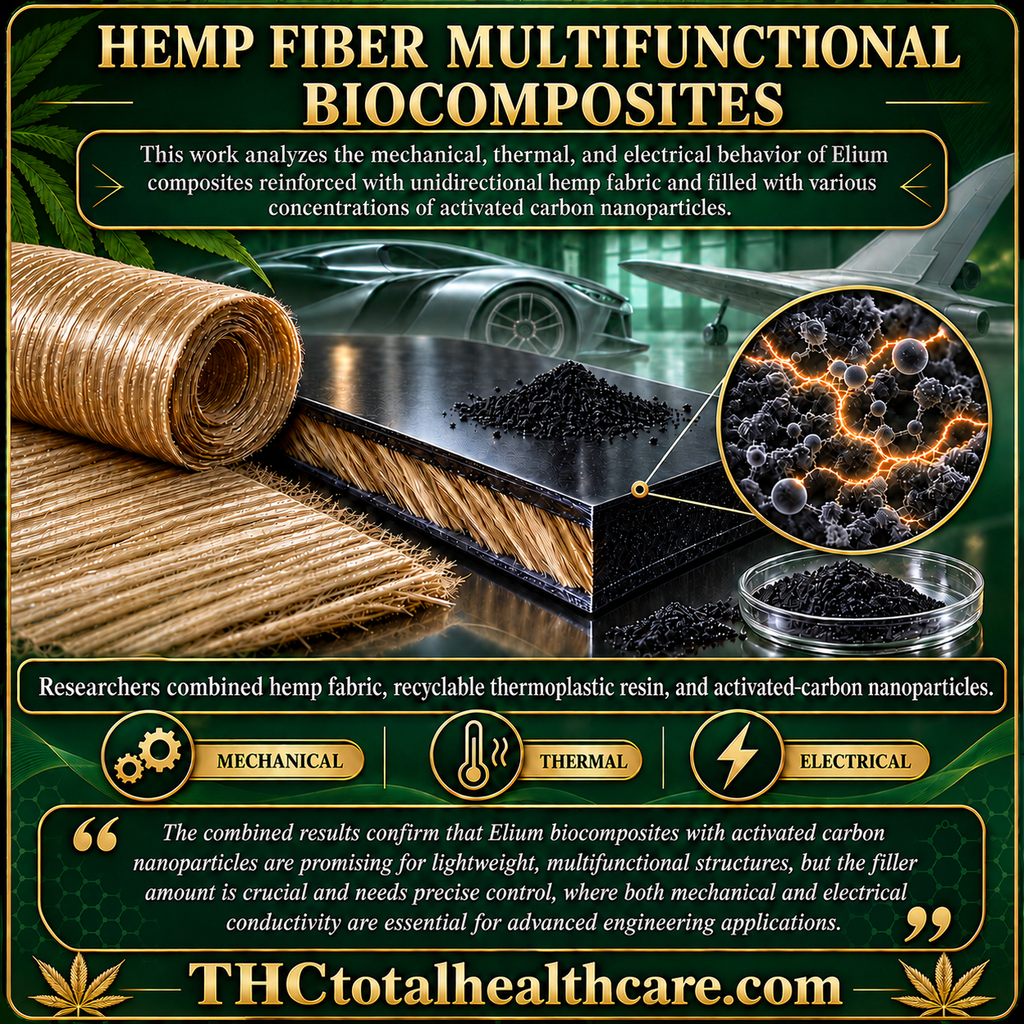
“This research examines the influence of various concentrations (0%, 1%, 1.4% and 1.8% by weight) of activated carbon nanoparticles (AC NPs) on the performance of Elium biocomposites reinforced with hemp fibers.
Unidirectional [0°/0°] laminates with 20% fiber volume fraction were fabricated via hand layup using two layers of 150 GSM hemp fabric and compression molded to achieve 0.9 mm cured thickness.
Quasi-static tensile testing (ASTM D3039, 2 mm/min, 100 mm gauge length) revealed a pronounced non-monotonic relationship between AC NPs loading and mechanical properties, with optimal performance at 1.0 wt.% fillers and catastrophic degradation at 1.8 wt.%. AC NPs filled composites, which were then characterized by their electrical and thermal behavior.
Electrically, it also achieved minimum resistivity (1.62 Ω·m) and maximum conductivity (0.62 S·m-1), in contrast to the elevated resistance (42.5 kΩ) found in samples with a higher filler content.
Thermal analysis showed a slight effect on the degradation of the onset temperature (300 °C) and a higher charring after addition of AC NP. Finite element analysis (FEA) provided a corroboration for these experimental findings, with simulations verification.
Microscopy revealed cohesive fractures in the 1.0 wt.% composite whereas voids and brittle failure were evident in samples with higher loading. Hence, the concentration of 1.0 wt.% AC NP offers the best trade off of mechanical, electrical, and thermal properties.”
https://pubmed.ncbi.nlm.nih.gov/41516850
https://www.mdpi.com/2073-4360/18/1/66