
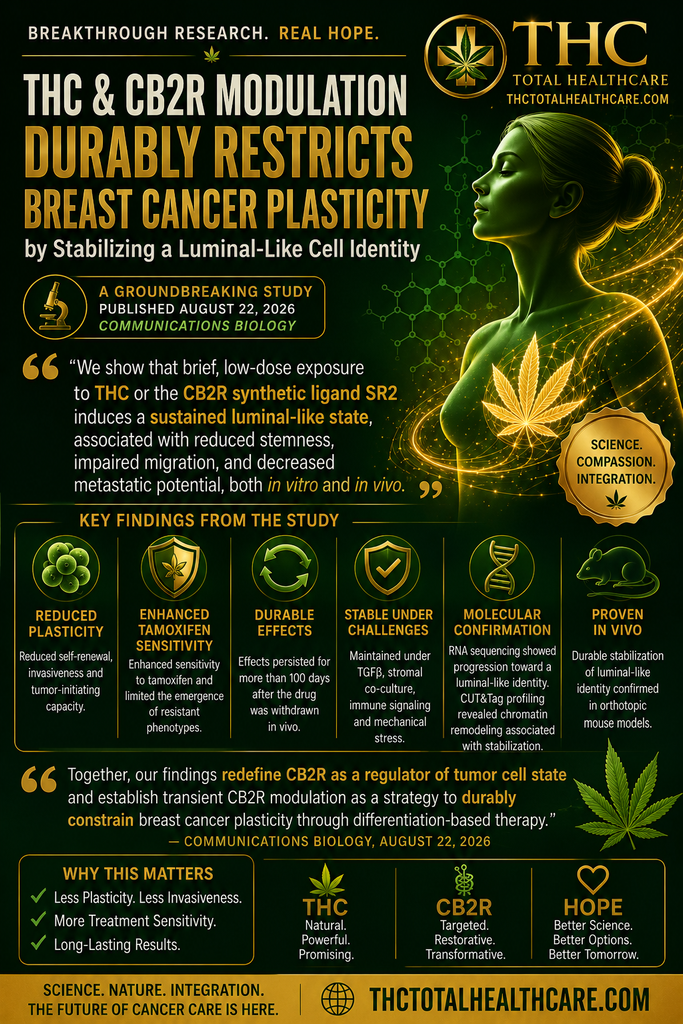
New breast cancer research suggests that brief modulation of cannabinoid receptor 2 (CB2R), including with THC, may have lasting effects on tumor cell behavior. Researchers found reduced self-renewal, invasiveness, and tumor-initiating capacity, along with greater tamoxifen sensitivity and a durable shift toward a more stable luminal-like cell identity.
“Cancer cell plasticity enables therapy resistance and metastasis by allowing transitions between stem-like and differentiated states. Differentiation-based strategies aim to stabilize tumor cell identity, yet pharmacological approaches that induce durable lineage restriction remain limited.
Here, we show that transient modulation of cannabinoid receptor 2 (CB2R) durably restricts breast cancer cell plasticity by stabilizing a luminal-like cell state. Using patient-derived and murine tumor organoids, we demonstrate that brief, low-dose CB2R modulation reduces self-renewal, invasiveness and tumor-initiating capacity, while enhancing tamoxifen sensitivity and limiting the emergence of resistant phenotypes.
These effects persist under pro-dedifferentiation conditions, including TGFβ exposure, stromal co-culture, immune signaling and mechanical stress, and are maintained in vivo following orthotopic transplantation. RNA sequencing reveals a progressive transition from an early plastic state toward a stabilized luminal-like identity, supported by CUT&Tag profiling that uncovers chromatin remodeling associated with this stabilization.
Together, our findings redefine CB2R as a regulator of tumor cell state and establish transient CB2R modulation as a strategy to durably constrain breast cancer plasticity through differentiation-based therapy.”
https://www.nature.com/articles/s42003-026-10837-1
“Low-dose THC keeps breast cancer cells in tumor models from reverting to an aggressive state”
https://medicalxpress.com/news/2026-09-dose-thc-breast-cancer-cells.html