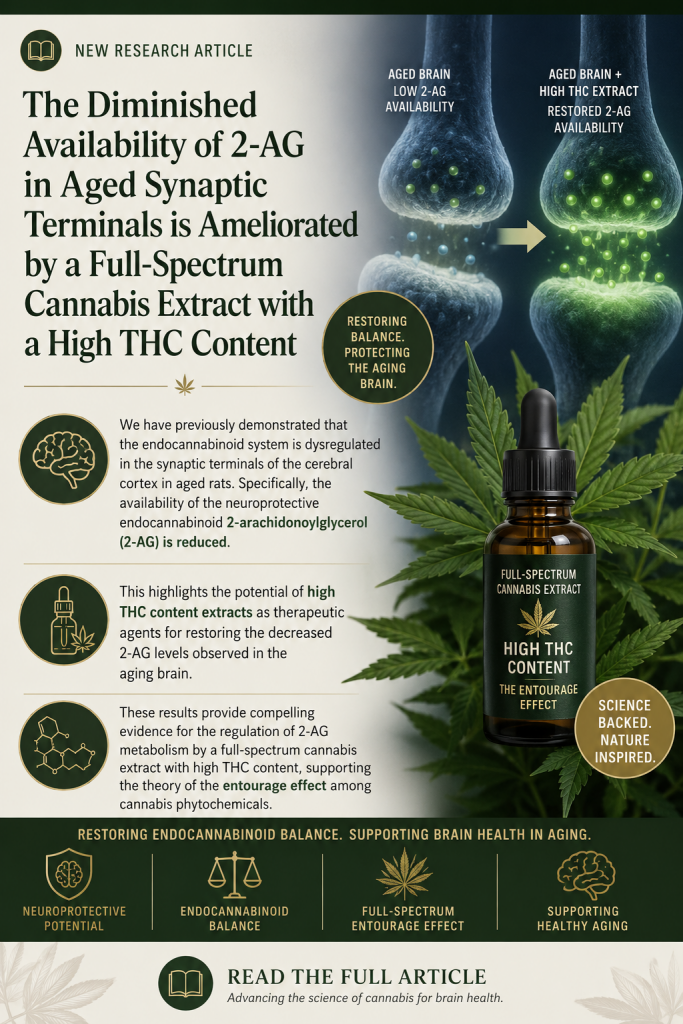
“We have previously demonstrated that the endocannabinoid system is dysregulated in the synaptic terminals of the cerebral cortex in aged rats. Specifically, the availability of the neuroprotective endocannabinoid 2-arachidonoylglycerol (2-AG) is reduced due to impairments in the enzymes involved in its metabolism, a deficit only partially compensated by the binding of cannabinoid receptor ligands.
Given that ∆9-tetrahydrocannabinol (THC) acts as a ligand for cannabinoid receptors (CBR), we designed the present study to investigate the effects of a full-spectrum cannabis extract with a high THC content, the THC-free fraction of this cannabis extract, and pure THC on the previously mentioned aging model. Thus, 2-AG metabolic enzymes were assayed incubating synaptosomes from aged and adult rat cerebral cortex, with ethanolic cannabis extract, the THC-free fraction of this cannabis extract or pure THC, and the corresponding radiolabeled substrates.
Our key findings indicate that the age-related decline in 2-AG bioavailability: (a) is exacerbated in the presence of either the THC-free fraction from the cannabis extract or pure THC, primarily due to a significant decrease in 2-AG synthesis; and (b) is partially mitigated by the inhibition of 2-AG hydrolysis when the extract contains THC.
These results provide compelling evidence for the regulation of 2-AG metabolism by a full-spectrum cannabis extract with high THC content, supporting the theory of the entourage effect among cannabis phytochemicals.
This highlights the potential of high THC content extracts as therapeutic agents for restoring the decreased 2-AG levels observed in the aging brain.”
https://pubmed.ncbi.nlm.nih.gov/41880097
https://link.springer.com/article/10.1007/s11064-026-04739-1