Muscle disuse can rapidly lead to atrophy through increased protein breakdown, mitochondrial dysfunction, and loss of muscle strength. In this preclinical study, cannabidiol helped protect against disuse-induced muscle wasting by reducing proteolysis and supporting mitochondrial regulation. CBD preserved key aspects of muscle structure and cellular energy function, suggesting that its effects extend beyond inflammation to mechanisms directly involved in maintaining muscle mass. The findings add to growing evidence that CBD may have value in protecting skeletal muscle during periods of immobilization or reduced activity.
“Muscle atrophy induced by prolonged inactivity (disuse), including denervation-induced atrophy, is accompanied by oxidative stress, inflammation, and dysregulated protein turnover, yet no effective pharmacological therapy is currently available.
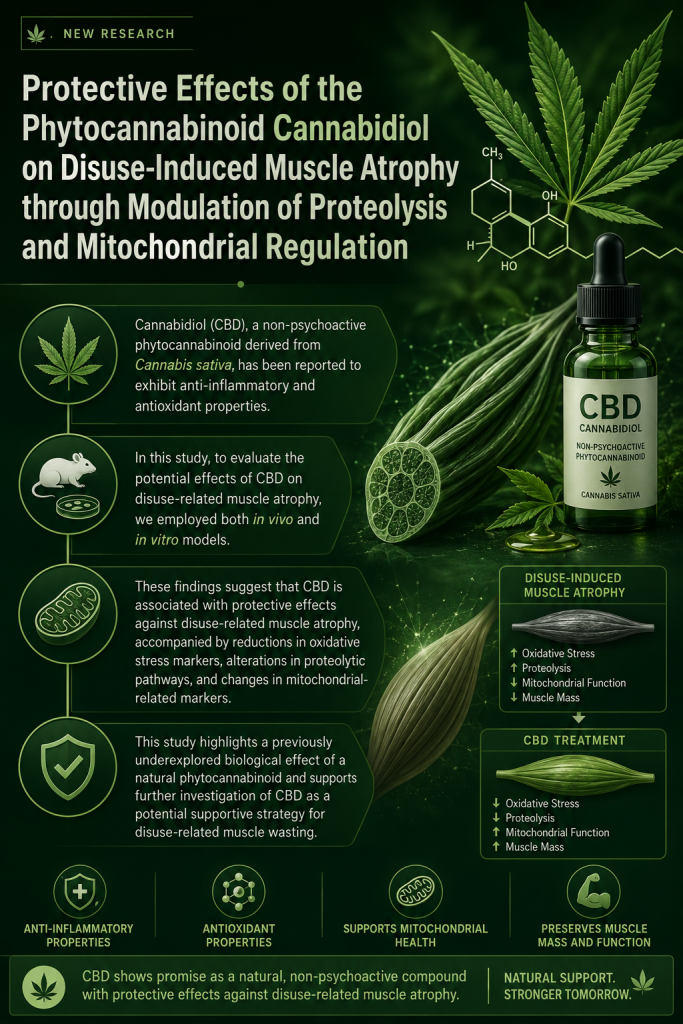
Cannabidiol (CBD), a non-psychoactive phytocannabinoid derived from Cannabis sativa, has been reported to exhibit anti-inflammatory and antioxidant properties; however, its potential involvement in disuse-related muscle atrophy has not been fully characterized.
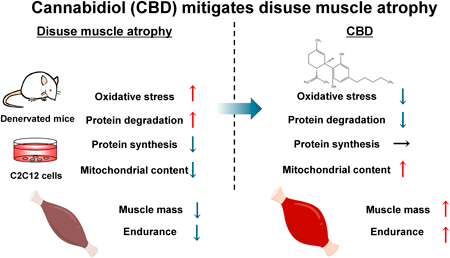
In this study, to evaluate the potential effects of CBD on disuse-related muscle atrophy, we employed both in vivo and in vitro models. A mouse model of sciatic nerve resection-induced muscle atrophy was used for the in vivo experiments, while C2C12 myotubes were utilized for the in vitro analyses.
In the denervated mouse model, CBD attenuated the decrease in muscle mass in the tibialis anterior and gastrocnemius muscles, as well as the decline in treadmill running performance. CBD also reduced oxidative stress and suppressed the denervation-induced upregulation of Atrogin-1 and muscle RING-finger 1 (MuRF1) proteins, as well as tumor necrosis factor-α (TNF-α) mRNA.
Furthermore, CBD partially restored the decreased mitochondrial markers observed following denervation. In vitro, CBD similarly suppressed MuRF1 and Atrogin-1 protein levels and TNF-α mRNA expression in C2C12 myotubes.
These findings suggest that CBD is associated with protective effects against disuse-related muscle atrophy, accompanied by reductions in oxidative stress markers, alterations in proteolytic pathways, and changes in mitochondrial-related markers.
This study highlights a previously underexplored biological effect of a natural phytocannabinoid and supports further investigation of CBD as a potential supportive strategy for disuse-related muscle wasting.”
https://pubmed.ncbi.nlm.nih.gov/42161484
https://www.jstage.jst.go.jp/article/bpb/49/5/49_b26-00020/_article