
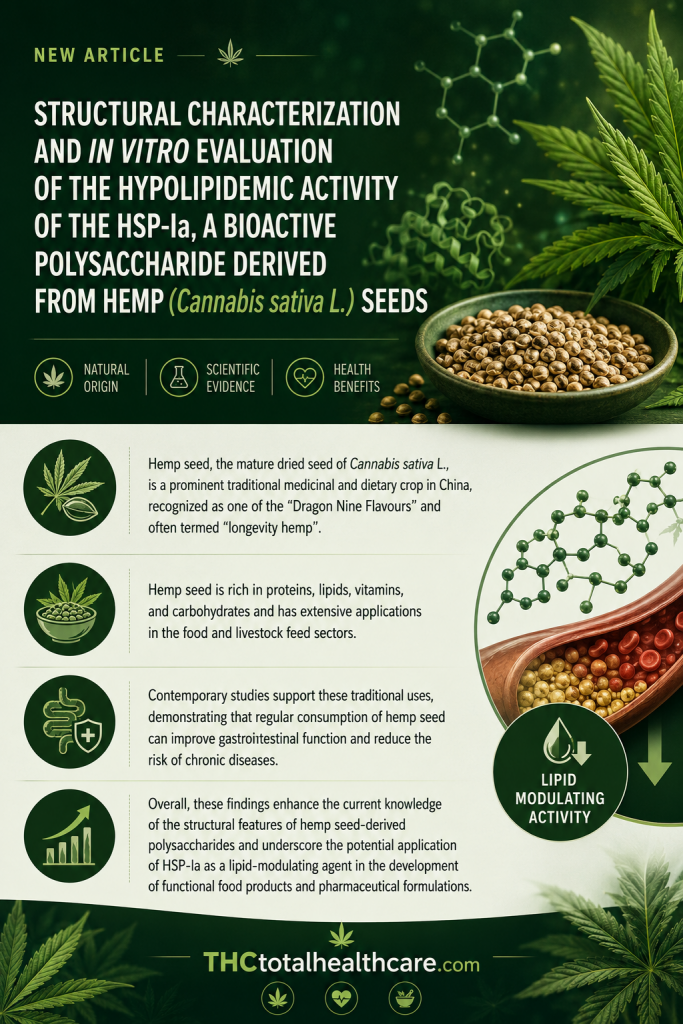
Hemp seeds contain bioactive compounds that may contribute to metabolic health beyond their well-known nutritional value. In this study, researchers isolated and characterized a polysaccharide known as HSP-IA from Cannabis sativa seeds and found that it showed significant hypolipidemic activity in vitro. The compound helped reduce lipid accumulation and influenced pathways involved in fat metabolism, suggesting that hemp-seed polysaccharides may have potential for managing abnormal lipid levels. The findings expand the therapeutic interest in hemp beyond cannabinoids and highlight its polysaccharides as promising metabolic bioactives.
“A novel polysaccharide, HSP-Ia, with a molecular weight of 973.6 kDa, was isolated from hemp (Cannabis sativa L.) seed residues using sequential aqueous extraction, ethanol-induced precipitation, and chromatographic fractionation.
Its structural attributes were determined through methylation profiling and nuclear magnetic resonance spectroscopy. The physicochemical characteristics were examined using X-ray diffraction, atomic force microscopy, scanning electron microscopy, and circular dichroism spectroscopy. The hypolipidemic potential of HSP-Ia was assessed using oxidized low-density lipoprotein-induced RAW264.7 macrophages.
HSP-Ia was predominantly comprised of glucose, with minor proportions of arabinose and galactose. It had a backbone of →6)-α-D-Glcp-(1 → residues with side chains attached at the O-2 and O-3 positions. HSP-Ia possessed an amorphous, nonuniform, and discontinuous morphology, with height distributions ranging from 0.7 to 10.5 nm. It exhibited a zeta potential of -7.4 mV and retained a triple-helix conformation in aqueous media. Notably, HSP-Ia facilitated lipid efflux in foam cells in a dose-dependent manner, associated with the upregulation of Liver X receptor α/ATP-binding cassette transporter signaling pathway.
Overall, these findings enhance the current knowledge of the structural features of hemp seed-derived polysaccharides and underscore the potential application of HSP-Ia as a lipid-modulating agent in the development of functional food products and pharmaceutical formulations.”
https://pubmed.ncbi.nlm.nih.gov/42230038
“Hemp seed, the mature dried seed of Cannabis sativa L., is a prominent traditional medicinal and dietary crop in China, recognized as one of the “Dragon Nine Flavours” and often termed “longevity hemp”. According to traditional Chinese medicine theory, hemp seed is associated with the meridians of the spleen, stomach, and large intestine and is used to lubricate the intestines, alleviate constipation, tonify deficiency, and enhance circulation. Hemp seed is rich in proteins, lipids, vitamins, and carbohydrates and has extensive applications in the food and livestock feed sectors. Contemporary studies support these traditional uses, demonstrating that regular consumption of hemp seed can improve gastrointestinal function and reduce the risk of chronic diseases.”
“This study successfully isolated and characterized a novel polysaccharide, designated HSP-Ia, from hemp (C. sativa L.) seed residues.”
https://www.sciencedirect.com/science/article/abs/pii/S0144861726005564?via%3Dihub