
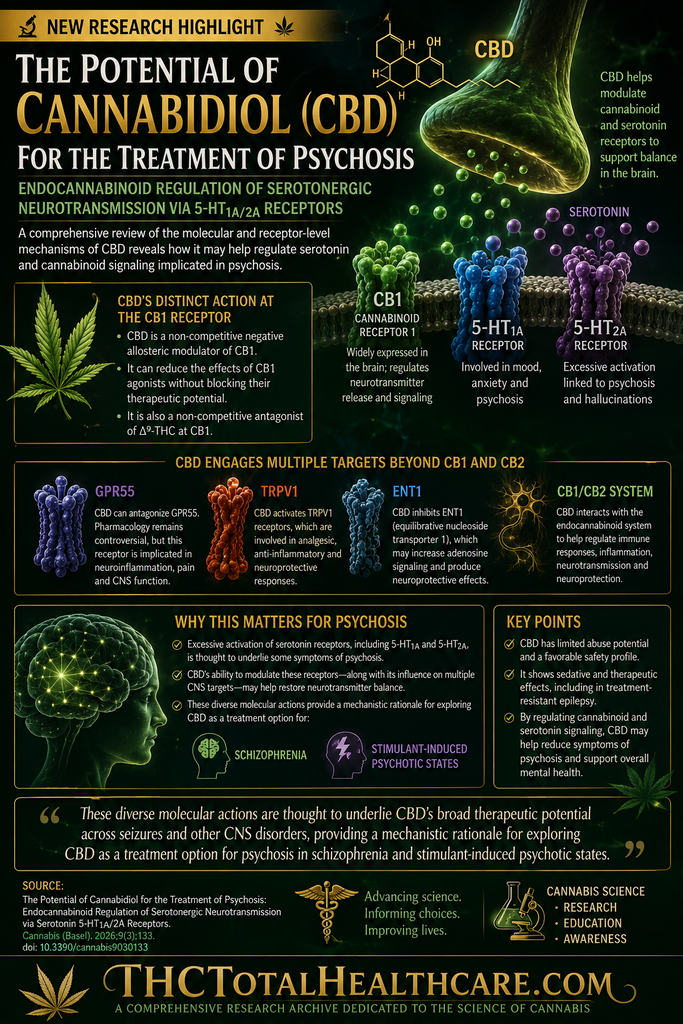
Psychosis involves complex changes in brain signaling, including systems regulated by serotonin and the endocannabinoid system. Cannabidiol (CBD) has drawn growing interest because it may influence both.
This review examines how CBD may affect serotonergic neurotransmission through 5-HT1A and 5-HT2A receptors, while also interacting with the endocannabinoid system in ways relevant to psychotic disorders.
The evidence supports continued investigation of CBD as a potential therapeutic approach for psychosis and related symptoms.
“Cannabis, widely used for both medical and non-medical purposes, primarily contains Δ9-tetrahydrocannabinol (Δ9-THC) and cannabidiol (CBD).
This review aims to clarify how the molecular and receptor-level mechanisms of CBD, compared with Δ9-THC, shape its distinct therapeutic profile and low liability for addiction, thereby informing the safer clinical application of CBD-containing interventions to schizophrenia.
CBD exerts sedative and therapeutic effects, including in treatment-resistant epilepsy, and acts in part via CB1 and CB2 receptors that also mediate Δ9-THC actions. While Δ9-THC activates these receptors as an agonist, triggering Gi-coupled signaling cascades such as MAPK pathways and suppressing presynaptic monoamine release, CBD functions as a non-competitive negative allosteric CB1 modulator and non-competitive antagonist of Δ9-THC. These distinct intracellular signaling mechanisms are considered to underlie the markedly different pharmacological profiles and abuse liabilities of Δ9-THC and CBD.
CBD also engages multiple CNS targets beyond CB1 and CB2, including GPR55, TRPV1 and ENT1, which are implicated in anticonvulsant, anti-inflammatory, analgesic and neuroprotective actions. Although GPR55 pharmacology remains controversial and Δ9-THC shows inconsistent activity at this receptor, converging evidence indicates that CBD can antagonize CB1/CB2 and modulate atypical cannabinoid-sensitive proteins. Excessive activation of certain serotonin receptors, including 5-HT1A/2A, are thought to underlie some symptoms of psychosis.
These diverse molecular actions are thought to underlie CBD’s broad therapeutic potential across seizures and other CNS disorders, providing a mechanistic rationale for exploring CBD as a treatment option for psychosis in schizophrenia and stimulant-induced psychotic states.”
https://pubmed.ncbi.nlm.nih.gov/42658346/
https://link.springer.com/article/10.1007/s11064-026-04860-1