
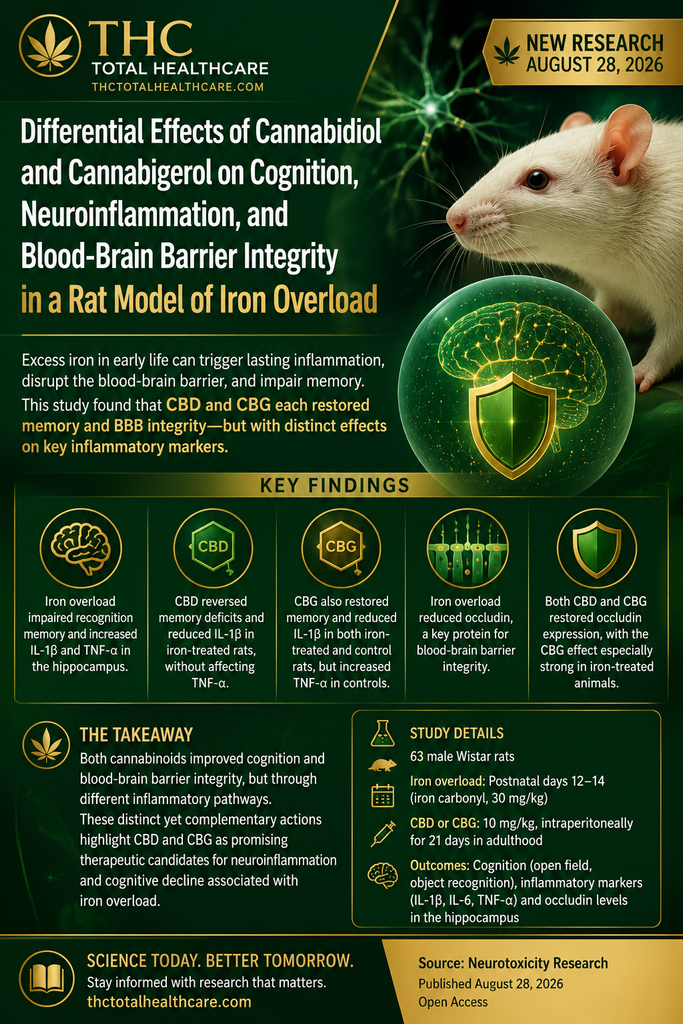
Researchers comparing cannabidiol (CBD) and cannabigerol (CBG) found that both cannabinoids reversed recognition-memory impairment and restored a protein important to blood-brain barrier integrity in rats exposed to excessive iron early in life.
Both CBD and CBG reduced the inflammatory marker IL-1β, although their broader effects on inflammation differed. The findings suggest that the two phytocannabinoids may protect cognitive function through distinct but complementary mechanisms involving neuroinflammation and the blood-brain barrier.
“Iron is an essential micronutrient for brain development, participating in mitochondrial respiration, myelination, and neurotransmitter synthesis. However, previous studies have demonstrated that excessive iron during early postnatal life induces oxidative reactions, leading to mitochondrial dysfunction and synaptic failure. These alterations compromise energy metabolism and neuronal integrity, contributing to long-lasting cognitive dysfunction and increased brain vulnerability later in life.
This study evaluated the effects of cannabidiol (CBD) and cannabigerol (CBG) on behavioral, neuroinflammatory, and blood-brain barrier (BBB) outcomes in rats exposed to early-life iron overload.
Male Wistar rats received iron carbonyl (30 mg/kg, intragastrically) from postnatal day 12 to 14. At three months of age, they were treated intraperitoneally with CBD, CBG (both at 10 mg/kg), or vehicle for 21 days. Cognitive performance was assessed in the open field and object recognition tasks. We examined hippocampal levels of interleukin-1 beta (IL-1β), interleukin-6 (IL-6), tumor necrosis factor alpha (TNF-α), as proinflammatory markers, and occludin, a protein known to regulate BBB permeability.
Iron-exposed animals showed impaired recognition memory, with elevated TNF-α and IL-1β, while CBD reversed memory deficits and reduced IL-1β in iron-treated animals, without affecting TNF-α.
CBG restored memory, decreased IL-1β in both iron-treated and controls, and increased TNF-α in controls. Also, iron overload reduced occludin expression in vehicle-treated rats which was reversed by both CBD and CBG.
These findings highlight inflammation and BBB disruption as mediators of iron-induced cognitive dysfunction and show that both phytocannabinoids act through distinct but complementary mechanisms, supporting their therapeutic potential in neuroinflammation linked to iron overload.”
https://pubmed.ncbi.nlm.nih.gov/42663810
https://link.springer.com/article/10.1007/s12640-026-00826-x