
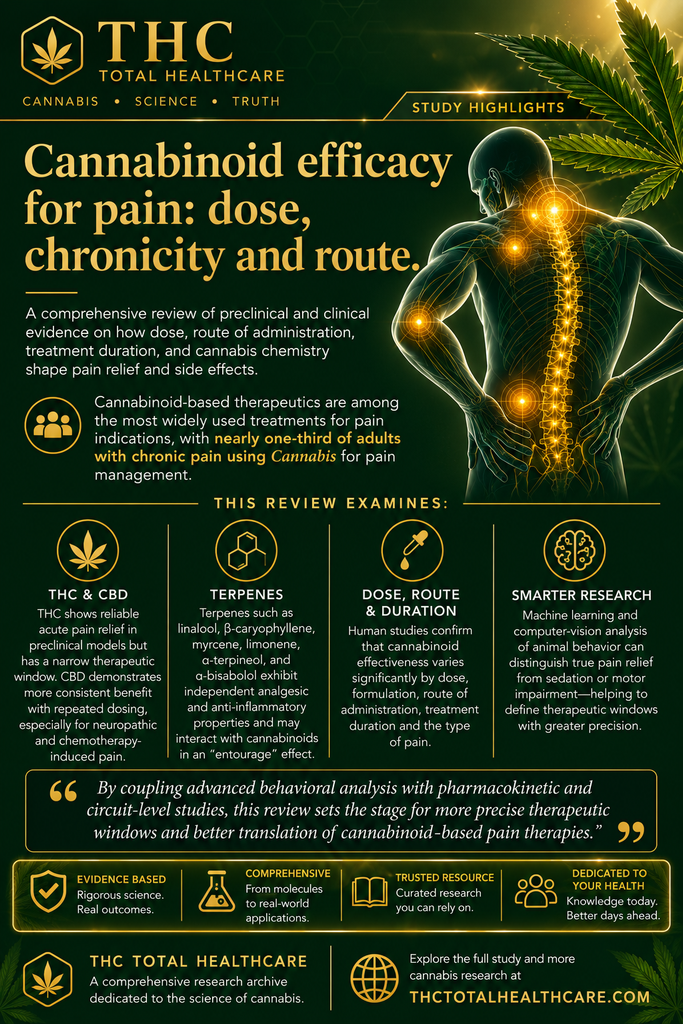
Cannabinoid pain relief depends on more than whether THC or CBD is used. Dose, route of administration, treatment duration and the type of pain can all influence whether a cannabis-based therapy provides meaningful analgesia or produces unwanted effects. This review examines those variables across preclinical and clinical research, while also considering the independent and combined roles of cannabis-derived terpenes.
“Cannabis-based therapies are widely used for chronic pain, yet their mechanisms and therapeutic windows remain incompletely defined. This review synthesizes preclinical and clinical evidence on how dose, route of administration, treatment duration, and chemical composition shape analgesic efficacy and adverse-effect liability for Δ9-tetrahydrocannabinol (THC), cannabidiol (CBD), and select cannabis-derived terpenes.
Across rodent pain models, acute THC reliably produces antinociception, but its therapeutic window is narrow because analgesic doses overlap with CB1 receptor-mediated side effects such as sedation, hypothermia, hyperphagia, and motor impairment. Repeated THC exposure leads to tolerance and dependence.
In contrast, CBD shows limited acute efficacy in naïve and inflammatory models but demonstrates more consistent benefit with repeated dosing in neuropathic and chemotherapy-induced pain, often without cannabimimetic adverse effects.
Terpenes such as linalool, β-caryophyllene, myrcene, limonene, α-terpineol, and α-bisabolol exhibit independent antinociceptive and anti-inflammatory properties and are thought to pharmacologically interact with cannabinoids in a dose-, ratio-, and route-dependent “entourage” effect that either enhance or constrain therapeutic benefit.
This review also focuses on integrating machine learning-based behavioral phenotyping of rodents to refine cannabinoid analgesia preclinical research. Computer vision pose-estimation and unsupervised clustering approaches enable high-resolution quantification of spontaneous and evoked natural behaviors, allowing the analytical dissociation of true analgesia from sedation, ataxia, or reduced exploration. By coupling these behavioral pipelines with pharmacokinetic and circuit-level analyses, emerging frameworks will define therapeutic windows with greater precision and improve the translational relevance of cannabinoid-based pain therapeutics.”
https://pubmed.ncbi.nlm.nih.gov/42661783
“Cannabinoid-based therapeutics are among the most widely used treatments for pain indications, with nearly one-third of adults with chronic pain using Cannabis for pain management.”
“Taken together, the studies reviewed here demonstrate that the analgesic efficacy of THC, CBD, and Cannabis-derived terepenes is dependent on dose, route of administration, treatment chronicity, and chemical composition.”
https://www.frontiersin.org/journals/neuroscience/articles/10.3389/fnins.2026.1888863/full