
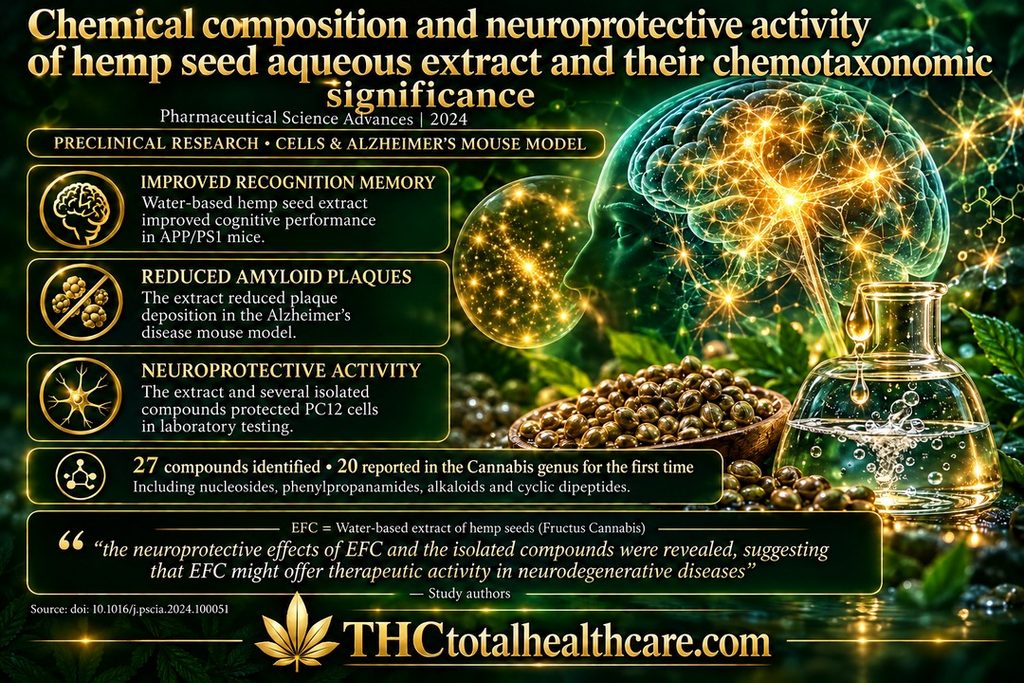
A water-based hemp seed extract improved cognitive performance and reduced amyloid plaques in an Alzheimer’s disease mouse model. Researchers also found neuroprotective effects from the extract and several isolated compounds in laboratory-grown PC12 cells, a cell model commonly used in neuroscience research.
Chemical analysis identified 27 compounds, including nucleosides, phenylpropanamides, alkaloids, and cyclic dipeptides. Twenty were reported in the Cannabis genus for the first time, expanding knowledge of the seed’s chemistry beyond its familiar oils and proteins.
In APP/PS1 mice, the extract improved recognition memory and reduced plaque deposition associated with Alzheimer’s pathology. These preclinical findings identify water-extracted hemp seed compounds as promising candidates for further research into neuroprotection and neurodegenerative disease.
“Fructus Cannabis (hemp seed) is important in food and traditional Chinese medicinal applications. Several studies have shown it has antioxidant, antiaging, anti-inflammatory, and neuroprotective properties.
Studies have reported its anti-Alzheimer’s disease effects. However, its active substances have not been defined, and little is known about the chemical constituents of the aqueous extract.
The chemical profile of the aqueous extract of Fructus Cannabis (EFC) was obtained via isolation, structural identification, and qualitative and quantitative analyses. Twenty-seven compounds were identified, including seven nucleosides (1–7), five phenylpropanamides (8–11, and 24), three alkaloids (15, 16, and 26), two cyclic dipeptides (17 and 25), and one pyrimidine (19). Compounds 1, 3–7, 12, 14–19, and 21–27 were not reported previously in the Cannabis genus. Therefore, their chemotaxonomic significance is discussed.
Neuroprotective activity screening revealed that EFC and the isolated compounds, particularly 9, 11, and 17, showed significant neuroprotective effects in PC12 cells (rat pheochromocytoma cells).
The novel object recognition experiment and Nissl staining showed that EFC improved cognitive impairment in APP/PS1 mice and that EFC intervention reduced the number of senile plaques. These findings will contribute to the utility of Fructus Cannabis.”