
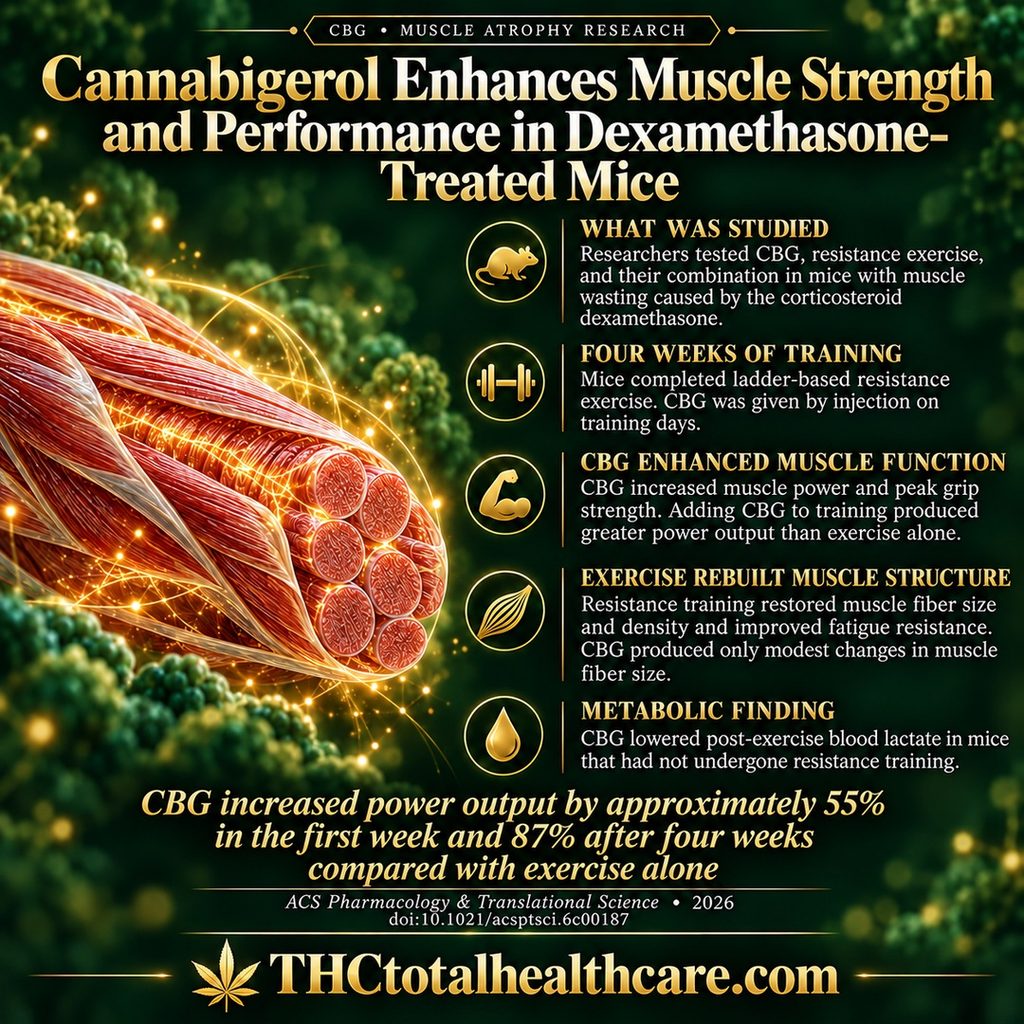
Cannabigerol (CBG) increased muscle power and grip strength in mice with muscle wasting induced by dexamethasone, a corticosteroid medication. Combined with resistance exercise, CBG increased power output by approximately 55% in the first week and 87% after four weeks compared with exercise alone.
Researchers tested CBG and resistance training separately and together. CBG increased peak grip strength by approximately 10% and lowered post-exercise blood lactate by approximately 48% in animals that had not undergone training. Resistance exercise restored muscle structure and improved fatigue resistance, while CBG’s strongest benefits involved muscle performance.
These findings suggest that CBG could complement resistance exercise in recovery from corticosteroid-induced muscle wasting. Exercise primarily rebuilt muscle structure, while CBG enhanced strength and power with only modest changes in muscle fiber size—supporting further research into its potential to improve muscle function.
“Sarcopenia is a major clinical condition associated with aging and is characterized by progressive loss of skeletal muscle mass and function. Resistance training is an effective intervention to counteract muscle atrophy; however, strategies that selectively enhance functional performance remain limited.
Cannabigerol, a phytocannabinoid that is not a CB1 receptor agonist and therefore lacks psychotomimetic activity, has emerged as a potential modulator of neuromuscular function, although its role in skeletal muscle adaptation remains poorly understood.
Here, we investigated the effects of resistance exercise and cannabigerol, alone and in combination, in a dexamethasone-induced model of muscle atrophy in mice.
Animals received dexamethasone (20 mg/kg, i.p.) for 12 days and were subsequently subjected to a 4-week ladder-based resistance exercise protocol. Cannabigerol (10 mg/kg, i.p.) was administered on training days. Resistance exercise restored muscle morphology and improved fatigue resistance. In contrast, cannabigerol acted mainly on neuromuscular performance, increasing muscle power while producing only a small increase in fiber cross-sectional area.
Cannabigerol potentiated training-induced power output, increasing performance by ∼55% in the first week and up to ∼87% after 4 weeks compared to exercise alone. In addition, cannabigerol increased peak grip strength (∼10%) and lowered post-exercise blood lactate in sedentary animals (∼48%).
These findings show that resistance exercise and cannabigerol exert complementary effects on skeletal muscleexercise promoting structural recovery and cannabigerol enhancing neuromuscular performance and lowering post-exercise lactateand support further investigation of cannabigerol as an adjunct to exercise in glucocorticoid-induced muscle atrophy.”
https://pubmed.ncbi.nlm.nih.gov/42871546/
https://pubs.acs.org/aptsfn/article/9/10/2772/5442265/Cannabigerol-Enhances-Muscle-Strength-and