
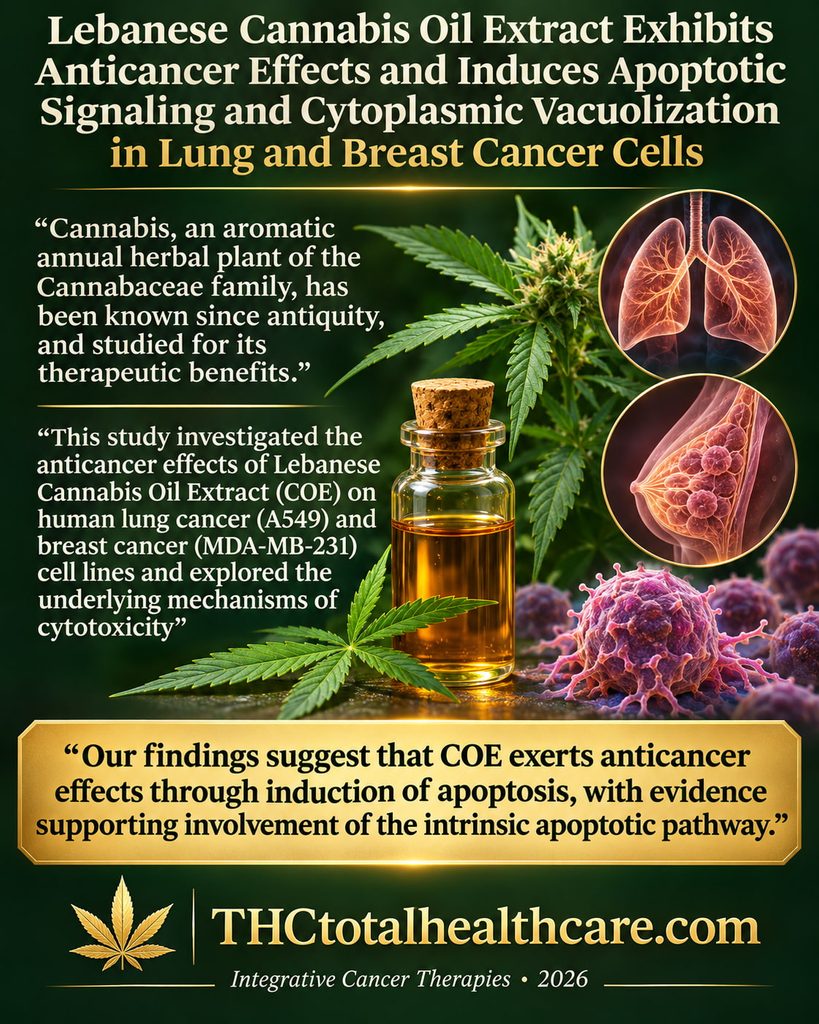
Lebanese cannabis oil extract induced programmed cell death and reduced cell migration in human lung and breast cancer cells grown in the laboratory. Researchers found evidence that these anticancer effects involved the intrinsic apoptotic pathway—the cell’s mitochondria-associated system for initiating its own destruction.
The study examined lung cancer (A549) and breast cancer (MDA-MB-231) cell lines, measuring cell viability, apoptosis, migration, and changes in signaling proteins. Treatment increased the pro-apoptotic protein BAX and decreased the survival-promoting protein Bcl-2. The extract also produced extensive cytoplasmic vacuolization—the formation of fluid-filled compartments within cells—and altered proteins associated with autophagy, the cellular recycling process.
These findings add to preclinical evidence that cannabis extracts can affect multiple processes involved in cancer-cell survival. By linking the extract’s effects to apoptosis and changes in cellular signaling, the study provides a foundation for further investigation of its constituents and their potential anticancer applications.
“Cannabis oil has traditionally been used in Lebanon to treat various ailments, including arthritis, diabetes, cancer, and neurological disorders.
This study investigated the anticancer effects of Lebanese Cannabis Oil Extract (COE) on human lung cancer (A549) and breast cancer (MDA-MB-231) cell lines and explored the underlying mechanisms of cytotoxicity.
COE cytotoxicity was evaluated using the MTS cell proliferation assay. Apoptosis was assessed by flow cytometry using propidium iodide (PI) and FITC-conjugated Annexin V/PI staining. Western blotting was used to determine the expression of apoptosis-related proteins and autophagy markers. Cancer cell migration was assessed using a wound-healing assay, while intracellular reactive oxygen species (ROS) were quantified using the DCFDA cellular ROS detection assay.
Results: COE showed greater selectivity toward MDA-MB-231 (IC50 = 26.7 μg/mL) and A549 (IC50 = 30.2 μg/mL) cells than rat stem cells (IC50 = 42.31 μg/mL). Phase-contrast microscopy revealed marked cytoplasmic vacuolization after 24 and 48 h of treatment. In MDA-MB-231 cells, COE significantly increased BAX, cleaved caspase-3, cytochrome c, LC3B, and p-ERK, while decreasing Bcl-2. A similar pattern was observed in A549 cells, except that increases in cleaved caspase-3 and cytochrome c were significant only at 24 h, while p62 was undetectable. COE (20 and 40 μg/mL) significantly increased apoptosis in both cell lines. Cell migration assay showed significant decrease in wound closure in the IC50/4 and IC50/2 treated groups respectively 24 h post COE treatment with A549 cells showing a more pronounced response. The results also displayed a significant decline in ROS levels in both cancer cell lines after COE treatment.
Conclusion: Our findings suggest that COE exerts anticancer effects through induction of apoptosis, with evidence supporting involvement of the intrinsic apoptotic pathway. COE treatment was also associated with alterations in autophagy-related markers, increased ERK phosphorylation, and extensive cytoplasmic vacuolization suggestive of methuosis-like morphological changes. In addition, COE did not increase intracellular ROS under the experimental conditions examined.”
https://pubmed.ncbi.nlm.nih.gov/43034904/
“Cannabis, an aromatic annual herbal plant of the Cannabaceae family, has been known since antiquity, and studied for its therapeutic benefits. The history of cannabis dates to the ancient world with its medicinal use going back about 5000 years ago.”
“Our findings indicate that Cannabis Oil Extract (COE) induces apoptotic cell death, with evidence supporting partial involvement of the intrinsic apoptotic pathway.”