
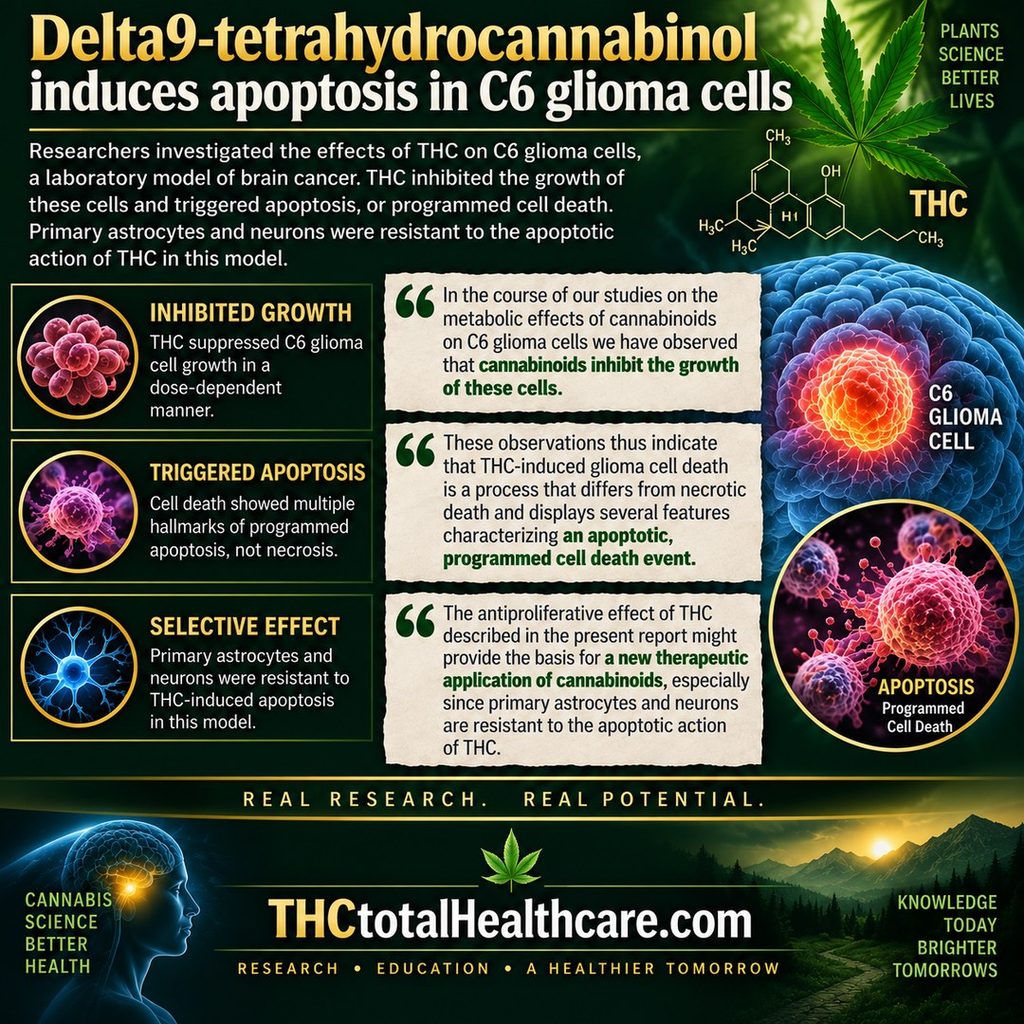
Researchers investigated whether Δ9-tetrahydrocannabinol (THC) could directly affect the survival of C6 glioma cells, a laboratory model of brain cancer. THC produced a dramatic, dose-dependent decline in cell metabolism and triggered apoptosis, or programmed cell death. The researchers confirmed this through several markers, including loss of membrane symmetry and the characteristic fragmentation of DNA seen during apoptosis.
The study also found that THC stimulated sphingomyelin breakdown, a process linked to ceramide signaling and cell death. Importantly, THC induced apoptosis in several transformed neural cell types but did not produce the same apoptotic effect in primary astrocytes or neurons. Even though the glioma cells expressed CB1 receptors, blocking CB1 did not prevent THC-induced apoptosis, suggesting that the effect occurred through a CB1 receptor-independent mechanism.
The authors concluded that THC’s antiproliferative effect could provide a basis for exploring new therapeutic applications of cannabinoids, particularly because normal primary astrocytes and neurons were resistant to THC-induced apoptosis in this model.
“delta9-Tetrahydrocannabinol (THC), the major active component of marijuana, induced apoptosis in C6.9 glioma cells, as determined by DNA fragmentation and loss of plasma membrane asymmetry. THC stimulated sphingomyelin hydrolysis in C6.9 glioma cells. THC and N-acetylsphingosine, a cell-permeable ceramide analog, induced apoptosis in several transformed neural cells but not in primary astrocytes or neurons. Although glioma C6.9 cells expressed the CBI cannabinoid receptor, neither THC-induced apoptosis nor THC-induced sphingomyelin breakdown were prevented by SR141716, a specific antagonist of that receptor. Results thus show that THC-induced apoptosis in glioma C6.9 cells may rely on a CBI receptor-independent stimulation of sphingomyelin breakdown.”
https://pubmed.ncbi.nlm.nih.gov/9771884
“In the course of our studies on the metabolic effects of cannabinoids on C6 glioma cells we have observed that cannabinoids inhibit the growth of these cells.”
“The antiproliferative effect of THC described in the present report might provide the basis for a new therapeutic application of cannabinoids, especially since primary astrocytes and neurons are resistant to the apoptotic action of THC.”
“These observations thus indicate that THC-induced glioma cell death is a process that differs from necrotic death and displays several features characterizing an apoptotic, programmed cell death event.”
https://febs.onlinelibrary.wiley.com/doi/10.1016/S0014-5793%2898%2901085-0
Need this THC study explained? thcXplained.com