
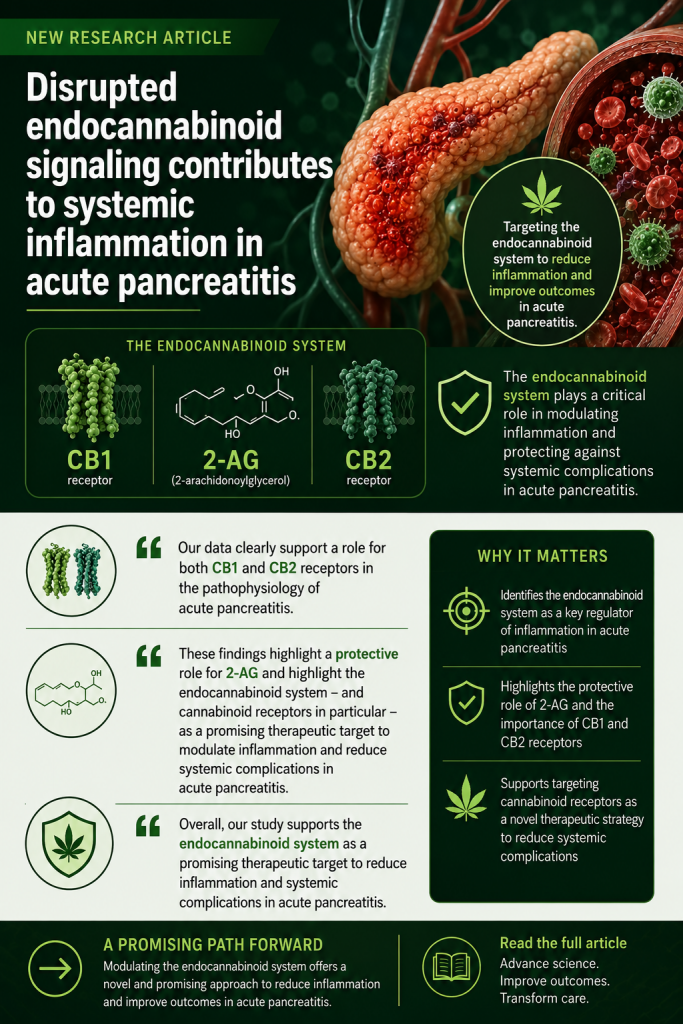
“Acute pancreatitis (AP) is an inflammatory disease that can lead to systemic complications in severe cases. The endocannabinoid system has emerged as a potential modulator of inflammation in AP.
We investigated the role of the endocannabinoid 2-arachidonoylglycerol (2-AG) and the cannabinoid receptors CB1 and CB2 during AP.
A severity-dependent decrease in circulating 2-AG was found both in patients and a murine AP model. Restoring 2-AG – by avoiding its degradation via monoacylglycerol lipase inhibitor or direct 2-AG administration – reduced local and systemic inflammation, modulated peritoneal macrophage polarization, and mitigated lung injury. Notably, endocannabinoid system effects were consistent across sexes.
Both cannabinoid receptors were involved in disease pathophysiology.
Genetic Cnr1 knockout and pharmacological CB2 blockade showed distinct and complementary roles of both receptors in regulating inflammation, immune infiltration, and pulmonary damage.
These findings highlight a protective role for 2-AG and highlight the endocannabinoid system – and cannabinoid receptors in particular – as a promising therapeutic target to modulate inflammation and reduce systemic complications in acute pancreatitis.”
https://pubmed.ncbi.nlm.nih.gov/42153289
“These findings raise the possibility that counteracting the inflammation-driven decline in endogenous 2-AG through pharmacological intervention may represent a promising therapeutic strategy for AP.”
“Our data clearly support a role for both CB1 and CB2 receptors in the pathophysiology of AP.”
“Overall, our study supports the ECS as promising therapeutic target to reduce inflammation and systemic complications in AP.”
https://pathsocjournals.onlinelibrary.wiley.com/doi/10.1002/path.70076
“The Diminished Availability of 2-AG in Aged Synaptic Terminals is Ameliorated by a Full-Spectrum Cannabis Extract with a High THC Content. This highlights the potential of high THC content extracts as therapeutic agents for restoring the decreased 2-AG levels observed in the aging brain.”