
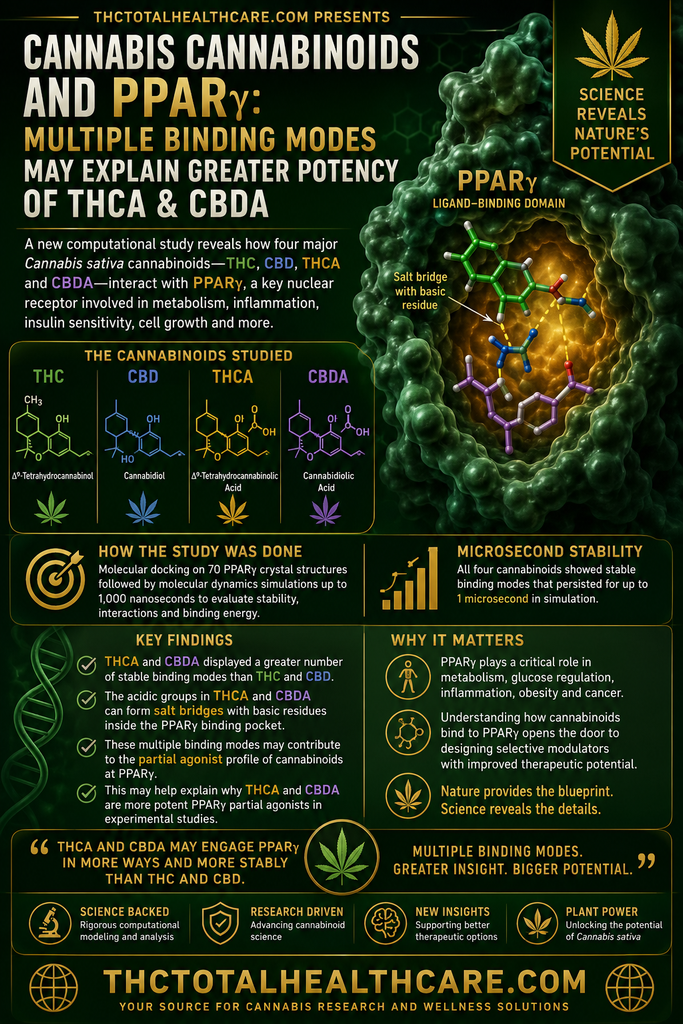
“Introduction: Peroxisome proliferator-activated receptor gamma (PPARγ) is a ligand-activated nuclear receptor with broad therapeutic relevance across various pathologies, including type 2 diabetes, obesity, cancer, and inflammatory disorders. Cannabinoids are a class of terpene-phenolic compounds from Cannabis sativa L. that have been shown to act as partial agonists of PPARγ. Among them, the acidic forms Δ9-tetrahydrocannabinolic acid (THCA) and cannabidiolic acid (CBDA) display higher potency than their decarboxylated counterp arts Δ9-tetrahydrocannabinol (THC) and cannabidiol (CBD). Despite experimental evidence supporting direct PPARγ-cannabinoid interaction, the molecular determinants governing ligand recognition within the binding pocket have not yet been comprehensively investigated.
Methods: A combination of molecular docking and molecular dynamics simulations was employed to characterize the binding modes of THC, CBD, THCA, and CBDA within the PPARγ ligand-binding domain. Docking calculations were performed on a curated set of 70 PPARγ crystal structures co-crystallized with structurally diverse ligands, exploiting thus the conformational variability of the binding pocket. The best-ranked solutions were subjected to 500 ns MD simulations and evaluated on the basis of ligand stability, persistence of polar and aromatic-aromatic interactions with the receptor, and energetic contributions estimated by MM/GBSA. Three candidate binding modes per ligand were selected and their trajectories extended to 1,000 ns.
Results: All four cannabinoids yielded at least one stable binding mode at the microsecond timescale. The cannabinoids THCA and CBDA displayed a greater number of stable binding modes than THC and CBD, a result consistent with the higher potency previously reported for these compounds in experimental studies. This behavior may be attributable to the formation of salt bridges with basic residues in the binding pocket.
Conclusion: Our findings provide a structural framework for understanding cannabinoid recognition by PPARγ. The ability of these compounds to adopt multiple binding modes may contribute to their partial agonist profile, opening new avenues for the rational design of selective PPARγ modulators with improved therapeutic properties.”
https://pubmed.ncbi.nlm.nih.gov/42639023
“This work provides a foundation for future studies addressing the molecular basis of cannabinoid action on PPARγ.
Moreover, these findings could serve as a starting point to explore the allosteric mechanism by which these small lipophilic molecules influence receptor structure and dynamics.
Finally, the strategy described here may also be applied to determine the binding modes of these natural compounds in other members of the nuclear receptor family, including PPARα and PPARδ, as well as to investigate the binding modes of minor cannabinoids, such as cannabichromene and cannabigerol.”
https://www.frontiersin.org/journals/bioinformatics/articles/10.3389/fbinf.2026.1893303/full