
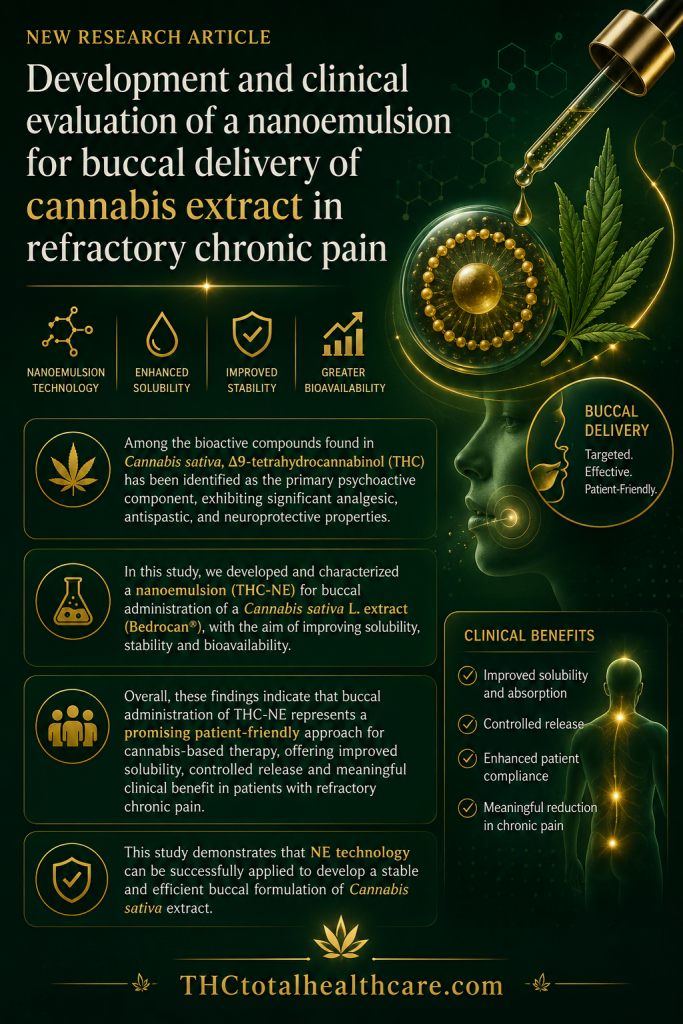
For patients with refractory chronic pain, one challenge with cannabis-based treatment is achieving reliable absorption while avoiding the variability associated with oral or inhaled products. In this study, researchers developed a nanoemulsion designed for buccal delivery of cannabis extract and evaluated it clinically in patients with difficult-to-treat chronic pain. The formulation was intended to improve cannabinoid absorption through the lining of the mouth, and the clinical findings showed meaningful improvements in pain-related outcomes with acceptable tolerability. The results suggest that nanoemulsion-based buccal delivery may offer a more controlled and practical way to administer cannabis extracts for chronic pain.
“Cannabinoid-based therapies have gained increasing attention for the management of chronic and treatment-resistant pain, although their clinical application is limited by the poor aqueous solubility and variable bioavailability of Δ9-tetrahydrocannabinol (THC).
In this study, we developed and characterized a nanoemulsion (THC-NE) for buccal administration of a Cannabis sativa L. extract (Bedrocan®), with the aim of improving solubility, stability and bioavailability.
The optimized formulation, composed of pharmaceutically acceptable excipients, showed a narrow droplet size distribution (DH ≈ 73 nm, PDI ≈ 0.2), a THC content consistent with the theoretical value (3.53 ± 0.56 mg/mL), and good physicochemical stability at 4°C for at least 90 days. The formulation maintained its properties upon extensive dilution in simulated buccal fluids and after spray nebulization, supporting its suitability for oromucosal delivery. In vitro release studies confirmed sustained THC release from THC-NE, whereas negligible release was observed from the oil extract, highlighting the role of nanoformulation in enhancing solubilization and controlled release.
An observational study was conducted in 18 patients with chronic pain unresponsive to standard treatments. After a median follow-up of 189 days, mean pain scores (NRS) decreased significantly from 8.6 ± 0.9 to 5.4 ± 2.8 (p < 0.001), with 83% of patients achieving a ≥ 20% reduction. Among responders, the mean NRS decreased by 45% and treatment persistence was found to be high, with 64% of patients still remaining under therapy after six months. A total of 17 adverse events were reported in 11 patients, most of which were mild to moderate and transient. Additionally, treatment interruption occurred in three patients due to adverse events, in other three owing to limited efficacy and in two for logistical reasons.
Overall, these findings indicate that buccal administration of THC-NE represents a promising patient-friendly approach for cannabis-based therapy, offering improved solubility, controlled release and meaningful clinical benefit in patients with refractory chronic pain.”
https://pubmed.ncbi.nlm.nih.gov/42336000
“Among the bioactive compounds found in Cannabis sativa, Δ9-tetrahydrocannabinol (THC) has been identified as the primary psychoactive component, exhibiting significant analgesic, antispastic, and neuroprotective properties. “
“This study demonstrates that NE technology can be successfully applied to develop a stable and efficient buccal formulation of Cannabis sativa extract. The optimized THC-NE proved to be physicochemically stable, robust under dilution, and suitable for administration via standard spray devices, while ensuring enhanced release of THC compared to the oily extract.”
https://www.sciencedirect.com/science/article/pii/S0939641126001839?via%3Dihub