
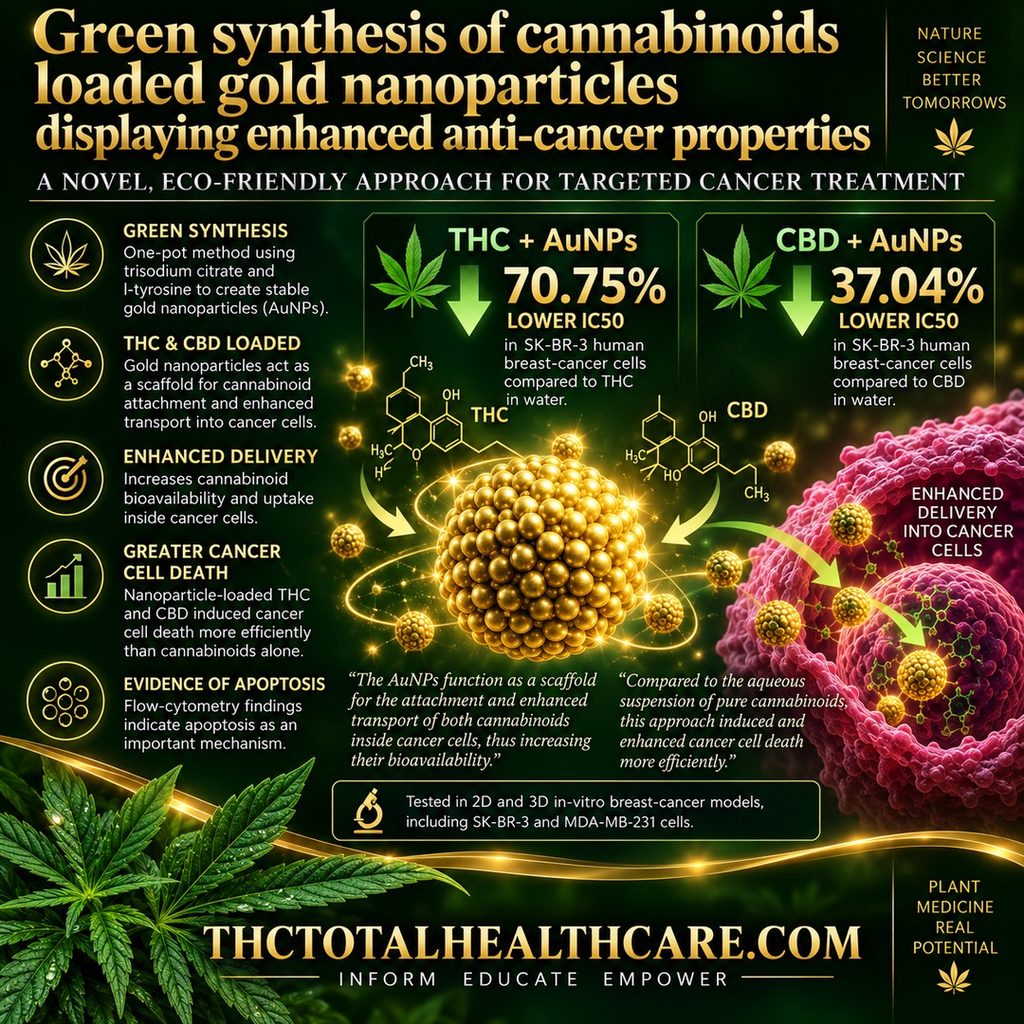
Researchers developed gold nanoparticles capable of carrying the highly hydrophobic cannabinoids THC and CBD into cancer cells, increasing their bioavailability and anti-cancer activity. The nanoparticles acted as a scaffold for cannabinoid attachment and enhanced transport inside cancer cells. Compared with aqueous suspensions of the pure cannabinoids, the nanoparticle-loaded THC and CBD produced cancer cell death more efficiently, supporting gold nanoparticles as a potential delivery system for cannabinoid-based cancer treatment.
“This study investigates the anti-cancer potential of cannabinoids loaded onto gold nanoparticles (AuNPs) for targeted cancer treatment. We adopted a multifaceted approach to explore and design this nano system, encompassing its synthesis, physicochemical characterization, stability assessment, and evaluation of anticancer efficacy in 2D and 3D in vitro models.
In this research, we have demonstrated that two highly hydrophobic phytocannabinoids like delta-9-tetrahydrocannabinol (THC) and cannabidiol (CBD), can be loaded on the surface of AuNPs with a one-pot synthesis protocol using trisodium citrate and l-tyrosine as a reducing and stabilizing agents. l-tyrosine plays a crucial role in cannabinoid loading, stability, and shelf life of the AuNPs.
After synthesis, the cannabinoid-loaded nanoparticles were characterized with UV–vis spectroscopy, dynamic light scattering (DLS), dark field hyperspectral microscopy, and electron microscopy. The AuNPs function as a scaffold for the attachment and enhanced transport of both cannabinoids inside cancer cells, thus increasing their bioavailability. Hyperspectral microscopy was used to confirm AuNPs uptake. IC50 values in SK-BR-3 human breast cancer cell line for both THC and CBD loaded onto AuNPs were lower by 70.75 % and 37.04 % than those of the aqueous suspension of pure molecules.
Compared to the aqueous suspension of pure cannabinoids, this approach induced and enhanced cancer cell death more efficiently. This enhanced efficacy was associated with a decline in cell viability, which is attributed to apoptosis, as indicated by flow cytometry results.
Our findings offer a significant step towards the green design and utilization of AuNPs to deliver cannabinoids into cells efficiently.”
“Cannabinoids loaded on AuNPs were synthesized as a nano-therapeutic drug agent for cancer. This study indicates that AuNPs can be used as efficient carriers for highly hydrophobic molecules with an anti-cancer effect. This protocol was straightforward and effective in entrapment of CBD or THC on the surface of AuNPs. The results revealed reasonable anti-cancer efficacy of this nanosystem in 2D and 3D in vitro cytotoxicity.”
https://www.sciencedirect.com/science/article/pii/S258923472500082X