
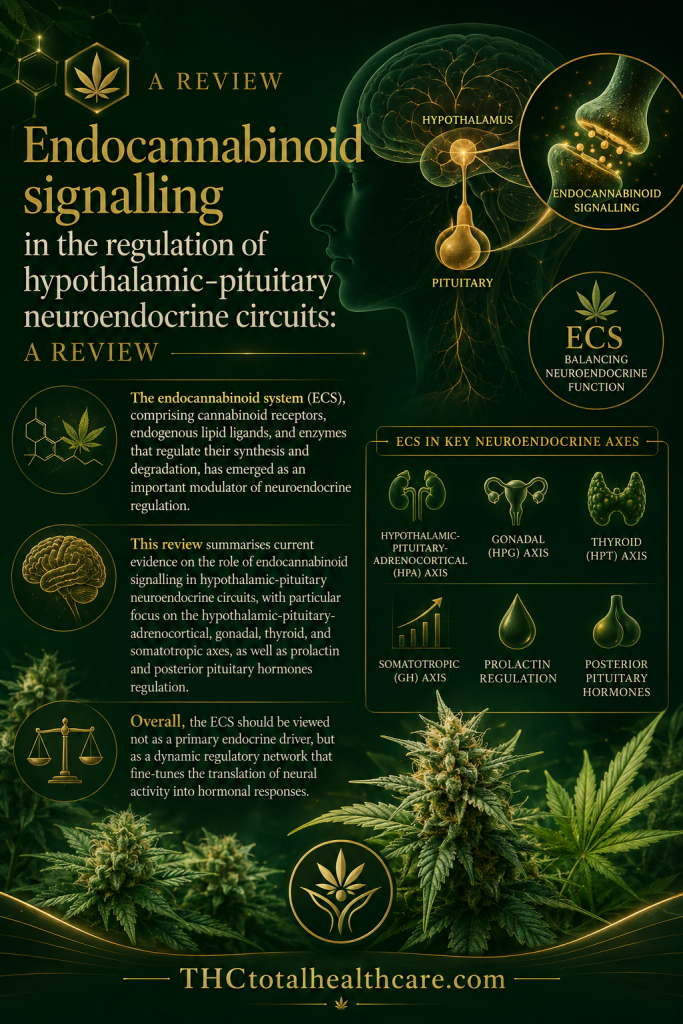
“The endocannabinoid system (ECS), comprising cannabinoid receptors, endogenous lipid ligands, and enzymes that regulate their synthesis and degradation, has emerged as an important modulator of neuroendocrine regulation.
This review summarises current evidence on the role of endocannabinoid signalling in hypothalamic-pituitary neuroendocrine circuits, with particular focus on the hypothalamic-pituitary-adrenocortical, gonadal, thyroid, and somatotropic axes, as well as prolactin and posterior pituitary hormones regulation.
Available data indicate that endocannabinoid signalling predominantly influences neuroendocrine function by modulating synaptic transmission within hypothalamic circuits. Acting mainly as retrograde messengers at presynaptic CB1 receptors, endocannabinoids regulate excitatory and inhibitory inputs to neurosecretory neurons and thus shape endocrine output in a context-dependent manner.
Among the systems discussed, the hypothalamic-pituitary-adrenocortical axis is the best characterised, with relatively well-defined links between glucocorticoid feedback and rapid endocannabinoid-mediated suppression of synaptic input to corticotropin-releasing hormone neurons.
In other neuroendocrine systems, evidence supports a predominantly modulatory, often inhibitory, role for endocannabinoid signalling, although the underlying cellular processes remain less well-defined and are largely based on preclinical studies. Interactions with glucocorticoids, gonadal steroids and neuropeptidergic pathways further underscore the integrative nature of ECS signalling.
Overall, the ECS should be viewed not as a primary endocrine driver, but as a dynamic regulatory network that fine-tunes the translation of neural activity into hormonal responses.”
https://pubmed.ncbi.nlm.nih.gov/42365630
https://reference-global.com/article/10.2478/enr-2026-0011