
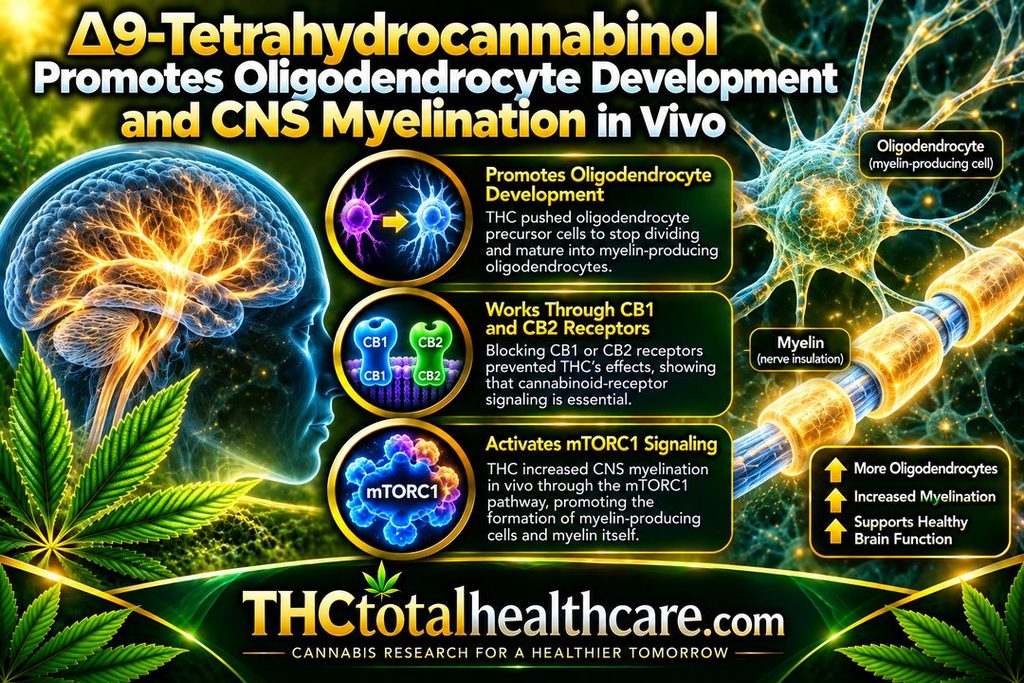
Δ9-THC promoted the development of oligodendrocytes, the cells responsible for producing myelin, and increased central nervous system myelination in young mice. THC pushed oligodendrocyte precursor cells to stop dividing and mature into myelin-producing cells.
The effect depended on both CB1 and CB2 cannabinoid receptors. When researchers blocked those receptors, THC’s effects on oligodendrocyte development and myelination were prevented, showing that cannabinoid-receptor signaling was central to the response.
The study also identified the mTORC1 signaling pathway as an important part of the mechanism. The authors concluded that THC represents a novel pharmacological candidate for enhancing oligodendrocyte development and CNS myelination in vivo.
“Δ9 -Tetrahydrocannabinol (THC), the main bioactive compound found in the plant Cannabis sativa, exerts its effects by activating cannabinoid receptors present in many neural cells.
Cannabinoid receptors are also physiologically engaged by endogenous cannabinoid compounds, the so-called endocannabinoids. Specifically, the endocannabinoid 2-arachidonoylglycerol has been highlighted as an important modulator of oligodendrocyte (OL) development at embryonic stages and in animal models of demyelination. However, the potential impact of THC exposure on OL lineage progression during the critical periods of postnatal myelination has never been explored.
Here, we show that acute THC administration at early postnatal ages in mice enhanced OL development and CNS myelination in the subcortical white matter by promoting oligodendrocyte precursor cell cycle exit and differentiation.
Mechanistically, THC-induced-myelination was mediated by CB1 and CB2 cannabinoid receptors, as demonstrated by the blockade of THC actions by selective receptor antagonists. Moreover, the THC-mediated modulation of oligodendroglial differentiation relied on the activation of the mammalian target of rapamycin complex 1 (mTORC1) signaling pathway, as mTORC1 pharmacological inhibition prevented the THC effects.
Our study identifies THC as an effective pharmacological strategy to enhance oligodendrogenesis and CNS myelination in vivo.”
https://pubmed.ncbi.nlm.nih.gov/32956517
“In summary, our findings identify THC as a novel pharmacological candidate to enhance OL development and CNS myelination in vivo.”
https://onlinelibrary.wiley.com/doi/10.1002/glia.23911
Need this THC study explained? thcXplained.com